
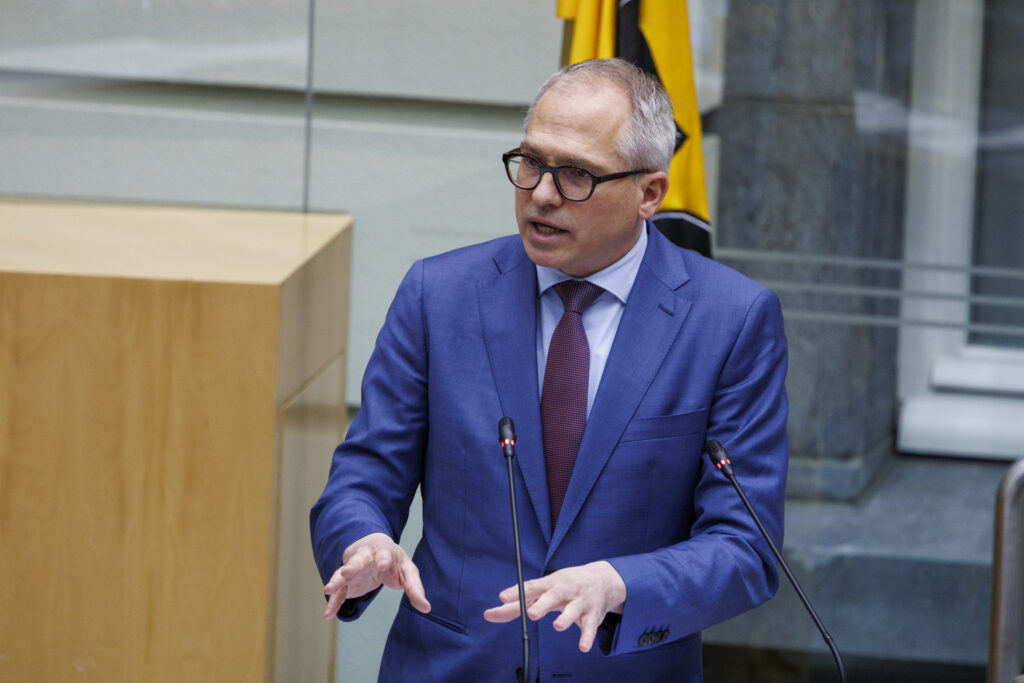
Flemish ministers Matthias Diependaele and Ben Weyts came under heavy opposition criticism on Wednesday over Flanders' rising debt and the region's investments in private enterprises, particularly Brussels Airport Company.
The opposition onslaught occurred as the Flemish Parliament debated the regional government's latest budget adjustment, with the sharp increase in debt emerging as a central issue.
This year, the Flemish debt is set to rise by €6.8 billion, 13.5% more than in 2025.
Government accused of passing debt burden on to the next generation
Groen legislator Bogdan Vanden Berghe accused the government of piling up debt and passing the burden on to the next generation, while Egbert Lachaert (Anders) said children would be left to carry not only the Flemish debt but also federal debt.
Vlaams Belang targeted Finance and Budget Minister Ben Weyts, criticising the way he calculates the debt standard and arguing that it makes the required savings effort appear smaller than it really is.
Within the governing majority, Nieuw-Vlaamse Alliantie (N-VA) faction leader Philippe Muyters acknowledged that debt needed to be watched closely. However, he argued that not all borrowing was the same, comparing investment-driven debt to taking out a mortgage rather than borrowing irresponsibly.
That defence failed to convince the liberals. Lachaert (Anders) replied that, in the end, it is always the taxpayer who pays.
Flemish stake in Brussels Airport Company under fire
The debate became more heated over Flanders’ stake in Brussels Airport, in which the region has become the largest shareholder.
The fact that the dividend received by the Flemish authorities was lower than expected gave fresh ammunition to Anders and Groen, which have long argued that the investment is an expensive prestige project that makes poor financial sense.
Groen MP Eva Platteau said the government was “gambling with Flemish people’s money” while cutting spending on essential services such as healthcare, public transport and education.
Need for debate on public authorities' role in the private sector
Lachaert echoed that criticism, saying the government was “playing with the money of the Flemish people” and urging it to stop acting like an entrepreneur and spend public money on useful purposes instead.
Minister-President Matthias Diependaele continued to firmly defend the government’s choices. At the same time, however, he said a broader debate was needed on the role of public authorities in the private sector.
Diependaele pointed in particular to the changing geopolitical context and developments across Europe, where state aid is sometimes used to set Member States against one another in competition for business.
According to the Flemish Minister-President, it is important for public authorities to be ready to support companies, but only in a way that is prudent and carefully considered.
