
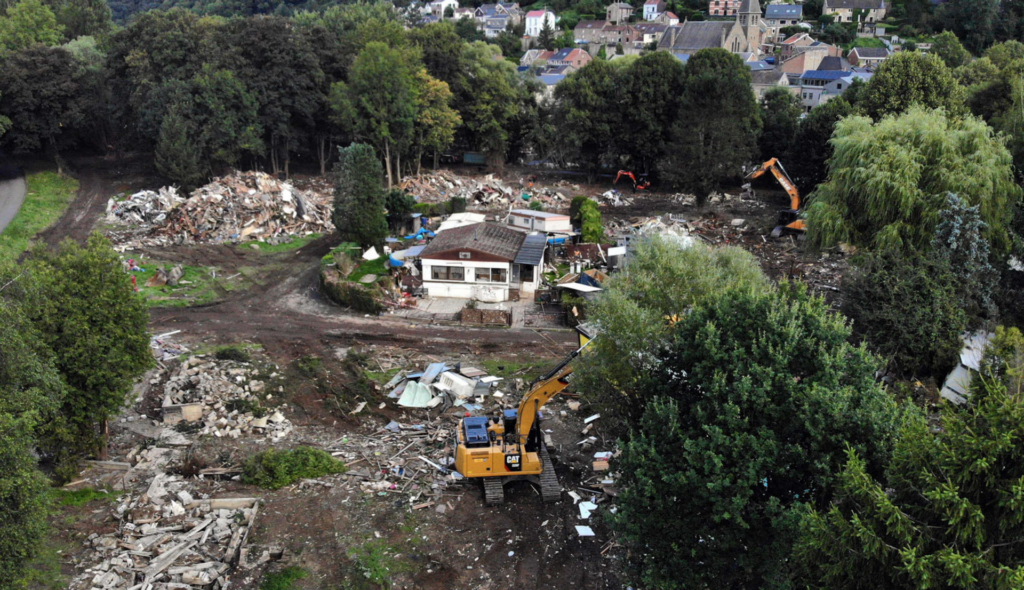
Scientists say the torrential rain that caused the deadly July 2021 floods in Wallonia could have happened without global warming, but climate change made such an event more likely and more intense.
The floods killed 39 people in Wallonia, affected more than 100,000 others and caused nearly €3 billion in damage. They also struck the German states of North Rhine-Westphalia and Rhineland-Palatinate, where 184 people died.
Just a month after the disaster, in August 2021, 39 researchers from World Weather Attribution (WWA) carried out an attribution study to assess the possible link between global warming and the extreme weather.
The scientists said attribution work was difficult, particularly because of the size of the area studied. Even so, they estimated that an extreme event of this kind had an average return period of about 400 years.
Later estimates put the return period at between 200 and 450 years.
The WWA researchers also concluded that global warming, then around 1.2°C above pre-industrial levels, had increased the likelihood of such an event by between 1.2 and nine times. They estimated that rainfall intensity was about 3% to 19% higher than it would have been in a stable climate.
Subsequent studies broadly confirmed the WWA findings. Taken together, the research suggests climate change, driven mainly by greenhouse gas emissions from human activity, played a significant role in the historic rainfall.
The downpours devastated the Vesdre valley, with some areas of Liège province receiving more than 200mm of rain in just two or three days. In some places, totals exceeded 250mm, equivalent to 250 litres of water per square metre.
A 2025 study by researchers from the University of Liège and the Royal Meteorological Institute of Belgium used several simulations for Belgium and found that, even under the most optimistic warming scenario, rainfall extremes are expected to rise sharply by 2100.
One of the authors, climatologist Nicolas Ghilain, told Belga news agency that the strongest rainfall events, with a 20-year return period, become around 7% more intense in Belgium for every degree of global warming.
“Global warming is now at about 1.4°C to 1.5°C, and by 2100 it will probably be between 2°C and 3°C,” Ghilain said.
He added that it is impossible to predict when another episode of extreme rainfall will occur. However, the study found that climate change does not appear to alter atmospheric dynamics, but does increase the intensity of rainfall.
