
Belgium is bucking EU trends on migration and regional population growth, according to Eurostat's newly released regional population projections for 2025 to 2050.
Across the EU, seven in 10 regions are projected to see population declines by 2050, driven by a negative natural replacement rate of more deaths than births.
The projections, based on assumptions about future developments in fertility, mortality and migration, show a shifting balance of population between EU Member States – carrying implications for budgets and European Parliament representation, as well as a changing face of Europe.
Eurostat's data shows that overall the EU population is projected to increase from 451.8 million in 2025 and peak at 453.3 million in 2029, then decrease to 445 million in 2050. However, this spread is uneven across the EU.
In 18 EU countries, more than half of regions are projected to experience a population decline, with most of this decline being centred in Eastern Europe.
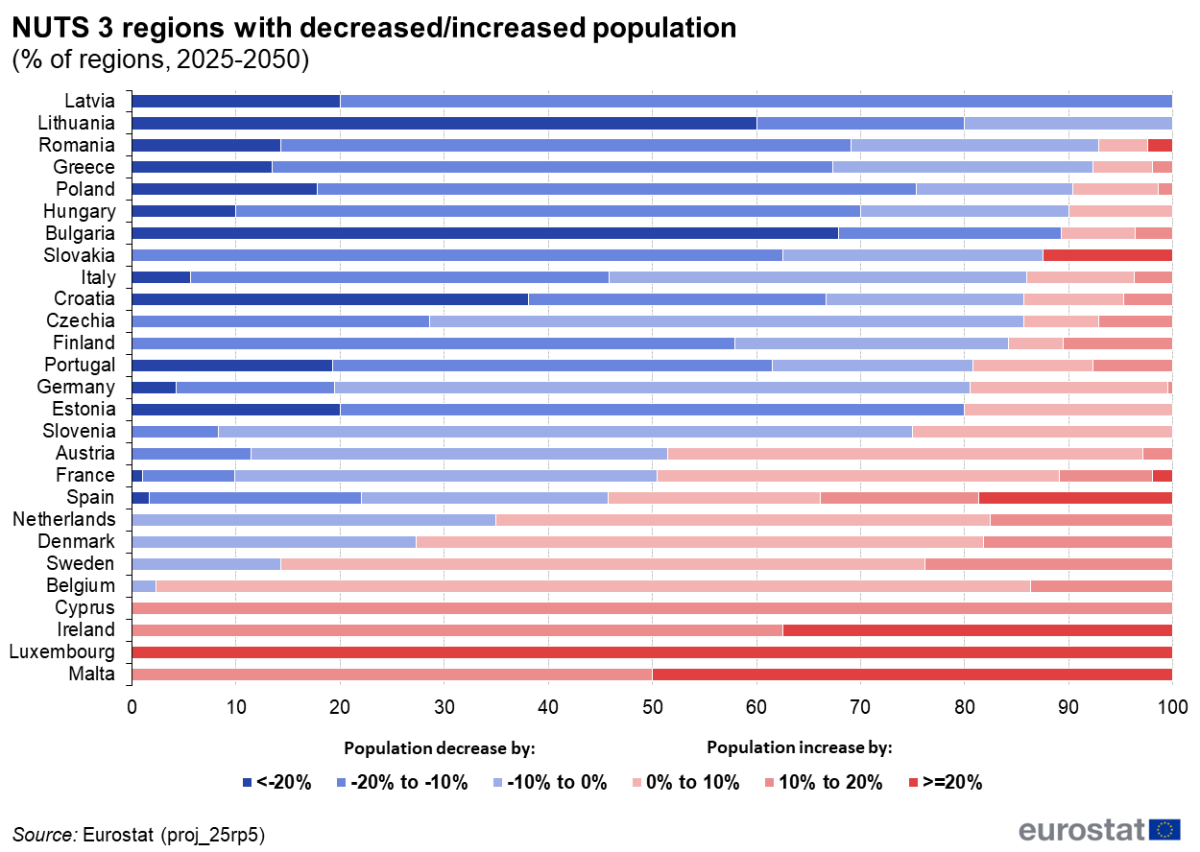
EU projected population changes by NUTS3 region. Credit: Eurostat
'Increasingly uneven demographic landscape'
According to Eurostat, by 2050, "most regions in the nine EU countries on the eastern border are projected to see population decline, as are more than 80% of regions in Greece, Czechia, Croatia and Portugal".
Eurostat says that overall, these projections "point to an increasingly uneven demographic landscape across the EU, with some regions facing sustained population loss while others continue to expand".
In Belgium, only Ypres (-0.4%) is projected to see a population decline, while Mons remains flat.
More deaths than births across the EU
By 2050, just 1.8% of EU regions are projected to see population growth due to a positive natural replacement rate (more births than deaths). These regions are also concentrated in just six countries in the West of Europe - Belgium, Denmark, France, Germany, the Netherlands and Spain.
The vast majority of regions across the EU will see a decline as the negative replacement rate becomes reinforced in population trends year after year.
According to Eurostat's historical data, the EU has had more deaths than births since 2012. This week's projection suggests this trend will continue into the 2050s.
"By 2050, at least 80% of the regions in 13 EU countries are projected to experience population decline driven by negative natural change," according to the statistics agency.
Brussels is one of the regions projected to buck the decline, which suggests a continuation of the trend in recent years of a positive replacement rate in the city compared to the rest of Belgium.
Net migration the main driver of any population growth in the EU
For the small number of EU regions projected to have positive population growth (three in 10), the majority of these (94%) will also be a result of positive net migration.
Belgium's overall projected growth is a result of positive net migration. This will be the main driver in 41 of Belgium's 44 regions.
Belgium's attractiveness is the key reason for continued growth, according to Patrick Deboosere, a lecturer in demography at the Vrije Universiteit Brussel (VUB).
He told The Brussels Times that "Belgium as a whole remains an attractive economy for people from all over Europe. Together with international migration for economic reasons, for study, family reunion and asylum, the yearly increase hovers between 35,000 and 50,000 persons."
However, Brussels is projected to see a decline in net migration by 2050, placing it 5th from the bottom by 2050 across all of the 1,165 EU regions surveyed by Eurostat.
This negative projection is disputed by Jean-Pierre Hermia from IBSA, Brussels' statistics office. He told The Brussels Times that as a result of different planning assumptions, the Federal Planning Bureau expects Brussels to continue to have positive international net migration of +10,000 a year between now and 2050.
"The figures published today by Eurostat do not correspond to the latest figures published by the Federal Planning Bureau and Statbel, which forecast that the population of the Brussels Region will stabilise by 2050 (rather than increasing by more than 7 per cent)," he said.
Capital cities as islands of growth
Capital cities look set to be the main beneficiaries of this migration, with Eurostat noting that "by 2050 almost 90% of the capital city regions (22) are projected to have a population change above the national average."
In some capital city regions, the growth in population stands in contrast to a wider decline across their respective countries.
"In 10 capital city regions (in Bulgaria, Czechia, Germany, Estonia, Finland, Croatia, Italy, Portugal, Slovenia and Slovakia), positive projected population change contrasts with a negative national average."
This suggests cities will start to become islands of population growth across the EU, with implications for tax receipts across some EU regions.
Overall, the projections from Eurostat show an EU facing significant population change between regions, with population growth in the west driven by positive net migration, and population declines in the east (except cities) driven by a falling natural replacement rate.
