
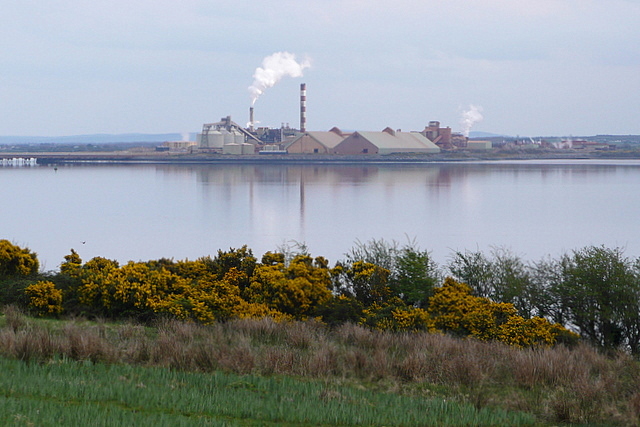
The Irish government published on Friday its investigation of the export of alumina from the Aughinish Alumina plant in Limerick to Russia for the production of aluminum, stating that it had found no definitive evidence linking the export to Russian weapons manufacturers while qualifying that it could not be ruled out.
As previously reported, the issue was raised at the official opening of Irish EU Presidency in beginning of July. The Aughinish Alumina plant, Europe’s largest alumina refinery, is owned by the Russian aluminum giant Rusal. Its founder and former top shareholder is an oligarch who has been sanctioned by the EU for his alleged involvement in companies working with the Russian defense sector.
An investigation carried out by the Organized Crime and Corruption Reporting Project (OCCRP) and published last March found that the Irish facility has sent more than half of its alumina exports to Russian smelters. A loophole in EU’s sanctions packages banned the import of Russian aluminum but did not restrict the export of alumina to Russia.
At a press conference, the Irish Prime Minister, Taoiseach Micheál Martin, said the Irish Enterprise, Trade and Employment ministry was carrying out an investigation which would be concluded within weeks. The findings would be shared with the European Commission. President Ursula von der Leyen said that it was up to Ireland to lead the investigation and did not address the loophole in the sanctions against Russia.
The report was finalized yesterday and submitted to the European Commission. “The matter is now with the European Commission for its consideration,” said the Minister for Enterprise, Tourism and Employment, Peter Burke, in a statement. The full report has not been published because of its content of confidential data.
According to Burke, the Department’s “independent review” assessed the information contained in the report by the investigative journalists and subsequent media coverage, in the context of potential leakage of Alumina from Limerick into military supply chains. It also sought information from other bodies and engaged with the company itself in the conduct of this review.
The findings are not clear-cut. On the one hand, he said that he “can confirm that no adverse findings have been determined in relation to the export of alumina to Russia by the company… No information of a sufficient evidentiary level is currently available to confirm the assertions that alumina from Ireland is entering the supply chain of Russian military contractors.”
On the other hand, the investigation relied mainly on data provided by the Aughinish Alumina plant, “The company has provided data stating that no alumina produced in Limerick is used for military purposes, and is solely used in the production of aluminium for export from Russia. However, this cannot be independently verified by the Department.”
The department will continue to monitor events and assess any further information or reports of potential sanctions breaches that can be examined and verified, and will act accordingly,” he concluded. “We will continue to work with the European Commission, relevant authorities within Ireland and other authorities throughout the Member States and Ukraine to enforce sanctions.
Knowledge versus doubt
Can the Irish investigation be trusted? Besides its inherent limitations, it is not an independent investigation because Ireland has an economic incentive to clear the plant from any wrongdoings. The Aughinish refinery is a major employer in Limerick and the government has been lobbied to protect local jobs and prevent EU sanctions.
How difficult is to track alumina in the supply chain? It differs from other goods or equipment which can be traced in the supply chains. Tracing specific batches of alumina through international supply chains and mixed smelters inside Russia is nearly impossible without internal Russian data.
Alumina is a fine white powder that is highly fungible, meaning one batch looks and behaves exactly like any other. When Irish alumina arrives at a Russian port or smelter, it is discharged into massive silos where it is mixed directly with alumina sourced from other countries or domestic Russian sources.
How much does the alumina from Ireland account for in Russia's total import of the material? Prior to Russia’s invasion of Ukraine, Russia imported a massive portion of its alumina from Ukraine. This has stopped. Almost immediately after the invasion, Australia, a non-EU country, banned the nearly 20% of Russia's alumina supply that came from Australia.
To replace the losses in imports of alumina, Russia started to import more from China. It also increased the imports from the Aughinish refinery which became its most vital Western source—accounting for almost all of EU’s alumina exports.
The investigative report last March estimated that Russia’s aerospace and defense sector absorbs 20% to 30% of Russia's total domestic aluminum supply. It is logical to assume that a similar proportion of all alumina, including from Aughinish, which enters smelters in Russia is destined to support military production, especially since its economy has been put on war footing.
By coincidence, the Irish government report was shared with the Commission the day after the EU adopted the 21th sanctions package against Russia. A senior Commission official said that it was important to close loopholes in the previous packages.
The new package targets among others the industrial – military complex in Russia. “We prioritized the area of long-range drones and mapped the whole supply change,” he said but did not address the alumina export to Russia which was not covered by the new package.
Since the issue of the Irish alumina export was first raised, the Commission has declined to reply to questions whether it considered to close the loophole before it had received the Irish government report. Asked to comment on the report, a Commission spokesperson replied that the Commission had just received it and needed time to analyse it.
It cannot be proven that a certain batch of alumina has been used for the manufacturing of Russian weapons but nor can it be disproven.
The Commission faces a dilemma: banning the export of alumina could hurt the economy of an EU country, not banning it could support Russia’s war against Ukraine. Considering the amount of alumina exported from Ireland to Russia, and the overall figures of the use of alumina in the Russian industrial – military complex, it can hardly be doubted that Irish alumina also ends up there.
