
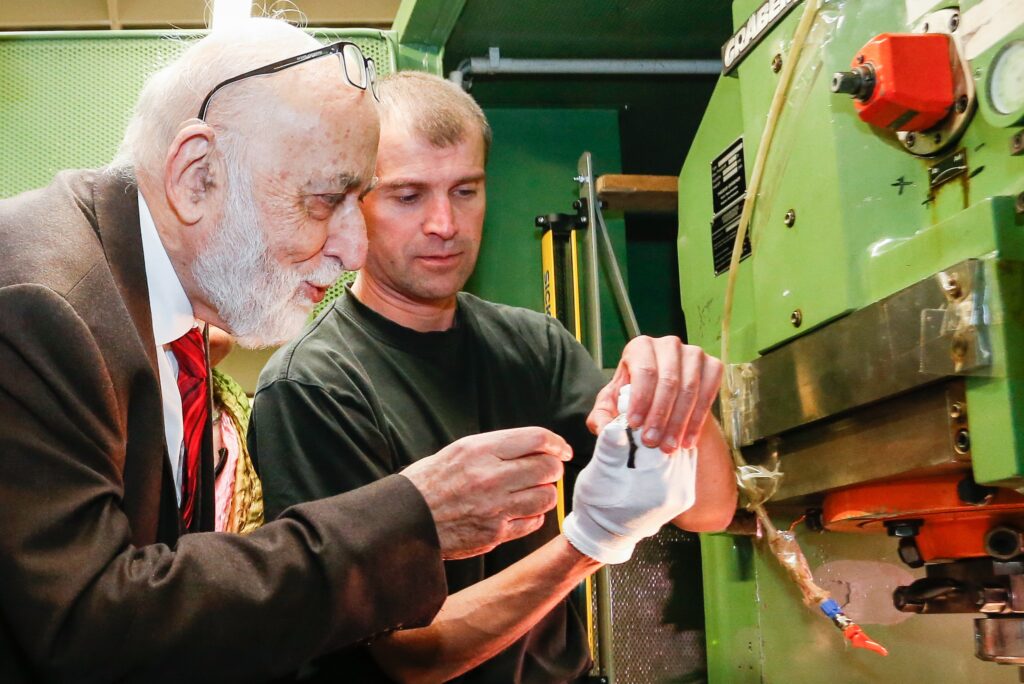
François Englert, the Brussels-born Belgian theoretical physicist who jointly deduced how the universe holds its shape, died on 18 June at the age of 93.
In 1964, Englert and his close American colleague Robert Brout formulated a radical theory while working at the Université Libre de Bruxelles (ULB). They proposed a mechanism to answer one of the biggest mysteries in physics: how subatomic particles acquire mass.
Their answer was an invisible, universe-spanning energy field. He and his colleague theorised that instead of generating mass internally, elementary particles gain it by interacting with this omnipresent field.
It can be explained as something akin to wading through water, as the resistance slows the particles down, preventing them from travelling at the speed of light. Without this field, atoms could not form. Stars, planets, and humans would simply not exist.
British physicist Peter Higgs published a nearly identical model just weeks later. The physical manifestation of this field eventually became known as the Higgs Boson, colloquially dubbed the "God particle". Englert himself shunned the sensational nickname, preferring "scalar boson".
Proving such abstract mathematics was impossible in the 1960s. Yet despite the lack of immediate recognition, the Brussels-based duo felt entirely certain they had cracked the code.
"We had the impression that at the end it would work, and so we celebrated," Englert recalled. They walked to a café near the university and split a bottle of champagne.
Physical proof demanded half a century of technological advancement. The validation finally arrived in 2012 via the Large Hadron Collider – a massive 27-kilometre particle accelerator beneath the Swiss-French border designed to smash protons together at unprecedented energies.
Researchers at CERN successfully observed the elusive boson, confirming the 1964 hypothesis.
Brout died in 2011, leaving Englert and Higgs to jointly accept the 2013 Nobel Prize in Physics. The achievement sparked widespread celebration across Belgium, prompting King Albert II to ennoble Englert as a baron later that year.
Born in the Brussels municipality of Etterbeek in 1932 to Polish-Jewish parents, Englert survived the Nazi occupation by hiding in rural Wallonia. He aided local resistance fighters as a ten-year-old, quietly counting German train carriages to help coordinate sabotage.
He eventually returned to the capital, graduating from ULB before abandoning applied physics to study the quantum realm.
As a professor, Englert operated on unconventional habits. He installed a second-hand mattress in his ULB office, asserting that his best inductive thinking happened while lying down to unleash his unconscious mind.
He also frequently cited classical music as a scientific tool, claiming a Mozart opera could communicate more about fundamental research than a standard academic lecture.
He was never particularly bothered by the long wait for his Nobel recognition. "I am very happy not to have received it when I was 50 years old," Englert quipped. "It would have posed a real problem for my research."
