
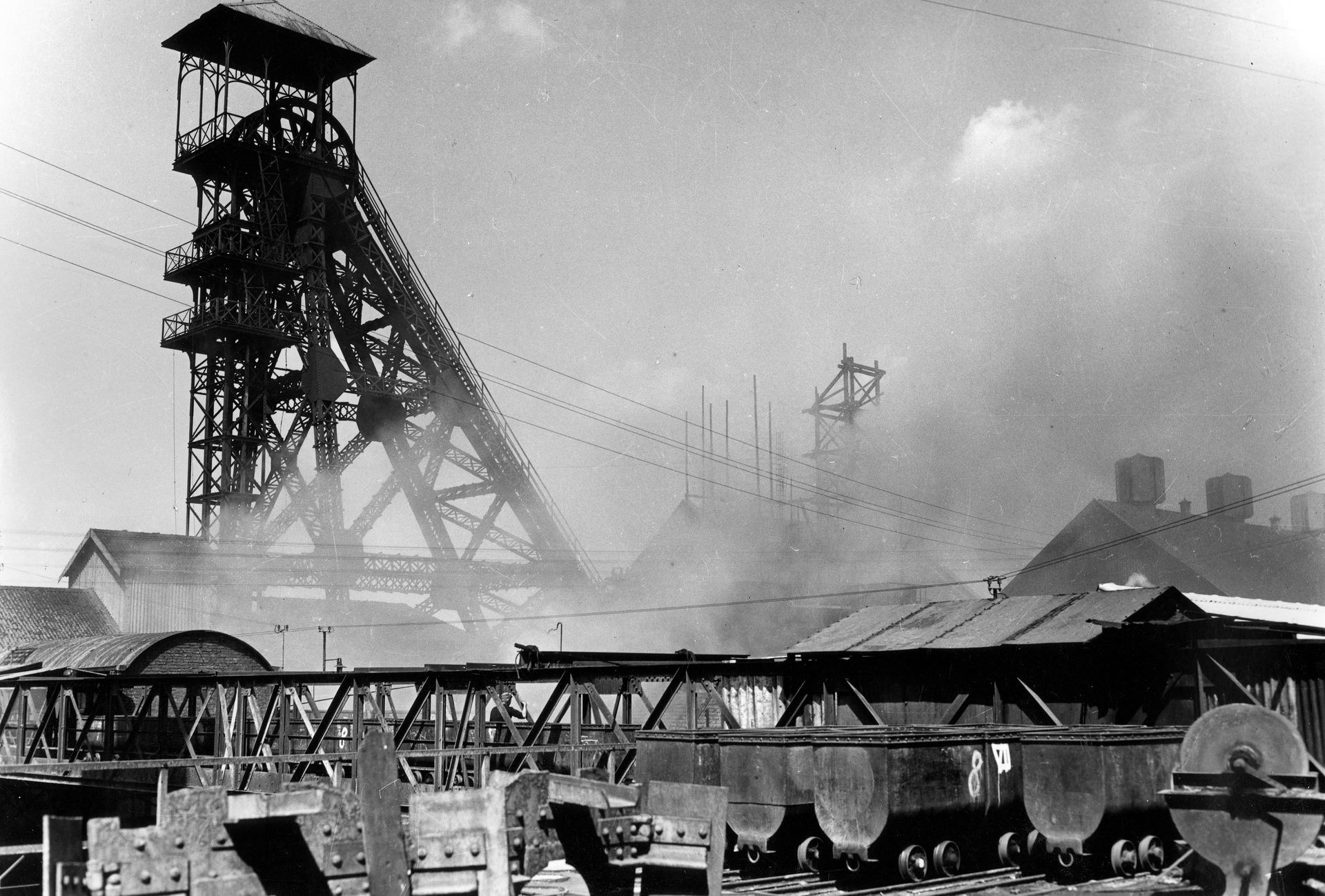
Seventy years after the Bois du Cazier disaster, the story of one miner who escaped and another who died reveals how Belgium's coalfields reshaped communities far beyond Wallonia.
On 29 July 1956, Urbano Ciacci married Elsa Tonucci in Fano, an Italian town on the Adriatic coast. He was due to leave for Belgium on 6 August and return to his job at the Bois du Cazier coal mine in Marcinelle. But his wife still had to prepare and send her dowry: sheets, blankets and mattresses.
Urbano decided not to leave her alone and postponed the journey. A domestic delay, the kind of small inconvenience that normally disappears from memory, saved his life.
On the morning of 8 August, as the newlyweds prepared to travel from Milan to Belgium, Urbano learned that the mine was on fire. His workmates were trapped underground. Among them was Filippo Talamelli, another man from Fano. Ciacci later returned to Marcinelle, joined the rescue effort and waited alongside the families pressed against the colliery gates for news that never came.
On 23 August, a rescuer emerged from the shaft and uttered two words that became the epitaph of the disaster: "Tutti cadaveri" – all dead.
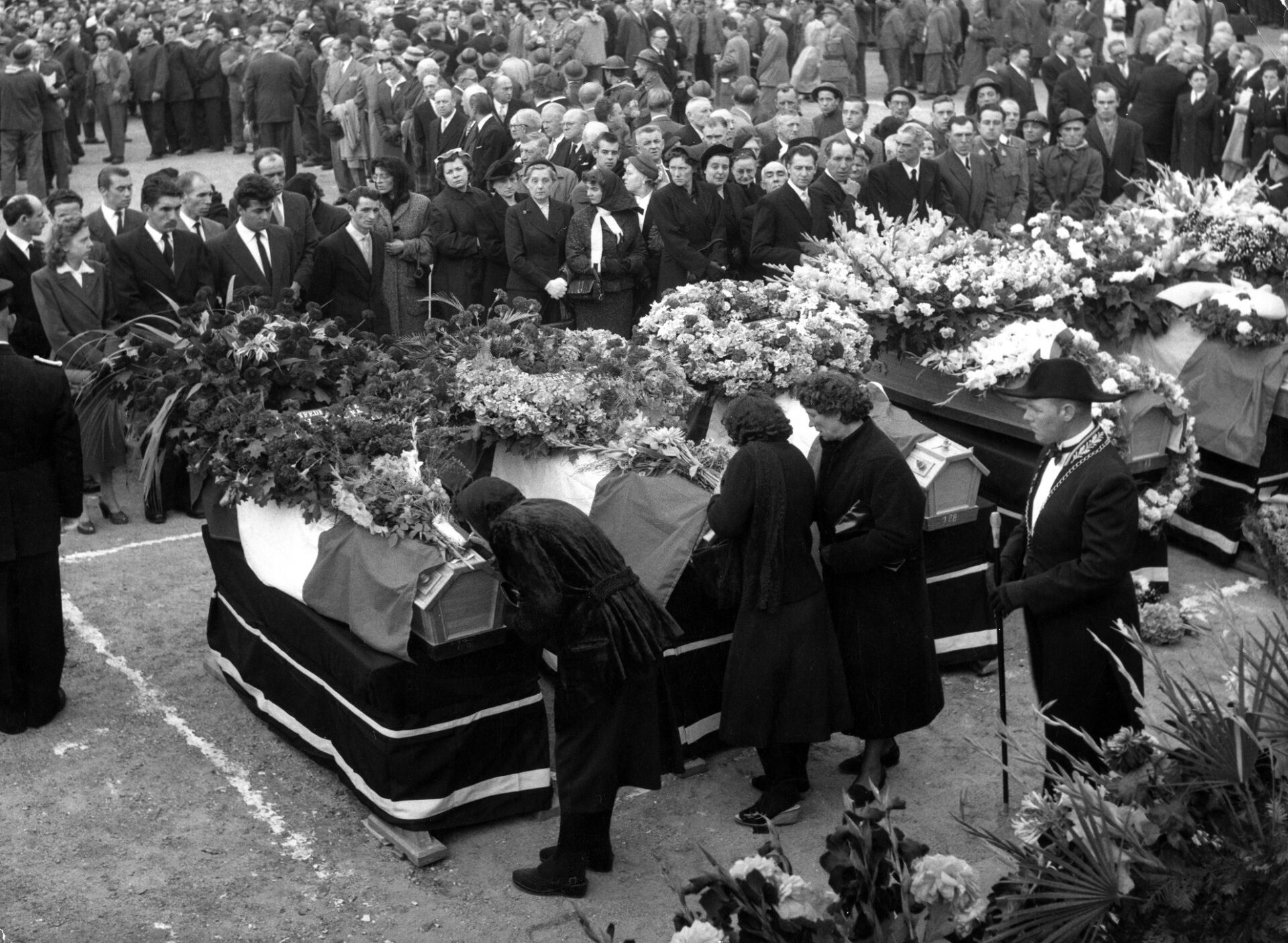
This file picture dated 13 August 1956 during the funerals of the miners of the Marcinelle mining disaster. Credit: Belga Archives
The fire killed 262 workers of 12 nationalities. Of these, 136 were Italian. Nine victims were connected to what was then the province of Pesaro and Urbino: Filippo Talamelli, Sisto Antonini, Alvaro Palazzi, Giuseppe Righetti, Edo Dionigi, Enrico Del Guasta, Antonio Gabrielli, Giovanni Bianconi and Antonio Molari. The home towns of the final three belonged to the province at the time, although they are now in the province of Rimini.
The bond between Fano and Marcinelle is therefore larger than the extraordinary story of a man who missed death by two days. It forms part of a geography of migration that local public memory has only partly preserved.
Italian workers in exchange for Belgian coal supplies
In the decade after the Second World War, hundreds of young people left the towns and countryside of this part of Italy for Belgium's coal mines. Italy needed coal for reconstruction; Belgium needed labour. A bilateral agreement signed in 1946 turned those needs into a recruitment programme: Italian workers in exchange for coal supplies.
Posters displayed across Italy promised higher wages and favourable conditions. Only after arriving did many migrants discover what awaited them. They were housed in barracks that had been used for prisoners during the war. They descended to depths approaching 1,000 metres and spent hours in passages where it was often impossible to stand upright.
Each worker was identified by a number. Ciacci's was 709, the same number marked on his lamp, locker and equipment. "I wasn't Urbano. I was 709," he would recall decades later.
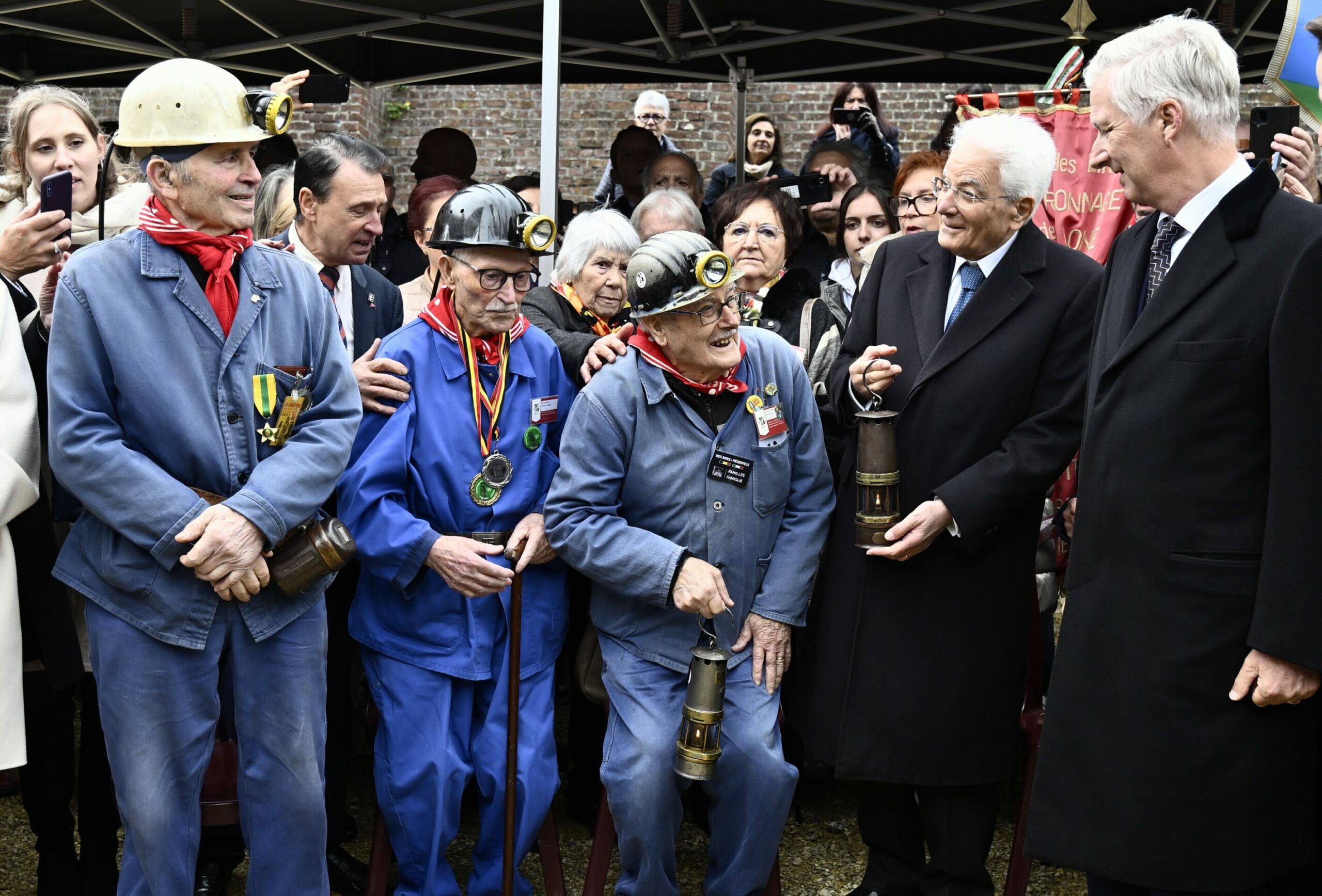
Former miners, Italy President Sergio Mattarella and King Philippe of Belgium pictured during a visit to Le Bois du Cazier industrial heritage site and former coal mine, in Marcinelle, on the second day of the official state visit of the Italian President, on Tuesday 21 October 2025, in Brussels. Credit: Belga / Eric Lalmand
Ciacci was not yet 19 when he left Fano in 1954. He remained a miner for 25 years. He became one of the last direct witnesses of the Bois du Cazier and devoted part of his life to guiding students and visitors through the place where the men killed on 8 August had worked.
Wearing his mining clothes, belt and the red scarf once used to cover the nose and mouth against coal dust, he could identify the faces in the memorial and remember the conversations exchanged before each descent.
The less visible side of migration
Yet the history of Fano's miners did not end at Marcinelle. Ennio Tomassini worked in the Limburg mines until he became disabled. Guido Gramolini descended into some of the deepest pits and developed silicosis. Alberto Gramolini worked in the Charleroi coalfield, later lived in Brussels and eventually returned to Fano as a pensioner. After coming home, Franco Barilozzi helped former miners secure recognition of pension rights earned abroad.
Their lives reveal the less visible side of migration: not just departure and work, but illnesses that emerged years later, disability, social-security claims and difficult returns.
Women were central to this history too. Wives and mothers held together families divided between two countries, managed remittances, faced unfamiliar surroundings or waited at home. In Ciacci's story, that presence appears in an almost paradoxical detail: Elsa's dowry, and the couple's decision to travel together, kept him away from the mine on 8 August.
Marcinelle brought organised Italian recruitment for the Belgian mines to an end and forced Europe to confront safety underground. Fire-prevention systems, gas masks and stricter controls followed, but the judicial reckoning was far less conclusive.
After acquittals at first instance, the appeal produced a single six-month suspended sentence. The compensation offered to the victims' families was widely regarded as inadequate.
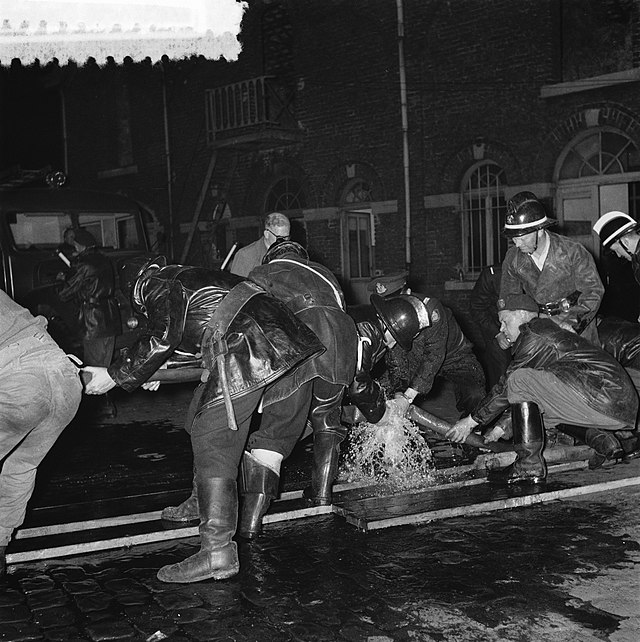
Local fire brigade tackles the Bois du Cazier fire on 9 August 1956. Belga Archives
Since 2001, Italy has marked 8 August as the National Day of the Sacrifice of Italian Labour in the World.
Yet, 70 years after the disaster, remembering Marcinelle in Fano means more than observing an anniversary. It means recognising that this seaside town also had an underground world of its own: a hidden history of departures, coal, illness and labour. That history was written in the lives of those who returned, those who remained in Belgium and those who, like Filippo Talamelli, never came home.
Perhaps the most honest way to commemorate Marcinelle is to begin there: by asking what trace remains in Fano's streets and public memory of the women and men whose labour helped rebuild Italy, Belgium and Europe.
A city is shaped not only by those who stayed, but also by those who had no choice but to leave.
Fabrizio Floris is an Italian sociologist and writer living in Fano, Italy.
