
A few hundred metres from the European Parliament, a museum devoted to the continent’s shared past is asking an awkward question: can Europe honestly describe itself as postcolonial?
At the House of European History, the question mark in the title of its new temporary exhibition, Postcolonial?, does most of the intellectual work. It turns what might have been a reassuring label into a challenge.
The exhibition, open until 14 March 2027, brings together 195 historical objects and documents, 25 contemporary artworks and eight filmed personal stories. Its four sections move from the structural foundations of European colonialism to the collapse of formal empires, the limits of independence and the persistence of colonial power today. The result is less a closed history than an argument about the present.
That argument matters especially in Brussels. The city is simultaneously Belgium’s capital, the administrative centre of the European Union and a place where the memory of the colonial rule in Congo remains embedded in monuments, institutions and public debate.
To stage Postcolonial? beside the institutions that speak most confidently in Europe’s name gives the exhibition a political charge that extends well beyond museum walls.
Between independence and freedom
The first section traces colonialism from the 15th century to 1945, presenting empire not simply as a sequence of national adventures but as a system sustained by extraction, racial classification and coercion.
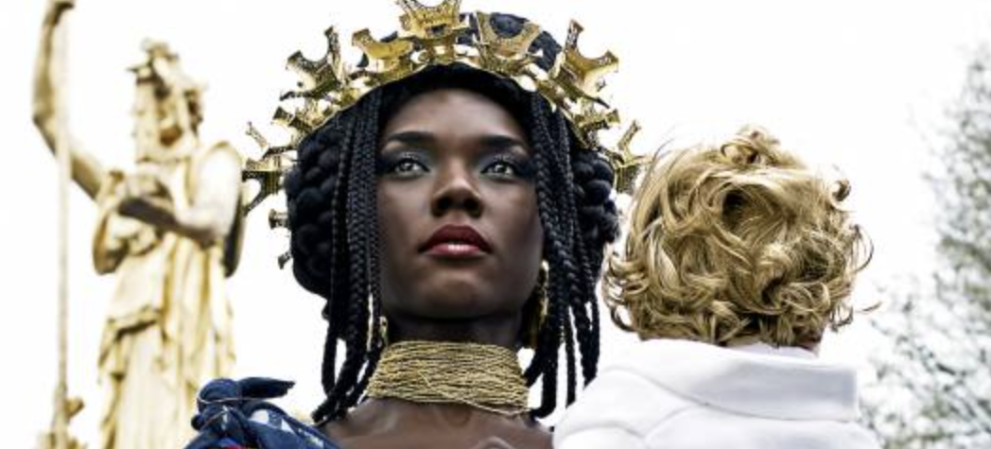
Yinka Shonibare’s Botanist Kid (Boy), made in 2024, sits within this longer history. Its presence points towards the relationship between scientific knowledge, collecting and imperial power – a reminder that conquest was organised not only by armies and administrators, but also through categories, maps and museums.
The second section, The End of Empire?, begins with a contradiction. European states emerged from the Second World War proclaiming freedom and democracy, yet several still tried to retain control over colonised territories. Independence movements exposed the gap between Europe’s universal principles and its political practice.
Susan Stockwell’s Colonial Dress and historical material on anti-colonial struggle prevent decolonisation from appearing as a generous European withdrawal; it was fought for by people whom conventional European narratives too often place at the margins.
The question becomes sharper in the third section, Between Independence and True Freedom. While 17 African colonies became independent in 1960 alone, political sovereignty did not automatically undo economic dependency, unequal access to resources or inherited administrative structures.
The exhibition therefore resists the comforting idea that colonialism ended when flags changed. Formal empire could disappear while many of its hierarchies survived.
A first step
Contemporary art is most useful here when it does more than illustrate the historical record. Works by artists including Hew Locke and Shonibare expose the symbols through which imperial authority is remembered, disguised or reproduced.
Alongside them, the eight personal testimonies bring questions of identity, family separation, structural racism, contested massacres and resistance into individual lives. That human scale keeps the exhibition’s language of systems and structures from becoming entirely abstract.
The museum also turns its criticism inward. It acknowledges that its permanent displays do not say enough about colonialism’s continuing effects and neglect the voices of people who suffered and resisted colonial violence. Postcolonial? is presented as the beginning of an effort to revise those displays.
This admission is significant: a museum created to narrate a shared European history is recognising that its own version of that history has been incomplete.
But acknowledgement is only a first step. The harder test will be whether colonialism becomes integral to the museum's account of Europe, rather than remaining contained within a temporary exhibition. If empire helped shape European wealth, borders, institutions and ideas of citizenship, it cannot be treated as a specialist subject or an external story involving distant territories. It belongs within the central narrative of modern Europe.
An honest history
That is also the exhibition’s most important challenge to the European project. Europe frequently defines itself through democracy, human rights and reconciliation after war. Those commitments need not be rejected, but they become less credible when detached from the violence and extraction that accompanied European expansion.
A more honest history would place these narratives together, showing progress and domination not as separate stories but as entangled ones.
Postcolonial? offers no definitive answer to the question in its title. Its value lies in refusing an easy one. A society cannot become postcolonial merely by declaring colonial rule over; nor can a museum correct an inherited narrative with a single exhibition.
The real measure will be what changes afterwards – in permanent galleries, public institutions and Europe’s understanding of its place in the world.
Practical information: Postcolonial? is at the House of European History, 135 Rue Belliard, Brussels, until 14 March 2027. Admission is free.
