

Who on earth would want to set off at 21:00 for a 100 km walk, finishing 24 hours later? Well, 12,759 people to be exact. They all bravely took part in last week’s gruelling 'Dodentocht', Belgium's famous 100km endurance walk.
The walk is the equivalent of walking from Brussels to Ghent and back again, and even writing about it makes me want to lie down pressing my palm to my forehead.
Dodentocht literally means 'Death March' – a rather dramatic name that I would imagine becomes all too real somewhere around kilometre 70. The walk takes place in Bornem, winding through the surrounding Klein-Brabant region before bringing walkers back to where they started. In case you were wondering that's 100,000-plus steps in one go, compressed into 24 hours.
The Dodentocht is the spectacular extreme end of the walking spectrum; an ultra-endurance event. You might be thinking: "Hmm, maybe I should do it next year, then I’m sorted for exercise for the rest of the year." Sure, by all means, do it, but spoiler alert: the health benefits of walking come largely from doing it regularly, not from a once-a-year heroic burst.
So, I’ll get to the question I’m asked all the time: how much should we be walking? And more specifically: should we be walking 10,000 steps a day?
The truth is, there is no magical threshold and no fixed biological requirement.
Smart marketing
Interestingly, the 10,000 came from a Japanese marketing campaign. In 1965, the company Yamasa Tokei Keiki launched the world’s first pedometer, a gadget that counted the number of steps you walked.
Back then, smartphones and smartwatches were still the stuff of science fiction and so, this Manpo-kei, as it was called, was worn around the waist (what my daughter would call prehistoric.)
Why did they plug the 10,000 steps? Partly because it is a wonderfully marketable, memorable round number, but also because it was roughly equivalent to 7 km. The idea was to try and get people to notch up their walking to counter their increasingly sedentary lives and while doing so, selling more Manpo-kei, of course.
Fast forward 40 years, and science finally started backing up this piece of Japanese marketing. In the 2010s, researchers began looking at whether people who walked more actually tended to be healthier. And the answer, time and again, was a resounding yes. More everyday walking was linked to lower risks of heart disease and less chance of dying prematurely.
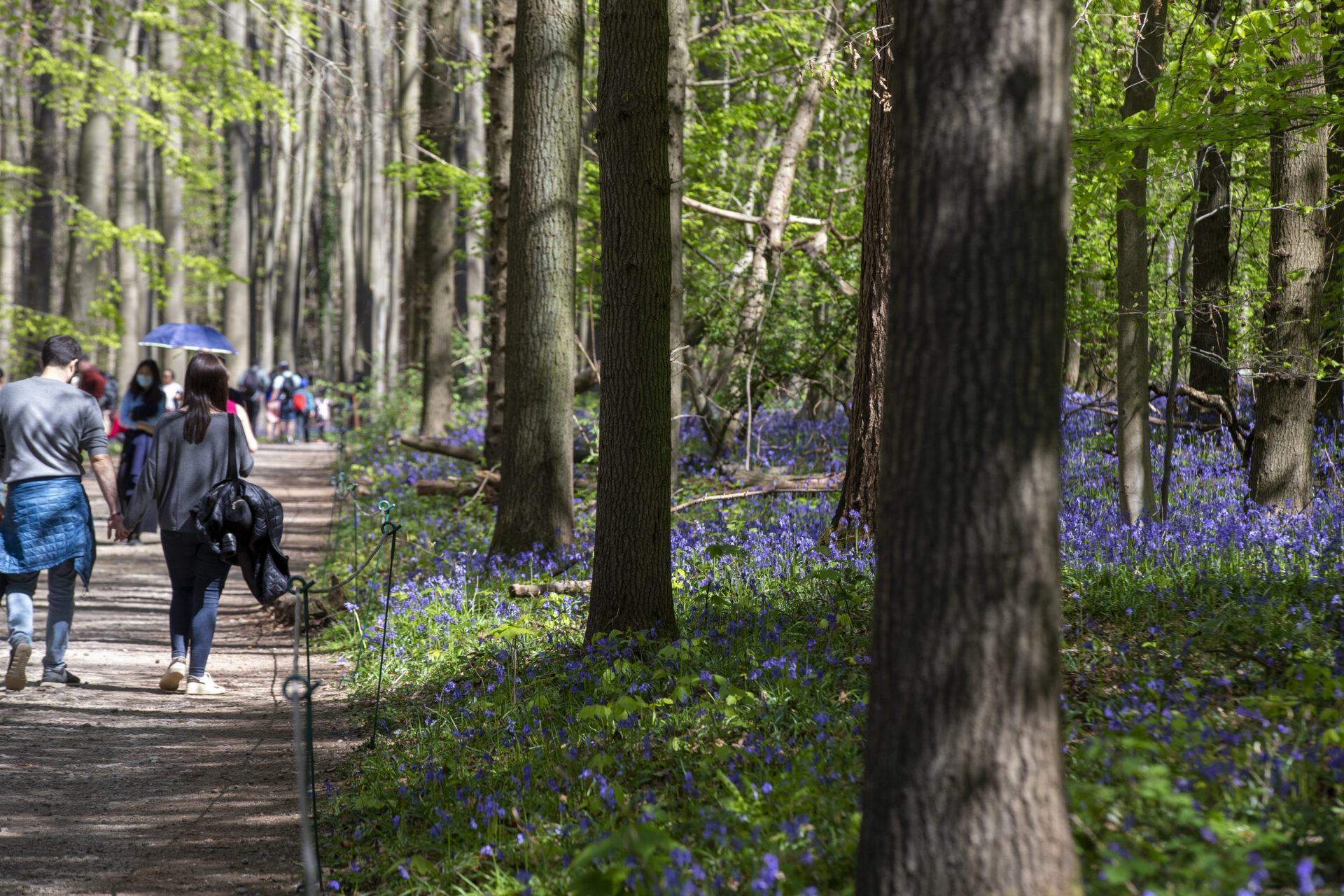
Lots of people walking in the Hallerbos in Halle, Sunday 17 April 2022. Credit/Belga Nicolas Maeterlinck
Meanwhile, other researchers were studying the Hadza, one of the best-studied hunter-gatherer populations living today. A large GPS study found that Hadza women walked an average of 8 km a day, while men covered 13 km. Another study, which looked at their daily movement using activity monitors, found that women averaged around 14,000 steps a day and men around 16,000.
These much-studied hunter-gatherers, equipped with a step counter, were not aiming for a step goal. No one told them anything about hitting the 10,000 mark. They walked because life required movement: finding food, gathering plants, carrying children or wood, climbing, travelling between places, tending the fire and socialising.
They did not announce to all and sundry not to be disturbed while on their 30-minute walk. Their movement was distributed throughout the day and woven into life. And importantly, it was not the same every day: sometimes it was light or moderate, and occasionally, when for example, they need to chase an antelope, it was very, very strenuous.
Interestingly, many of the chronic diseases we now see everywhere, from heart disease and Type 2 diabetes to obesity, are far less common among these hunter-gatherers.
We cannot help but conclude that walking is one of those rare, unglamorous activities which really, really works.
More than burned calories
Regular brisk walking (not dawdling please) lowers the risk of heart disease and high blood pressure. In fact, one of the simplest things you can do for your health is to forgo the siesta and take a short fast walk after a meal – this little habit helps blunt the rise in blood sugar that naturally follows eating and wards off Type 2 diabetes risks.
And the benefits do not stop at the heart. Walking is good for the brain too, with regular physical activity linked to a better mood, less anxiety and depression, and healthier cognitive function. Not to mention, as we get older, walking helps us maintain strength, balance, and mobility, and also helps us sleep better.
What matters is not turning movement into a daily pass-or-fail test. “Argh! I’ve only done 6,457 steps today!” should become “Great, I did 6,457 steps today; I will try and do some more tomorrow.”
Always ask yourself how you could make movement a natural part of your life. It could be walking to work, taking the stairs rather than the lift or escalator, a lunchtime stroll, or even dancing in the kitchen. It depends where you start. For someone who currently does very little activity, moving towards 5,000 steps a day can already be a hurrah moment.
The most important thing is that it is done in a way that does not turn walking into another chore to be endured to avoid disease. Someone walking 10,000 steps on a treadmill while feeling miserable is not necessarily healthier than someone walking 5,000 steps through the Sonian Forest. Movement is not simply about calories burned. It can bring connection, stress relief, and little moments of joy.
And perhaps that is the difference between the Dodentocht and the rest of us. We can walk to work, through Parc du Cinquantenaire, or simply around the block without even looking at our step mark on our wristwatch. The Dodentocht walkers had 24 hours to cover their 100 km. We have tomorrow.
Kristina Chetcuti is a registered health coach (UKIHCA) specialising in behaviour change and lifestyle medicine (ELMO).
