
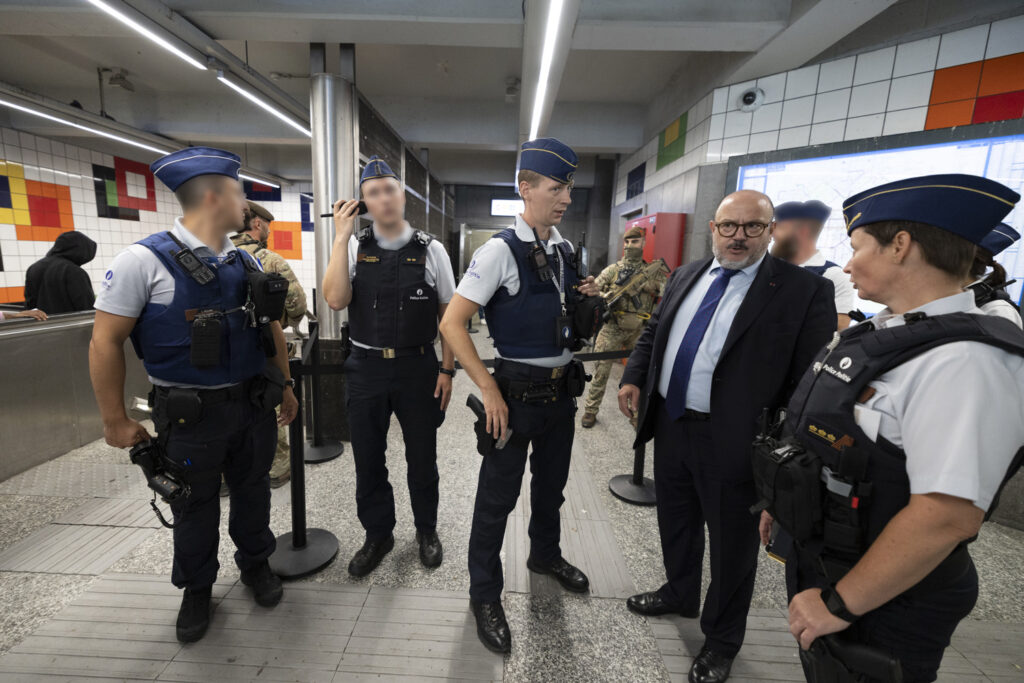
A major police operation involving hundreds of officers and, for the first time, including soldiers was carried out across Brussels on Friday afternoon in neighbourhoods affected by drug trafficking, as authorities seek to disrupt criminal activity and visibly reassure residents.
The operation, known as FIPA - for Full Integrated Police Action - took place in several parts of the city, including Clémenceau, Yser, Rogier and Hankar.
Police, transport inspectors and military personnel were deployed at key locations, particularly around metro stations.
'The streets belong to our fellow citizens'
At Clémenceau station, where journalists accompanied Interior Minister Bernard Quintin and Defence Minister Theo Francken, officers and soldiers were stationed at the exits.
Within an hour, eight people had been arrested, including some found carrying quantities of drugs well above personal-use levels.
Although the operation had been planned at the start of the summer, it comes just days after shots were fired at a police station in Anderlecht, giving it added significance.
“The main message is that the streets and metro stations of Brussels belong to our fellow citizens,” Mr Quintin said. “So that they can feel safe there, the state is using its full force, through the different levels of the police and, for the first time, the army.”
A national emergency that requires all authorities to act
In total, the operation involved 450 local and federal police officers, backed by 70 soldiers and staff from Brussels public transport operator STIB. It forms part of the 'Big Cities' plan introduced a year ago.
Mr Quintin said the response to organised crime linked to drug trafficking had to be broad and sustained.
“I have never said I had the solution, but it is the full range of actions we are putting in place that allows us to fight organised crime linked to drug trafficking,” he said, calling the issue a national emergency that required all authorities to act.
He argued that recent violence showed that the strategy was having an impact. The shooting at the Anderlecht police station, he said, suggested traffickers were being disrupted in the way they operated.
Some local residents sceptical
“They sent a message, we heard it clearly, and we will continue the operations with all the forces at our disposal,” he said.
Not everyone was convinced. Some local residents watching the ministers’ visit expressed scepticism, saying similar displays had followed previous shootings without producing lasting change.
One member of a neighbourhood committee said the real priority should be community policing by officers who know local residents and dealers.
He said young traffickers simply hide when police patrols appear and return soon afterwards, while drug users also create serious problems and can behave aggressively.
Further police-military joint operations to follow
The Interior and Defence ministries have signed a protocol allowing police to call on the army to assist in tackling organised crime.
Mr Francken said police and the military were working closely together and that further joint operations would follow.
He said Brussels’ security situation was highly problematic and had worsened further, adding that authorities had to regain control of the streets of the capital of Europe and NATO.
He also said it was important to prevent dealers from moving their activities to nearby areas such as Zaventem, Vilvoorde and Machelen, where they might believe they could operate more easily.
