
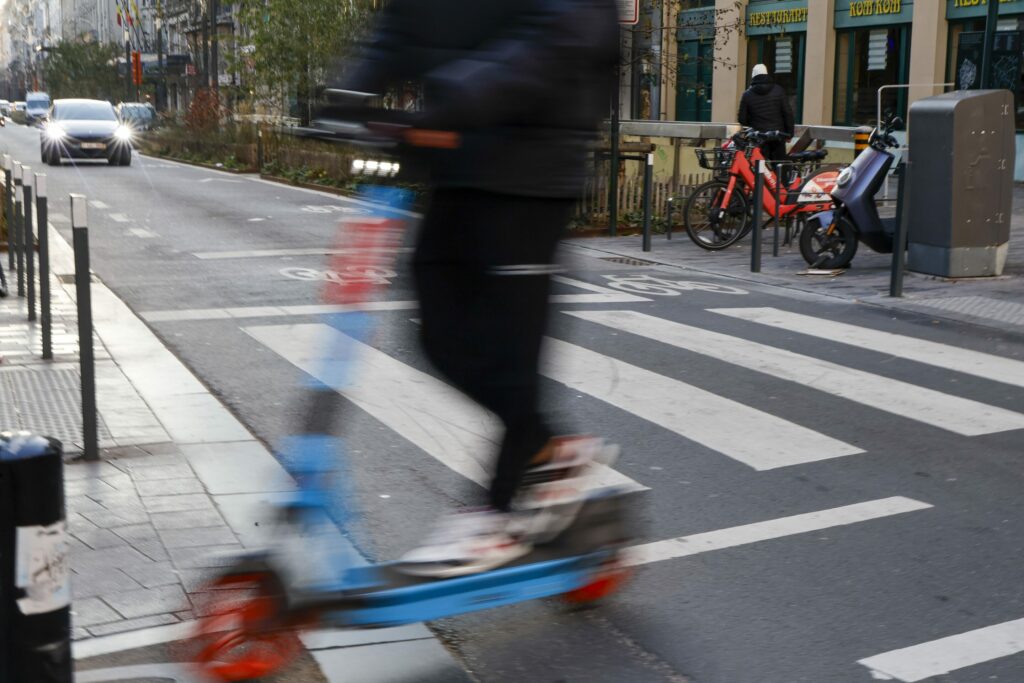
As of 1 September, Belgium will enforce a federal helmet requirement for electric scooter riders who use vehicles capable of exceeding 20 km/h. Anyone caught violating this mandate will be fined €64, with an administrative fee of €10.67.
In the Brussels-Capital Region, the shared e-scooters will not be affected by this law as the vehicles cannot exceed 20 km/h. In the rest of the country, the speed limit for e-scooters allowed on public roads is capped at 25 km/h – meaning the compulsory helmet rule will only apply to the group of shared e-scooters with a maximum speed between 20 and 25 km/h, as well as private e-scooters which can go faster than 20 km/h.
This caveat has led some, like the European Transport Safety Council (ETSC), to question why a more uniform helmet requirement for all scooters wasn’t implemented.
"ETSC's view is that all e-scooters should have a factory-set 20 km/h cap – a vehicle technical standard, and properly an EU competence – and that the EU should issue guidelines on rider rules (helmet use, minimum age, no pavement riding) so that Member States implement them consistently," said ETSC said in a 27 April post.
Related News
- Two shooters on e-scooters target old police station in Anderlecht
- E-scooters allowed to remain on Brussels' streets until end of 2026 after all
- 'Key part of transport ecosystem': Petition forces Brussels to reconsider shared e-scooter ban
With the initiative, Belgium joins other EU countries such as Denmark, Italy and Croatia that have already established similar requirements.
Belgium's Federal Minister of Mobility Jean-Luc Crucke (Les Engagés), who announced the helmet requirement on Monday, cited 2025 statistics showing a 34% increase in injury accidents involving e-scooters compared with the previous year as a major concern. These statistics show that there were 2,453 e-scooter injuries in 2025, an increase of roughly 34% from the year before.
Previous reporting by The Brussels Times found that out of the 2,453 injuries, 161 were classified as serious and 13 were fatal.
“Electric scooters are now part of our daily mobility,” Crucke said. “But when the number of fatalities more than triples in a single year, we cannot look the other way – we must take action wherever we can save lives.”
A study of serious e-scooter injuries found that 60% resulted in a head injury, highlighting the particular risk of head trauma among riders. Out of that 60%, reportedly only 4% were wearing helmets at the time of the accident.
Reducing risk instead of preventing it
However, helmets reducing the severity of traffic accidents are not the only way they could save lives. Despite e-scooters relatively low speeds, severe head injuries can still occur at speeds much lower than 20 km/s.
A biomechanical study from Imperial College London which simulated falls at 10, 20 and 30 km/h, found that lowering the scooter's speed from 30 km/h to 20 km/h reduced the resulting head-impact force by only 12%.
While helmets can reduce an accident's severity, they cannot address the factors that cause them in the first place. That is why, in the future, the Belgian Federal Government hopes to expand on its efforts to increase e-scooter safety by addressing other concerns.
These other concerns include, but are not limited to, addressing other crash factors like speeding, drunk drivers and distracted driving.
"Safety is not just about protection after an accident, but also about preventing them," Crucke said. "That’s why we are combining the mandatory helmet law with other measures designed to contribute to safer use of electric scooters in traffic."
With the Brussels Government's recent decision to remove all shared e-scooters beginning 1 January 2027 still fresh in many Belgians' minds, Crucke wanted to ensure that this requirement is not perceived as the government trying to enforce a complete ban on e-scooters.
"For many people, the electric scooter offers a practical and sustainable way to get around," he said. "Our goal is not to discourage this form of mobility, but rather to ensure that it is as safe as possible. Safety and mobility must go hand in hand."
