
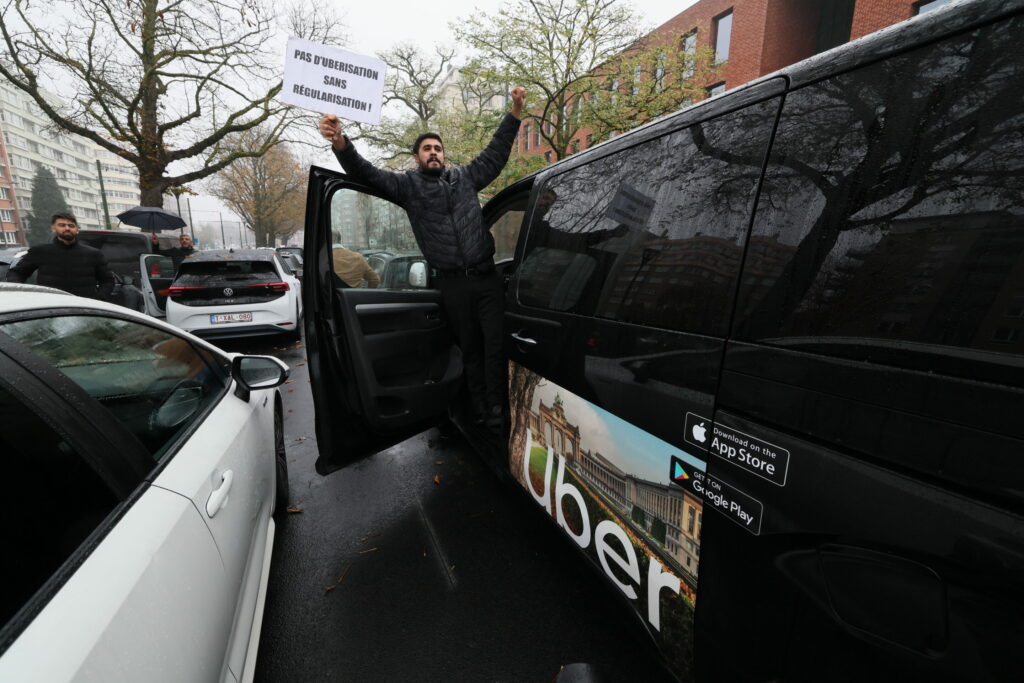
About 30 taxi drivers protested in Brussels on Friday to demand changes to regional regulations in Brussels and Flanders.
However, sector representatives said after meetings with regional officials that the talks were a step forward.
The drivers gathered on Boulevard Pachéco to denounce what they called 10 years of suffocation under competition from multinationals such as Uber.
After meetings with the offices of Flemish Mobility Minister Annick De Ridder and Brussels Minister-President Boris Dilliès, the drivers' representatives said the outcome of the day had been broadly positive.
'We came away feeling that things are moving forward'
Dilliès did not attend the meeting himself, but his deputy chief of staff received a delegation. “We came away from the meeting with the feeling that things are moving forward,” Jean-Paul Mbenti of the Belgian Limousine Drivers Association told Belga News Agency.
In Brussels, the talks focused on several provisions in the regional ordinance that the sector considers discriminatory.
Drivers are calling in particular for access to dedicated lanes, the right to transfer or sell their licences, and an increase in the minimum fare.
They also criticised the commissions charged by platforms, which can reach 35%, according to Mbenti.
'At least today we have a deadline'
He said a meeting had already taken place on Thursday with the office of Brussels State Secretary Karine Lalieux, who is responsible for the sector.
According to Mbenti, the contested provisions of the Brussels ordinance should be revised by the end of the year. “We have been working on this for nearly four years," he said. "At least today we have a deadline.”
Earlier on Friday, the delegation also met De Ridder’s office to discuss the fare rate and the Flemish decree governing the sector.
Some drivers operating at a loss
Mbenti said some drivers in Flanders were charging less than €1 per kilometre while fuel was almost €2 a litre. “These drivers are operating at a loss,” he said.
He added that taxi drivers were facing a growing list of difficulties, including higher fuel prices and tax pressure.
In his view, the current regulations no longer meet the needs of regular drivers and the business is no longer profitable under such conditions.
