
Cheap, colourful and marketed like a party accessory, nitrous oxide – laughing gas – has become one of Belgium’s most visible drugs. From rave culture to exploding waste plants, Brussels is struggling to contain the fallout, as Dominique Soenens reports.
The evidence is easy to spot near the Brussels-North railway station. Beneath a rubbish bin lie several discarded nitrous oxide cylinders – black canisters with flashy branding and names designed to catch the eye. One reads “C.R.E.A.M.” in gold lettering. Nearby refuse collectors barely react anymore. They see them everywhere. “Three, no, four,” one mutters while counting the empty cylinders before tossing them aside.
The canisters have become part of the urban landscape: abandoned in parks, scattered near nightclubs, piled beside roads, dumped in residential streets. They are also becoming expensive. When crushed in waste-processing plants, the pressurised cylinders can explode violently, damaging machinery and forcing incinerators to shut down.
“Each explosion costs around a quarter of a million euros,” says Nathalie Debast, from the Flemish Association of Cities and Municipalities (VVSG). In 2025 alone, the damage bill reached €12 million.
What began as a niche party accessory has evolved into one of Belgium’s strangest drug headaches: part public nuisance, part health problem, part waste-management crisis. Two years after Belgium banned recreational nitrous oxide use, the gas remains highly visible – and remarkably easy to obtain.
Party gas
Deborah Apelmaen, Commissioner of the Brussels-Midi police zone, has watched the trend spread steadily through the capital’s nightlife.
“Nitrous oxide has been popular for several years as a cheap party drug,” she says. “You see it in nightclubs, at festivals, at raves. Anyone arriving with cylinders immediately becomes popular.”
The pandemic accelerated the phenomenon. With bars and clubs closed during lockdowns, young people gathered in parks, warehouses and private parties instead. Nitrous oxide – cheap, portable and easy to share – fit perfectly into that environment.
Unlike other drugs, it arrived wrapped in the aesthetics of celebration. The gas is typically inhaled through balloons after being released from a metal cylinder. Manufacturers increasingly package the canisters in bright colours with sweet flavours and playful branding. Online sellers advertise promotions, discounts and home delivery.
“There’s a lot of marketing through Snapchat and TikTok,” says Apelmaen. “The packaging is attractive, which makes it appear harmless.”
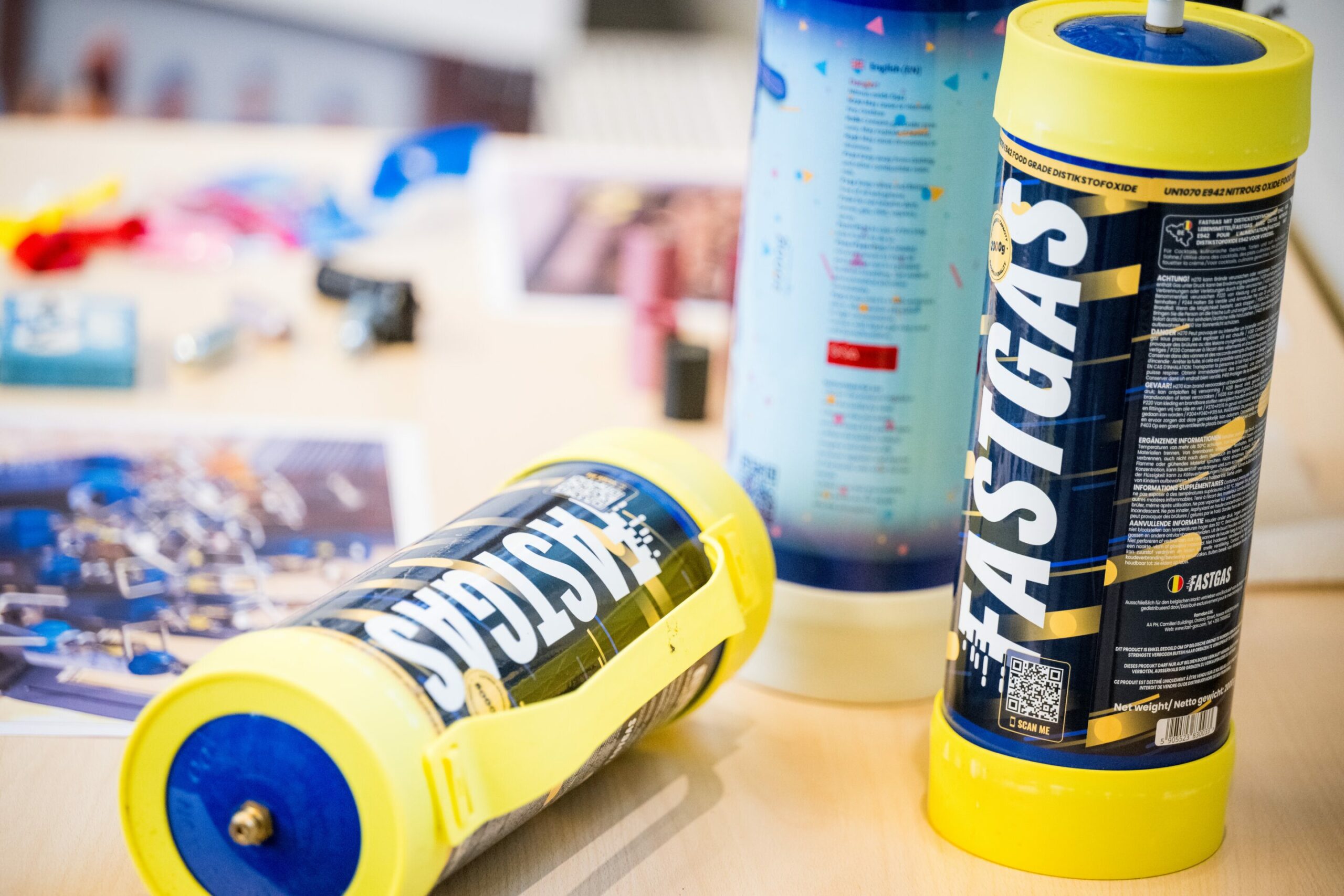
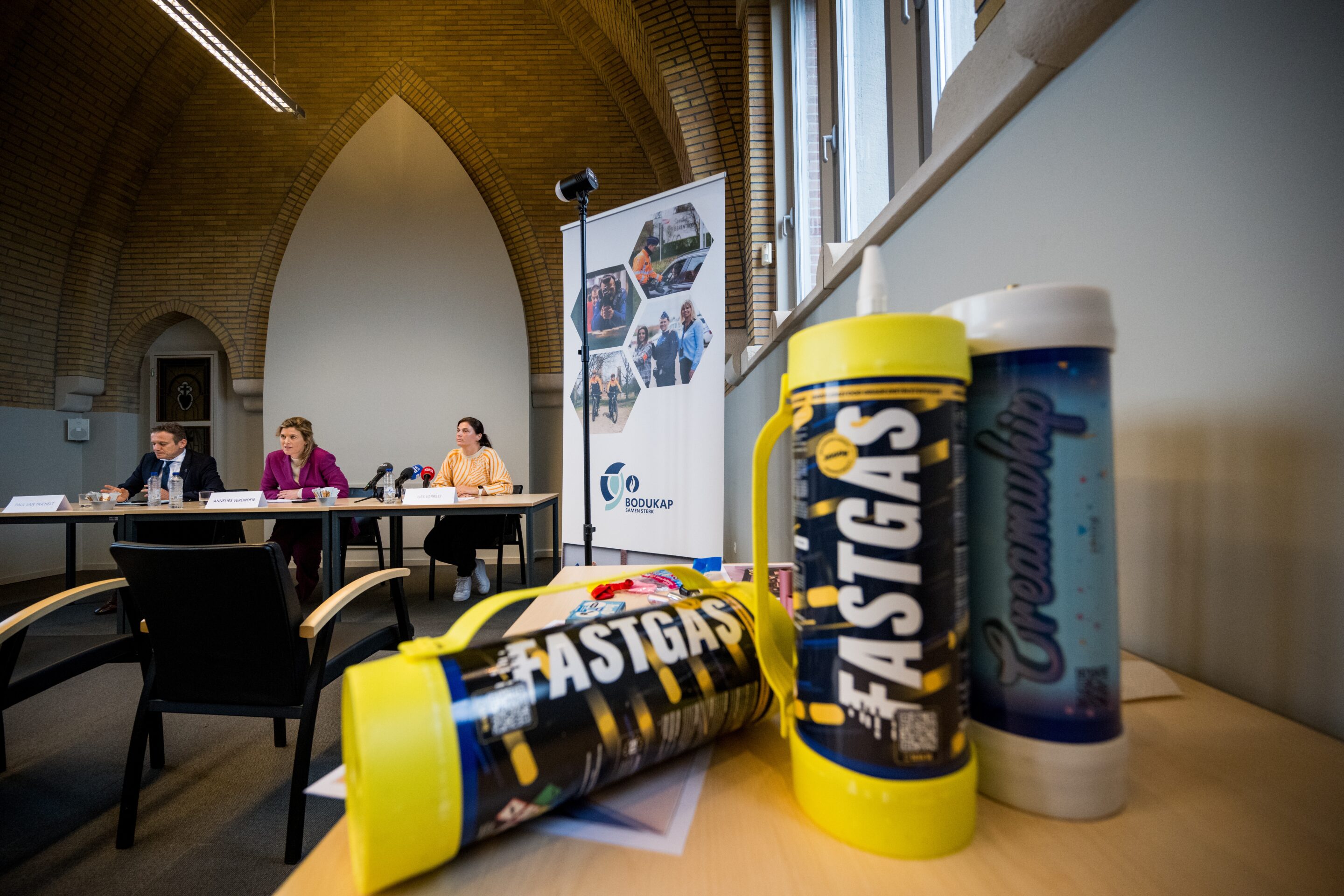
Illustration picture shows nitrous oxide gas cylinders ahead of a Press moment explaining a legal measure to combat the possession, transport and sale of nitrous oxide, Friday 15 December 2023. Credit: Belga/Jasper Jacobs
It is far from harmless. “It’s extremely dangerous,” Apelmaen says. “For 10 to 30 seconds, users lose touch with reality completely. Someone driving through the city in that condition no longer sees other road users.”
Belgium officially banned the recreational use, sale and possession of nitrous oxide two years ago, except for medical, technical and food-industry purposes. Police welcomed the move.
“The ban gives us more room to act,” says Apelmaen. “We can issue fines of up to €500 per cylinder in Brussels and refer cases to prosecutors.”
But the ban had unintended consequences. Rather than disappearing, the trade has shifted increasingly into criminal networks. Earlier this year, federal police dismantled a gang distributing nitrous oxide across Belgium and seized more than 7,000 cylinders.
“Nitrous oxide is now circulating through the same channels as other drugs,” Apelmaen admits. “You see professionalisation, organised delivery systems and much larger cylinders designed for group use.”
Easy addiction
Compared to cocaine or ecstasy, nitrous oxide also feels accessible. A cylinder costing around €50 can keep a group entertained for an evening. The high is brief – usually less than a minute – but intense enough to encourage repeated use.
Frederick remembers exactly how easy it seemed when he first encountered it at 19. “I went to illegal parties where it was offered to me,” he says. “It looked innocent. You didn’t have to search for it.”
The appeal was obvious. “You’re completely high for a moment,” he recalls. “Sounds echo. You see double.”
That illusion did not last.
“I became addicted,” he says bluntly. “Nitrous oxide destroyed my brain cells. I could no longer function properly physically. His addiction spiralled alongside other substance abuse and eventually led to several years in psychiatric care.
“I had completely lost control,” he says. “When people hear the word addiction, they think of heroin or cocaine. Not laughing gas.”
A very modern high
Nitrous oxide – chemical formula N₂O – has a surprisingly respectable history. The British chemist Humphry Davy first isolated the gas in 1799 and quickly became fascinated by its euphoric effects. After inhaling it himself, he reportedly wandered around his laboratory laughing uncontrollably.
Davy began hosting nitrous oxide parties at his home in Bristol, helping to turn the gas into a fashionable curiosity among Europe’s upper classes. One advertisement from the 19th century specified that demonstrations were intended only for “respectable gentlemen”.
The gas later found more practical applications. Davy noticed it reduced pain, paving the way for its use as an anaesthetic during minor medical procedures. In modern times, nitrous oxide became widely used in whipped cream dispensers and food processing.
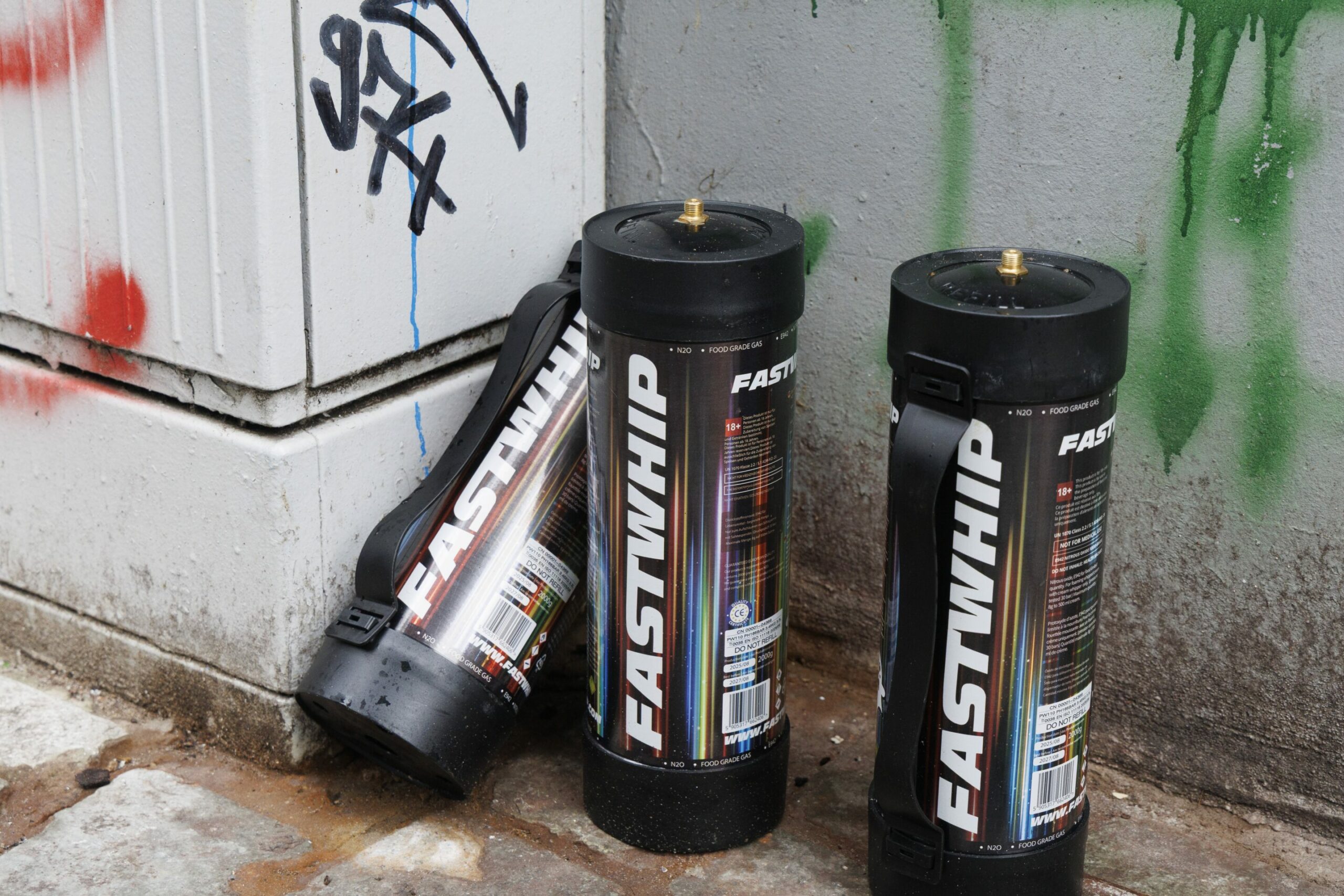
Nitrous oxide (laughing gas) waste pictured after the celebrations on New Year's Eve, Thursday 01 January 2026, in Brussels. Credit: Belga/Nicolas Maeterlinck
Its recreational effects remain essentially unchanged. Inhaling nitrous oxide deprives the brain briefly of oxygen, producing euphoria, distortion of sound and altered perception.
The brevity of the high partly explains its appeal – and its dangers. Users often inhale repeatedly in rapid succession.
“It seems harmless, but it isn’t,” says Fred Laudens of the Flemish Expertise Centre for Alcohol and Other Drugs (VAD). “It’s not physically addictive in the traditional sense, but psychologically it can become very addictive because people constantly want to repeat the feeling.”
Heavy use can lead to nerve damage, vitamin B12 deficiency and, in extreme cases, paralysis. Inhaling directly from cylinders can also cause severe frostbite injuries because of the gas’s temperature.
The scale of consumption remains difficult to measure. Surveys suggest nitrous oxide use among students is relatively limited: fewer than one in 50 Flemish pupils reported using it in 2024. University surveys in Flanders and Brussels produced similarly low numbers.
Yet those statistics clash sharply with the visibility of the problem in cities.
“A relatively small group can still create a huge amount of nuisance,” says Laudens. “And surveys often miss vulnerable populations such as homeless people or marginalised users in big cities.”
Other figures are more alarming. According to road safety institute VIAS Institute, 7% of motorists admitted driving under the influence of nitrous oxide in the previous year during a 2023 survey.
The cylinders themselves are getting bigger. Under current rules, large canisters intended technically for catering or industrial use can still be purchased relatively easily. Online sellers simply require buyers to tick boxes declaring the gas will be used for whipped cream dispensers.
Supermarket sweep
Frederick Vinckenbosch, a researcher and nitrous oxide expert at VIAS, argues Belgium’s legislation still contains major loopholes.
“You can still walk into supermarkets and buy nitrous oxide,” he says. “The websites protect themselves legally, but everyone understands what is really happening.”
Waste figures suggest the ban has done little to reduce circulation. According to Interafval, the Flemish umbrella organisation for waste-management bodies, the number of cylinders collected at recycling centres rose by 35% in 2025 compared with the previous year. More than 3,200 explosions were recorded in incinerators during the same period.
In Sint-Truiden alone, dozens of cylinders are now collected weekly.
“We only see the problem growing,” says Mayor Ludwig Vandenhove. “The ban apparently doesn’t solve much.”
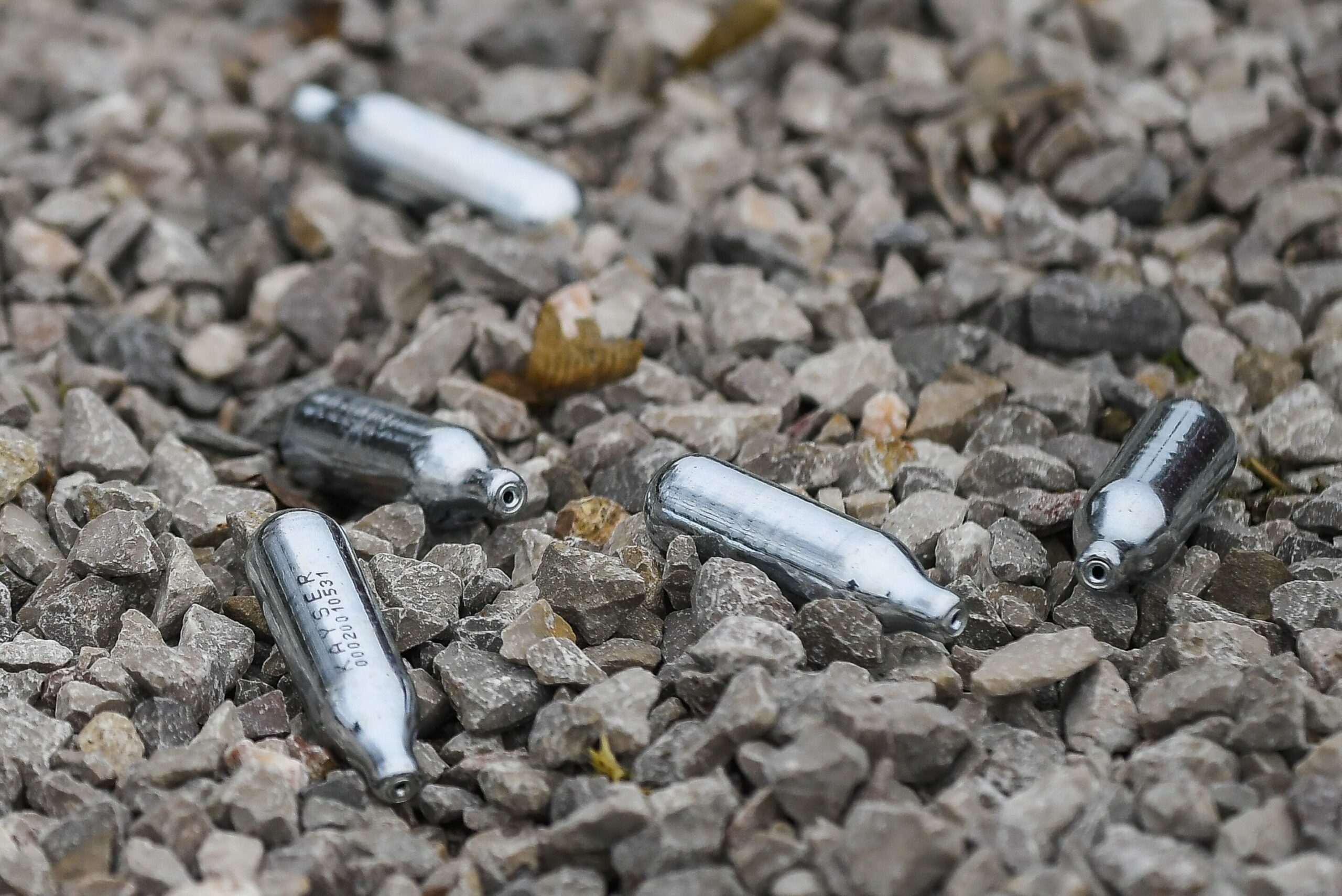
Nitrous oxide capsules at a sidewalk downtown Brussels, Sunday 17 January 2021. Credit: Belga/Laurie Dieffembacq
Interior Minister Bernard Quintin (MR) rejects the idea that the legislation has failed entirely. “At least police forces now have a clear legal framework to intervene systematically,” he says.
Still, pressure is mounting for additional measures. Municipal authorities want stricter controls on online sales, more prevention campaigns and better support for waste processors coping with the explosions. The federal government has asked the National Drug Commission to prepare a new action plan before the summer recess.
Europe is moving too. From 2027, the EU plans to ban larger nitrous oxide cartridges entirely. Only tiny containers of less than 24 millilitres – too small for recreational extraction – will remain permitted.
Paying for rubbish
For now, some cities are experimenting with more pragmatic approaches.
Ghent introduced one of the most unusual schemes in Belgium last year: residents receive €5 for every nitrous oxide cylinder handed in through the city’s waste system. The money is credited to their municipal waste account and can be used for rubbish collection or recycling-centre access.
The idea initially caused unease. Critics feared it might unintentionally encourage consumption by attaching monetary value to the canisters.
“That concern existed,” says Louise Blondé of waste company Ivago. “But most cylinders are handed in by volunteers cleaning the streets, not by users.”
The results have been striking. Ghent’s waste incinerator has not suffered a major shutdown caused by nitrous oxide explosions since the scheme began. Small blasts still occur, but catastrophic damage has largely disappeared.
Elsewhere, however, authorities remain cautious about introducing similar incentives.
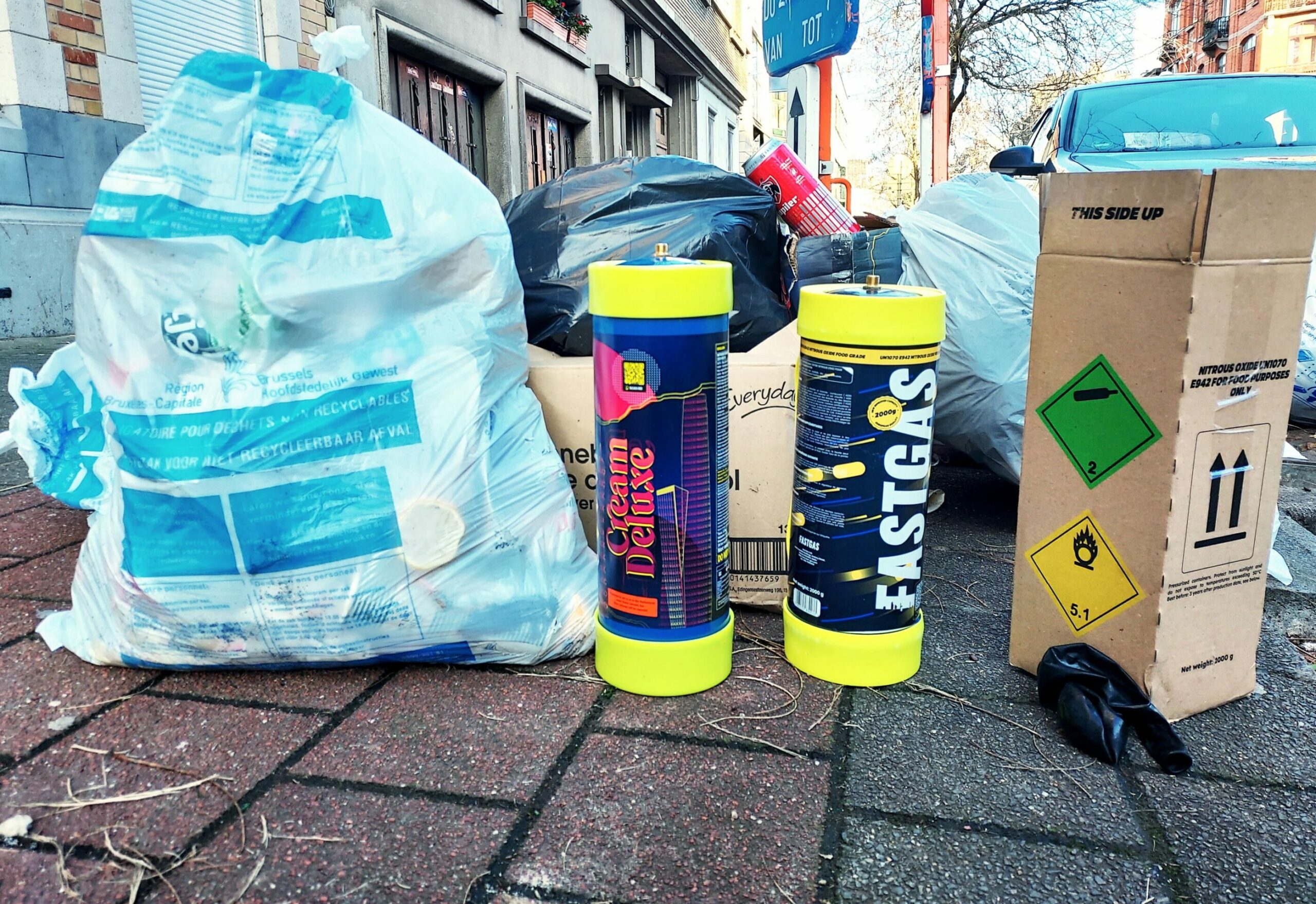
Illustration picture shows nitrous oxide at the illegal dump in a street in Brussels, Sunday 17 December 2023. Credit: Belga/Jens Thys
The broader dilemma remains unresolved. Belgium has criminalised recreational nitrous oxide use, yet the gas remains visible across cities, embedded in nightlife and increasingly tied to organised distribution networks.
Meanwhile, the canisters continue piling up.
While there have been awareness campaigns about alcohol and drink-driving, none have yet been proposed for nitrous oxide, which many young people still see as harmless.
That disconnect may be the core of the problem. Nitrous oxide does not look dangerous. It arrives in colourful packaging, flavoured and branded like a novelty product. It produces laughter rather than aggression. The high lasts seconds rather than hours.
And yet, the consequences are becoming impossible to ignore: damaged nerves, psychiatric problems, dangerous driving, criminal distribution networks and millions of euros in destroyed infrastructure.
Near Brussels-North station, the refuse collectors continue gathering canisters from the pavement. By tomorrow morning, there will almost certainly be more.
