
Belgium is often seen as a highly secularised country. More than half of the population has no religious affiliation, and regular Catholic Sunday Mass attendance is very low. But this only tells part of the story.
Religious identity and religious practice do not always go hand in hand: religious funerals remain relatively common, while baptisms and church weddings have declined sharply. Migration has meanwhile made Belgium’s religious landscape more diverse.
At the same time, religion continues to have a strong institutional presence through recognised faiths, public funding and historically religious organisations.
To understand how these different realities coexist, it is useful to look briefly at Belgium’s religious history and the institutional framework that still shapes the place of religion today.
From Catholic influence to secularisation and state neutrality
From Belgium’s independence in 1830 until the mid-20th century, Catholicism strongly influenced areas such as politics, education, healthcare, trade unions and charity. From the 1960s onwards, however, church attendance and traditional religious practices declined sharply.
Historically religious institutions such as Catholic schools and the Christian health insurance fund remain important, but their continued existence does not necessarily reflect widespread religious belief.
Belgium’s relationship with religion is also shaped by a specific legal framework. Under article 21 of the Constitution, the State may not interfere in the appointment of religious ministers or in their relations with their religious hierarchy, while article 181 provides for State payment of the salaries and pensions of recognised religious ministers and representatives of organised secularism.
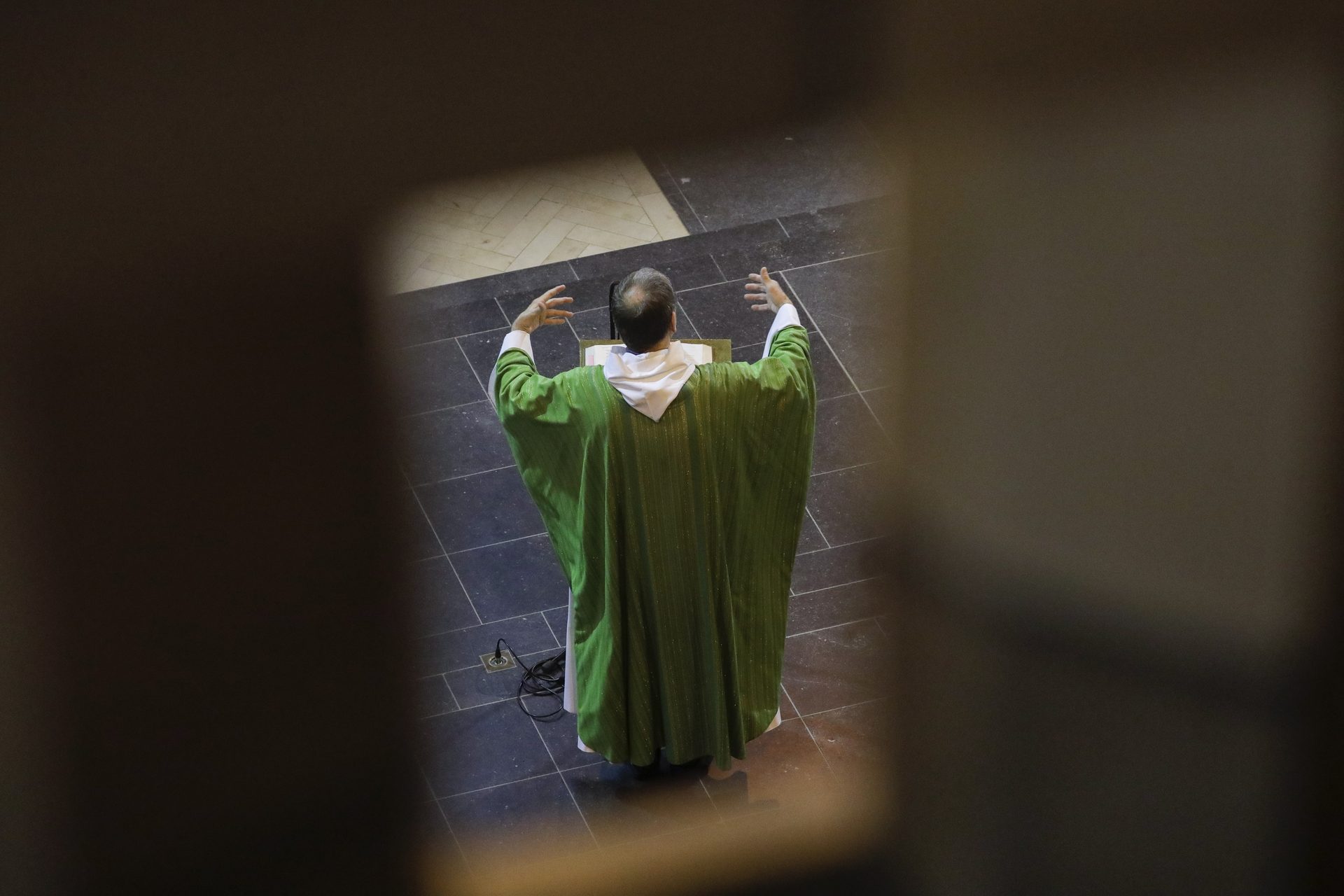
Credit: Belga/Thierry Roge
In 2024, the federal government paid about €129 million in salaries under this system, while regional, provincial and municipal authorities provide additional funding amounting collectively to tens of millions of euros each year, particularly for the maintenance and operating costs of places of worship.
The foundations of this system were laid when Catholicism overwhelmingly dominated Belgian society, but it was gradually extended to other recognised religions and, later, to organised secularism. The system therefore continues to operate in a much more secularised and religiously diverse society than the one in which it developed.
In the case of Catholicism, this creates a striking contrast: the Church still receives by far the largest share of public funding, even though regular religious practice has declined significantly.
Belgium currently recognises six religions – Roman Catholicism, Orthodox Christianity, Judaism, Anglicanism, Protestant-Evangelical Christianity and Islam – as well as organised secularism. Buddhism and Hinduism are not formally recognised, although their representative organisations receive public subsidies.
This institutional framework also reflects Belgium’s model of state neutrality, which differs from the stricter French conception of laïcité: the State remains neutral towards religion while still recognising and financially supporting certain religions and non-religious organisations.
Religious identity and practice in a changing society
Recent European Social Survey data put the share of Belgians with no religious affiliation at around 59%, compared with about 31% identifying as Catholic and 6% as Muslim.
Regular religious practice is low overall, but varies considerably across groups and depending on how it is measured. In 2024, the Catholic Church counted 173,335 people attending Mass on an ordinary Sunday in October – around 1.5% of Belgium’s population.
In a 2022 Flemish government survey, 6% of respondents classified as being of “Belgian origin” reported attending religious gatherings at least weekly, while the share ranged from about a quarter to a third among respondents of Turkish, Moroccan and Afghan origin and reached around half among those of Congolese origin.
Catholicism provides the most detailed long-term data on religious practice, reflecting both its historical importance and the availability of statistics.
The contrast with the past is striking: in Belgium’s first population census, carried out in 1846, around 99% of the population was recorded as Roman Catholic. Catholic data therefore offer a useful measure of secularisation, although they capture only part of Belgium’s current religious landscape.
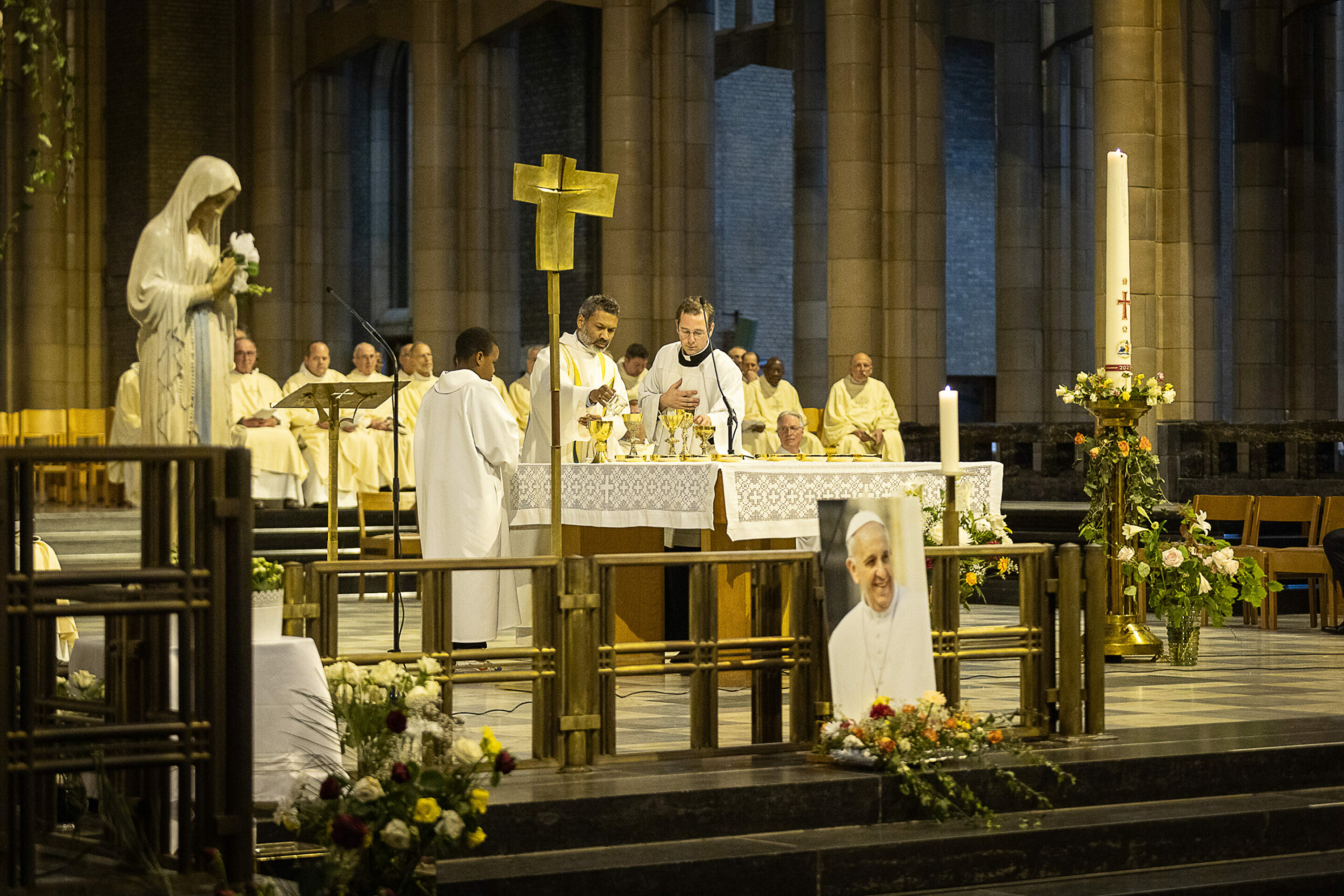
A mass in memory of Pope Francis at the Basilica of Koekelberg, in Brussels, Thursday 24 April 2025. Credit: Belga/James Arthur Gekiere
The changing place of Catholicism in Belgian society is also reflected in participation in traditional Catholic rituals. In 2024, Belgian parishes recorded 29,769 baptisms, more than 30,000 first communions and around 27,500 confirmations – figures that are substantially lower than in previous decades.
Catholic marriages have declined substantially. In 2007, just over one in four marriages in Belgium was also followed by a Catholic ceremony; by 2024, the Church recorded 4,896 marriages compared with 48,589 marriages registered nationally – equivalent to roughly one in ten.
Funerals show a different pattern: the Catholic Church recorded 35,515 Catholic funerals in 2024, equivalent to 31.7% of all deaths, showing that Catholic rituals remain relatively common around death despite low levels of regular religious practice.
Schools provide another, imperfect indicator of religious affiliation: Catholic school attendance does not necessarily reflect a family’s beliefs, while choices in public education – Community, provincial or municipal – can be more revealing. In Flemish public secondary schools in 2025–26, around 43% of pupils chose ethics, 26% Islam and 20% Catholicism.
In French-speaking public schools in 2024–25, a CRISP analysis based on data supplied by the Fédération Wallonie-Bruxelles administration found that around 32% of secondary pupils chose ethics, 26% Islam and 15% Catholicism. These overall figures include Brussels, where the pattern was different: 53% chose Islam, compared with 17% ethics and 10% Catholicism.
Belgium is therefore highly secularised, but religion has not disappeared.
Catholic practice has declined sharply, while the country’s religious landscape has become more diverse and patterns of affiliation and practice vary considerably between groups. How religious Belgium is ultimately depends on what – and whom – you choose to measure.
