

Despite the fact that Belgium’s property market is cooling, with 2.2% fewer homes being sold compared to a year ago, property prices continue to rise.
While flat sales remained virtually stable (-0.4%), the decline for houses was 2.8%, according to the latest Property Barometer published by the Federation of Notaries (Fednot).
“The main reason for the fall in sales is rising interest rates,” said notary Bart van Opstal, Fednot spokesperson. “Borrowing has become more expensive in recent months, causing our property market to cool off slightly. Interest rates will remain the decisive factor in the coming months too.”
“In Brussels, the number of sales remained virtually stable (-0.1%),” said van Opstal. “In Flanders, the fall in the number of sales was 1.1%. In Wallonia, the decline was -5.1%.”
Biggest rise in Brussels
In the first nine months of 2026, a house in Belgium cost an average of €360,613 – a 3% price increase compared with the annual average for 2025.
The biggest increase (+4.8%) was seen in the Brussels-Capital Region, where the average price stood at €609,227.
In Flanders, the average price rose by 3.5% to €398,182. In Wallonia, the average price rose by 0.6% to €270,239.
A flat, meanwhile, cost an average of €287,616 in Belgium – a 2% price increase. Here, too, the different regions show very different pictures.
While the average prices are very similar in Brussels (+1.7% to a €301,666 average) and Flanders (+1.8% to €300,349), the average price for a flat in Wallonia is much lower, at €216,239.
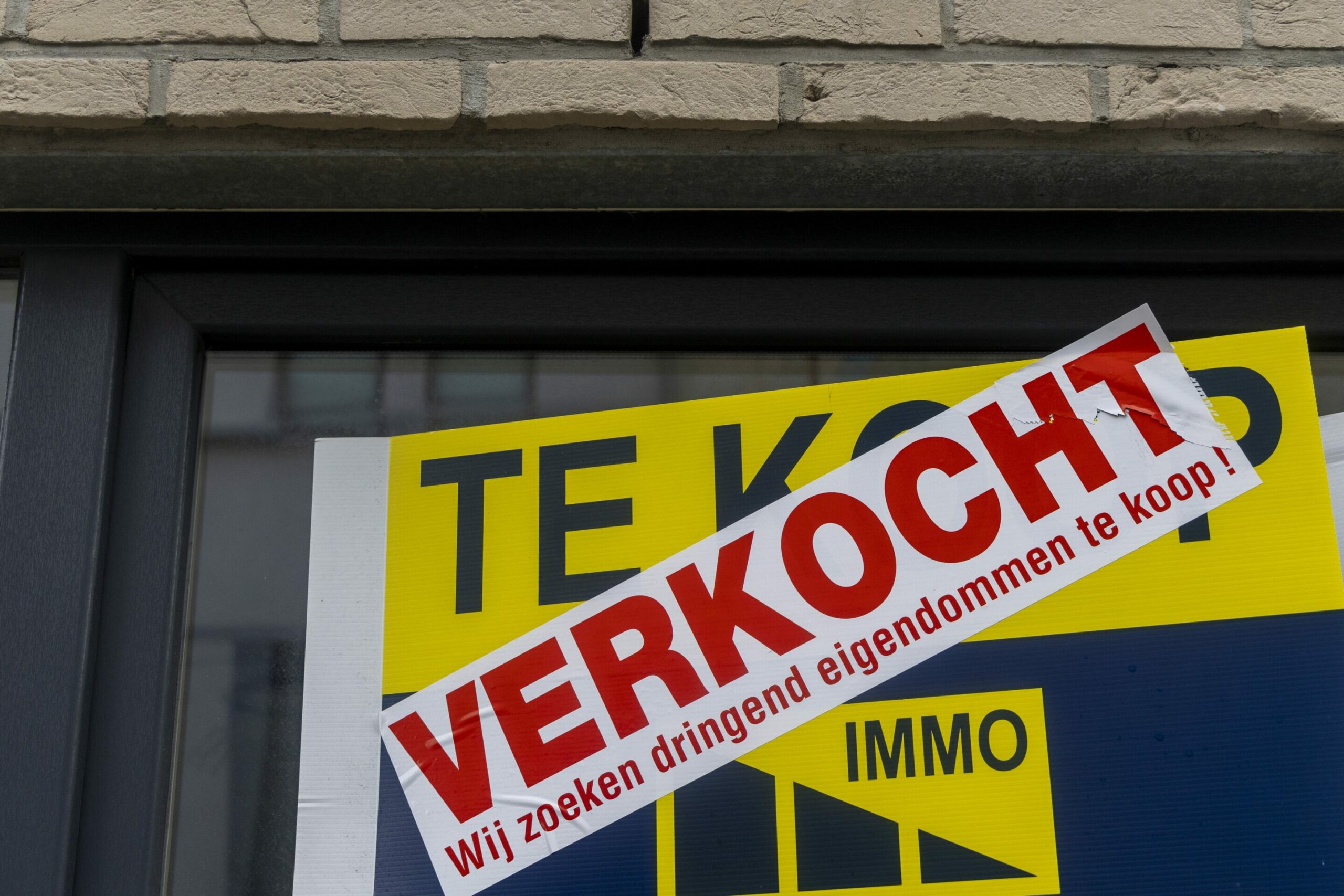
Illustrative image of houses for sale. Credit: Belga / Nicolas Maeterlinck
Anyone who bought a flat in Belgium in the first nine months of 2026 was, on average, 45 years old. For a house, the average age was 38.
Looking at who bought property in Belgium during the first nine months of this year, the barometer shows that buyers aged 26-30 formed the largest group for both flats and houses.
For flats, their share was 15%, followed by the 31-35 age group and those aged 65 and over, each with a share of 12%.
For houses, buyers aged 26-30 accounted for 21%, followed by buyers aged 31-35 with a share of 20%.
The figures published by Fednot via this Property Barometer are based on all property transactions concluded in Belgium. The data is collected electronically at the time the sale agreement is signed and is supplemented with information from the deed of sale.
For this Property Barometer, Fednot analysed all property transactions concluded up to and including the third quarter of 2026.
