
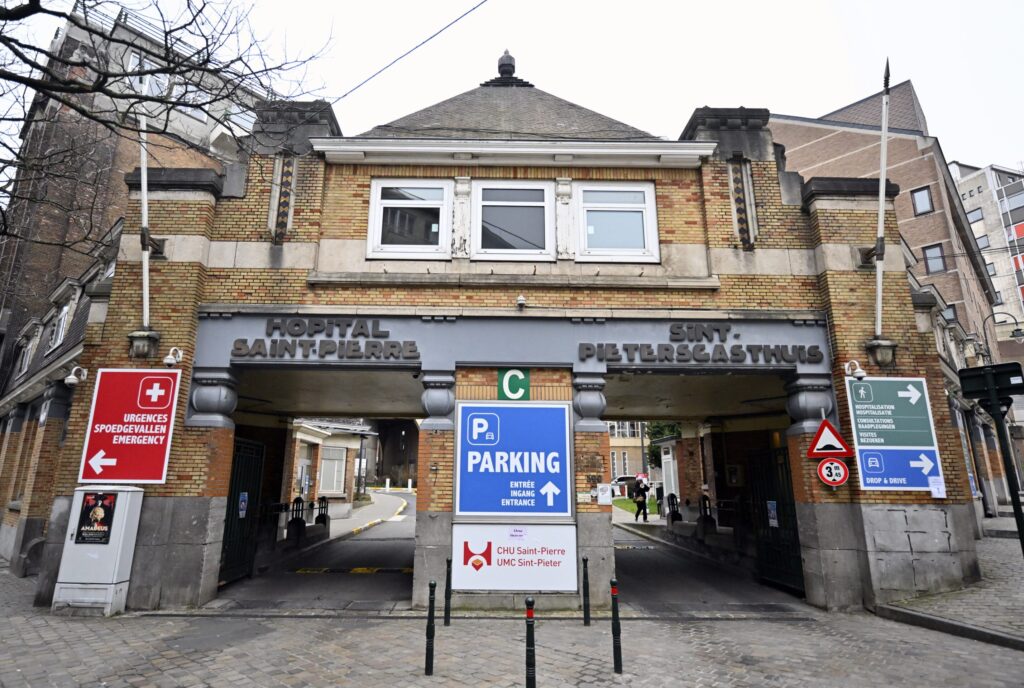
In Brussels, whether a Dutch-speaking patient can expect to receive care in Dutch depends on where – and how – they are treated.
That may seem surprising in a region where Dutch and French have equal official status. In practice, however, French remains Brussels’ main common language, while English is also widely used in international and multilingual circles. But official bilingualism does not create the same language rights in every healthcare setting.
An independent doctor working in a private practice can generally choose the language of consultation and is not required to work in both Dutch and French. Some services follow stricter rules: the Brussels on-call GP service (Garde Bruxelloise/Brusselse Wachtdienst), for example, must provide care in both languages.
The situation becomes more complex in hospitals.
The rules depend on the hospital
Public hospitals such as the Etterbeek-Ixelles site of Hôpitaux Iris Sud/Iris Ziekenhuizen Zuid must be able to provide care in both Dutch and French. This is an obligation on the institution, not a requirement that every individual doctor or nurse be bilingual.
Private hospitals are different. For ordinary planned care, hospitals such as Delta Hospital (part of the CHIREC group) are not subject to the same bilingual requirement. A Dutch-speaking patient making an ordinary appointment there therefore cannot automatically expect the consultation to take place in Dutch.
University hospitals can be more confusing. They are linked to Belgium’s Communities: UZ Brussel, affiliated with the Dutch-speaking Vrije Universiteit Brussel (VUB), falls under the Flemish Community, while Cliniques universitaires Saint-Luc, affiliated with French-speaking UCLouvain (UCL), falls under the French Community.
Like private hospitals, they are not generally required to provide care in both Dutch and French.
In practice, however, patients are not necessarily limited to a hospital’s main language. UZ Brussel, for example, says Dutch is its working language but that staff try to speak the patient’s language, with French also commonly used.
The labels themselves can also be misleading. CHU Saint-Pierre/UMC Sint-Pieter is a “university hospital” by name and function, but it is also part of Brussels’ public Iris hospital network, so it remains subject to the bilingual obligations applying to public hospitals.
Emergency care is different
In Brussels, the rules are stricter in an emergency. If you are treated in a hospital emergency department or by a mobile emergency medical team, you must be able to receive assistance in both Dutch and French.
Emergency care is treated differently because patients often have little or no control over which team or hospital treats them, unlike someone booking a planned consultation.
When the law and practice diverge
The Standing Commission for Language Supervision has repeatedly found complaints to be well-founded where Dutch-speaking patients could not obtain services in Dutch in Brussels hospitals, including in emergency departments.
One such case involved Clinique Saint-Jean’s Botanique emergency department, where a Dutch-speaking patient complained that neither the nursing staff nor the emergency doctor could assist him in Dutch. In its response to the Standing Commission, the hospital said it had a language coach to help staff, particularly healthcare workers, learn Dutch. The Commission nevertheless found the complaint well-founded.
The case also points to a broader practical problem: finding enough Dutch-speaking staff. This can make bilingual services harder to provide consistently, although it does not remove the legal obligations.
The question also extends beyond the Brussels regional border, because emergency teams based in the capital can be sent into neighbouring Flemish Brabant.
Among the many cases that have raised concerns about access to care in Dutch, one particularly sensitive case occurred in 2023. Eleven-month-old Cisse was found unresponsive while staying with his grandparents in Roosdaal, a Flemish Brabant municipality just west of Brussels.
A mobile emergency team from Erasme Hospital in Brussels was dispatched, and he was later taken to the Queen Fabiola Children’s University Hospital, where he died after resuscitation efforts were unsuccessful.
His family told VRT that the emergency medical team from Erasme Hospital could not communicate with his grandparents in Dutch. Staff from an ambulance dispatched from the Lennik fire station were also at the scene and, according to the local fire zone, provided simultaneous translation for the French-speaking members of the Erasme team. Later, at the hospital, communication with a doctor eventually switched to English.
The language barrier was not found to have caused his death, but the case highlighted the practical problems that can arise when Brussels emergency services operate in neighbouring Dutch-speaking areas.
Flemish Brabant has a 12-minute rule allowing patients to ask to be taken to the nearest Dutch-speaking hospital if this adds no more than 12 minutes to the journey. The request can still be refused if the patient’s condition is too urgent or if the longer journey would place too much pressure on ambulance services.
Brussels’ linguistic reality
BRIO’s latest Language Barometer found that 7.5% of Brussels residents grew up in an exclusively Dutch-speaking household and 4.3% with both Dutch and French. By comparison, 41.3% grew up in an exclusively French-speaking household, 18.0% with French and another language, and 28.8% in households where neither Dutch nor French was spoken.
The imbalance is also visible among younger residents. BRIO found that just 6.5% of 18- to 30-year-olds who attended French-speaking schools in the capital reported a good to excellent command of Dutch, compared with 82.9% of those who attended Dutch-speaking schools there who reported a good to excellent command of French.
The latter figure may partly reflect the fact that some pupils in Brussels’ Dutch-speaking schools are themselves French-speaking or grow up in a largely French-speaking environment.
Despite this complex picture, healthcare language rights in Brussels remain built around Dutch and French. What matters in practice is not simply that Brussels is bilingual, but when that bilingualism gives patients an enforceable right to be treated in one of the city’s official languages — and whether that right is actually respected.
