
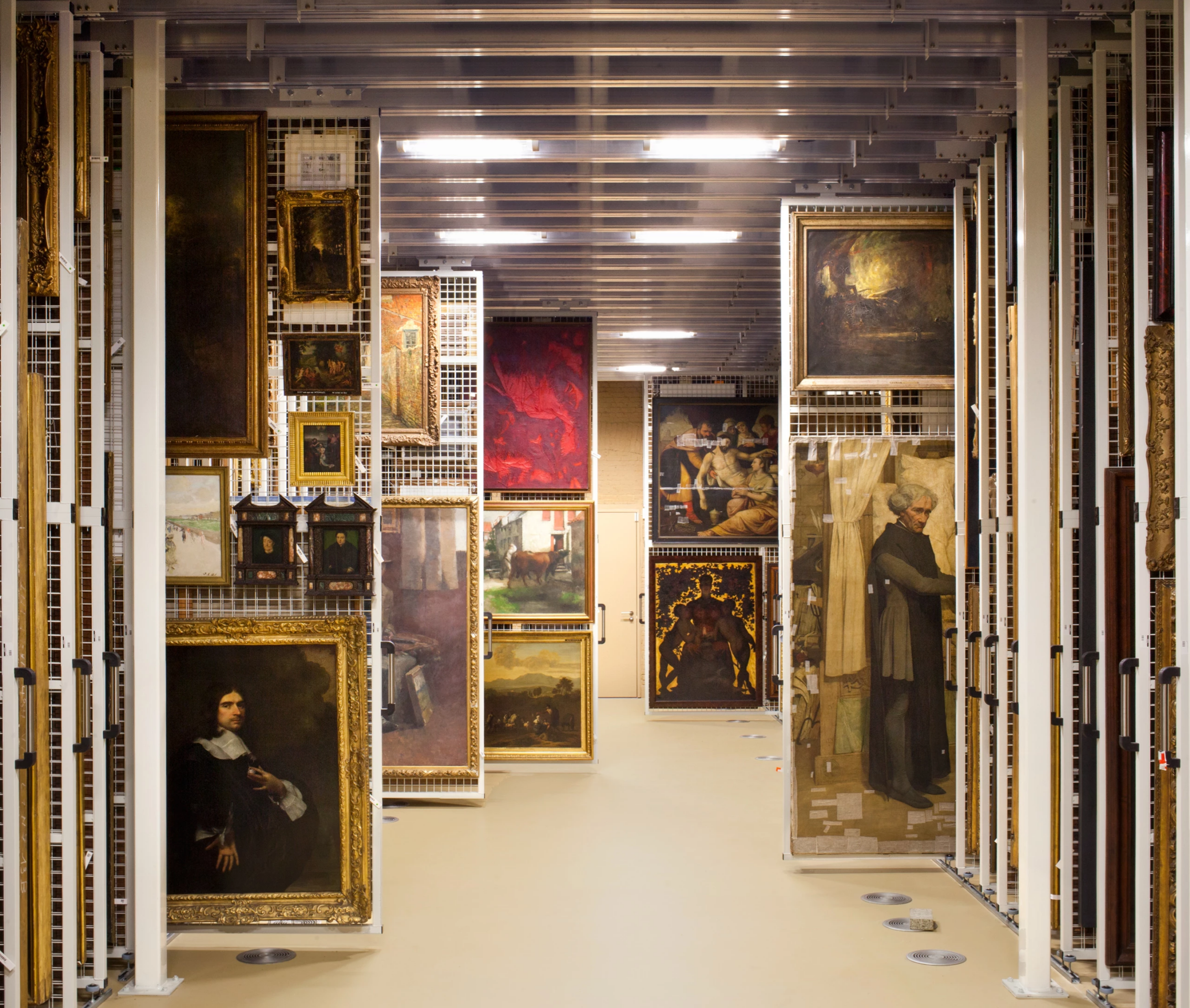
Works by Rembrandt, René Magritte and Auguste Rodin are among more than 2,700 artworks that Belgian authorities can no longer account for.
Some may have been stolen, others have ended up at flea markets, while retiring civil servants have reportedly taken paintings home as souvenirs.
Behind the disappearances lies a troubling pattern of neglect, poor record-keeping and astonishing carelessness.
Art detective Janpiet Callens, formerly of the federal police, remembers it well. At the flea market on Place du Jeu de Balle in Brussels, he once found a lithograph by the then Minister for Education, Auguste Vermeylen.
The stamps on the back revealed that the owner was the Flemish government. Stolen? Possibly, but not necessarily, he tells The Brussels Times.
“It happens that civil servants retiring take items they’ve had in their offices for years with them. As souvenirs. Later, they or their heirs get rid of them because they don’t realise their value. The lithograph, for example, was offered for sale far below its value.”
Works of art that disappear, are stolen, thrown away or sold at a flea market: such cases are no exceptions. The Flemish government has gradually lost some 2,300 works over several decades due to systemic administrative oversight, a fact that emerged years ago, and in recent years a further 160 works of art have been added to that figure, according to figures from Flemish Minister for Culture Caroline Gennez (Vooruit).
Figures obtained by The Brussels Times show that 158 works are also missing in the French-speaking community and at least another 101 in the Brussels Region. That brings the total up to more than 2,700.
The actual figure is likely to be even higher, as not every missing work is recorded. According to Lucas Verhaegen, former head of the federal police’s art team, the problem extends to major museums: “There are still hundreds of works that staff do not even realise have gone missing from their storerooms.”
There are tens of thousands of works of art in the collections of the Belgian authorities. They purchase them to build up a cultural heritage and to support artists. After purchase, they entrust the works to ministries, museums, embassies, municipal departments and schools, which use them to decorate their buildings. The Brussels Region has 75,000 such objects on its register, the Walloon Region around 60,000, whilst Flanders has 40,000 heritage items, including 18,000 works of art.
From Rodin to Rembrandt
The missing works are often by unknown, local artists, but there are also pieces by big names: Paul Delvaux, Auguste Rodin, Rogier van der Weyden, Gustave Van de Woesteyne, Rembrandt, Magritte and Panamarenko.
In addition, a 15th-century altarpiece, forty paintings by Flemish Primitives, a cross from Roman times, an altarpiece in carved oak and a collection of 125 ethnographic and archaeological objects from Central Africa have also gone missing. “From an art-historical perspective, the loss is almost impossible to quantify,” says Janpiet Callens.
How can valuable works simply vanish? A lack of proper management, it turns out. For example, there is barely any proper inventory of the Flemish Community’s collection. It was only in 2024 that Flanders began implementing a digital system in which every work is recorded.
This is done manually and takes a great deal of time. As a result, works can still go missing even today. In addition, an audit of part of the collection is carried out every year, but this is mainly to check the condition of the works. There is no record kept of what has gone missing.
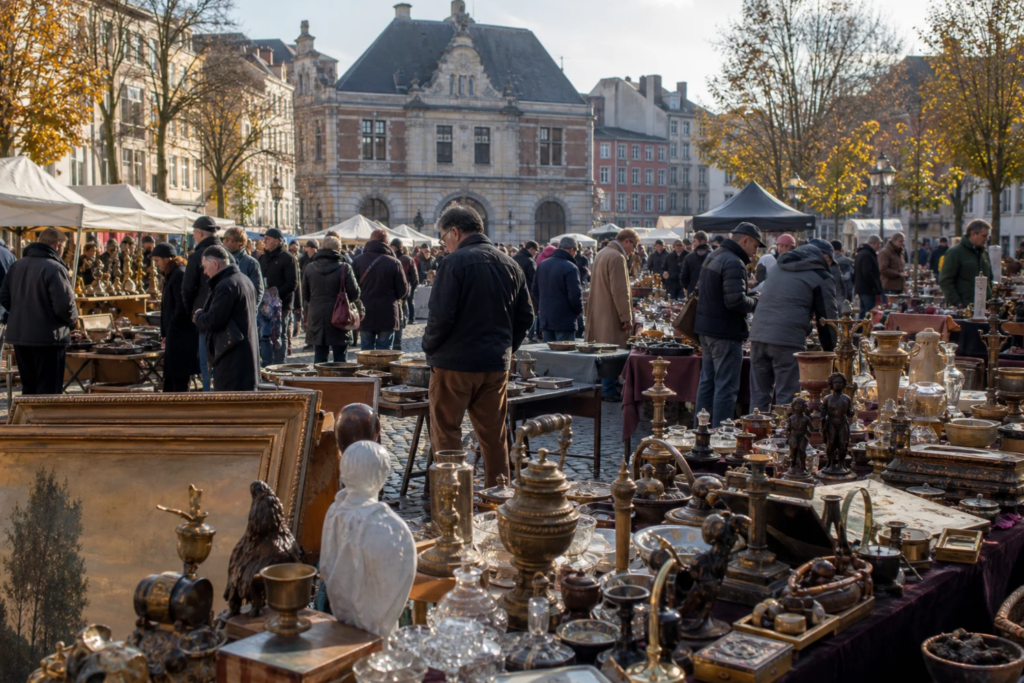
Lost art has even been found at Brussels’ famous Place du Jeu de Balle flea market, with the seller seemingly unaware of its true value. Credit: Belga.
“Moreover, the works are scattered across a wide variety of departments and buildings: in Flanders alone, in addition to art institutions and museums, there are a further 900 locations where they are housed,” says Rebecca Castermans from the office of Flemish Minister for Culture Caroline Gennez.
In the Brussels Region, too, the inventory process is not without its challenges. The authorities have been working since 2019 on an inventory of the collections held within the territory of Brussels. “The inventory is by no means complete at present. It provides an overview of around a hundred collections out of the several hundreds that exist in the Brussels Region,” says Pascal Ingelaere of Urban Brussels, who is responsible for movable property in the region.
“These include municipal collections, museum collections (public or private museums), or collections held by regional and federal government bodies, religious institutions and so on,” Ingalaere said. This lack of overview also came to light when The Brussels Times asked the federal police for a list of the missing works that the authorities had reported with them. “We don’t have the figures,” was their response.
Art used as a drinks cabinet
Several anonymous accounts shared with The Brussels Times illustrate the casual attitude and lack of interest with which the art is managed. David, a Flemish civil servant, recounts that his line manager used an art installation as a drinks cabinet. “I don’t think he even realised it was a work of art. After he left, we saw from the stickers on the back that it was a work of art belonging to the Flemish government.”
A member of staff at Ghent University recounts that a professor who was retiring simply took a painting from his office with him. He thought it was the most natural thing in the world. “It had been hanging there for years; he regarded it as his property. I’ve also seen works stashed away behind a photocopier, in a dark cellar or next to the boiler, because nobody liked them. They stayed there until everyone had forgotten about them.”
Janpiet Callens does not believe it is always harmless. “I can’t believe that when it comes to well-known works or artists, it doesn’t ring a bell. I suspect that there is indeed malicious intent at play, although that is difficult to prove.”
Belgium’s complex state structure: a piece of art in itself
In addition to indifference, the country’s complex political structure plays a role too in the mystery of the missing artworks. The Belgian state began acquiring its first artworks in 1860, but the country was later federalised. From 1980 onwards, responsibility for culture was transferred to the Flemish, Walloon and German-speaking communities.
This transfer made it even more difficult to trace some of the works. The effects of this are still being felt today. “All movable heritage is the responsibility of the communities,” says Lucas Verhaegen. “Immovable heritage on the other hand falls under the remit of the regions. This leads to situations where someone from the Walloon Region is in dispute with someone from the Walloon Community over six wooden sculptures from an altarpiece. In Brussels Region however, there is no Brussels Community. There, too, there is debate about who is responsible for which works of art.”
Many of the works of art may well have disappeared from the radar for good, Verhaegen believes. Tracing them is not a priority for the police or the public prosecutor’s offices. “For each work of art, you can expect two or three years’ worth of investigative work by two people. We don’t have those resources. Moreover, the chance of being able to prosecute anyone is very slim: the statute of limitations for such an offence expires after just five years.”
While some works are assumed to never to be recovered, various Flemish government bodies have started paying out compensation in a bid to reduce this number. Ghent University paid the Department of Culture just over 5,000 euros for seventeen works. And the city of Mechelen coughed up 13,634 euros for missing works by William Sweetlove, Jean Rets, Guy Vandenbranden and Godelieve De Pelsmaeker.
The KTA in Sint-Truiden paid nearly 900 euros for a Roger Raveel and a Lieven Bellefroid, and 1,500 euros for a work by Narcisse Tordoir. Tourism Flanders had to pay just over 1,200 euros for two missing works by Raoul De Keyser and one by Maurice Frydman.
Dozens of pieces return every year
Nevertheless, works do still return every year. Usually because they are offered for sale somewhere or turn up on the internet. “Sometimes 30 or 40 pieces come back in a year; in other years, only two. It varies greatly,” says Verhaegen.
He believes that the art heritage is managed much better today. “We have urged the communities to draw up an inventory of the artworks that have gone missing. The Flemish Community is currently working on this in earnest, while progress is slower in the French-speaking Community. The problem is that there is often barely any description, let alone photographs. But there is an awareness that things need to improve. There are highly competent civil servants working hard on this.”
This is also what Flemish Minister for Culture Caroline Gennez reiterates. “The Flemish Community Collection has taken a number of steps in recent years to further improve the monitoring of works on loan and thus minimise the risk of loss. Among other things, we have invested in more staff, a high-performance image management system and a new storage facility in Vilvoorde.”
At the same time however, the question arises as to what the future will bring, now that the Flemish Government is making drastic cuts to subsidies for culture and heritage. Those involved consider this a disastrous decision. In the past, a shortage of staff and resources has already proved to be a major problem. Today, there is a risk that history will repeat itself. For Janpiet Callens, it is a painful illustration of something he has been criticising for some time: “Art is not taken seriously. For many, it is nothing more than a backdrop.
