
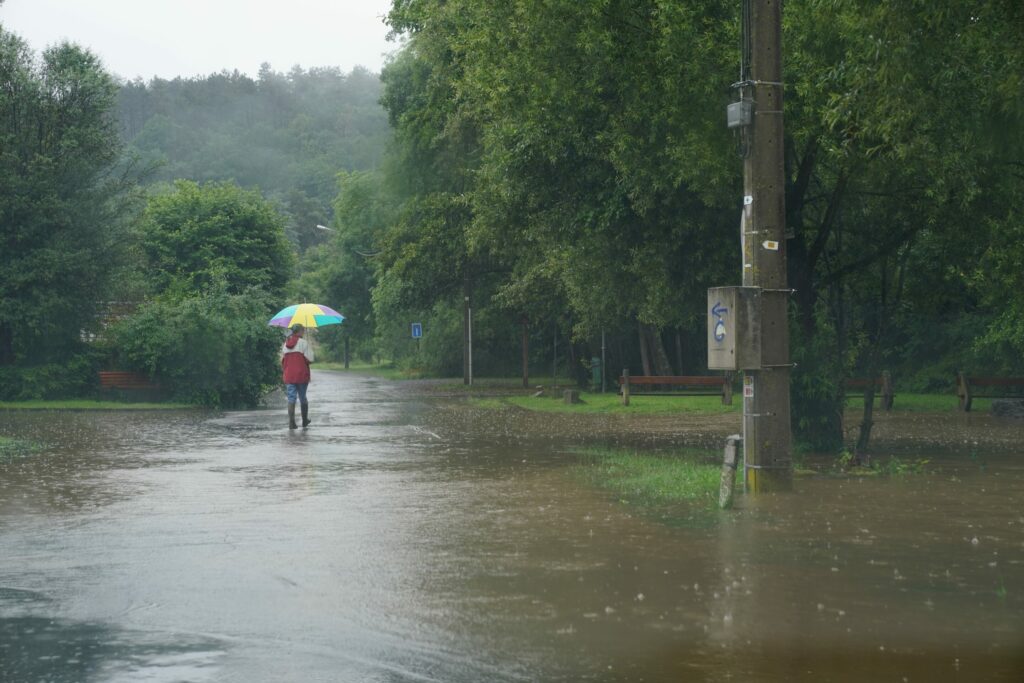
Almost one in three Brussels residents could face basement flooding during heavy rainfall, according to Brussels Environment, which has launched an updated interactive map allowing residents to check the flood risk at their address.
The new tool provides detailed information on flood-prone areas across the Brussels-Capital Region, alongside practical advice on protecting homes against heavy rain and storms.
The updated map, which complies with the latest European requirements, allows residents to zoom in on individual properties and identify potential flood risks.
It also directs users towards practical solutions to prevent water from entering their homes.
According to Brussels Environment, protecting a property does not necessarily require expensive structural work.
Simple measures, such as placing sandbags in front of basement windows during weather warnings, installing flood barriers or adding a raised threshold at the top of a garage ramp, can help reduce the risk of flooding.
Related News
Which areas of Brussels are most at risk?
Lower-lying areas of Brussels are particularly vulnerable to flooding, including the Senne, Molenbeek, Maalbeek and Woluwe valleys.
However, other neighbourhoods where rainwater accumulates during heavy downpours are also exposed.
One of the main threats comes from sewage systems overflowing and pushing wastewater back into basements.
Brussels Environment estimates that almost one in three residents could be affected by this phenomenon during heavy rain or thunderstorms.
In the event of an exceptionally severe rainfall event, statistically expected once every 1,000 years, one in five Brussels residents could be exposed to flooding.
For rainfall events with a probability of occurring once every 100 years, the risk affects approximately one in 12 residents.
Residents can check the risk at their address using the interactive flood map published by Brussels Environment.
Brussels steps up flood prevention measures
Brussels State Secretary for the Environment, Climate and Urban Renewal Ans Persoons (Vooruit) stressed the importance of preventive measures to make the capital more resilient to extreme weather.
“There are already several measures making a difference. In new construction projects, rainwater must be disconnected from the sewage network. We are also removing paved surfaces wherever possible so that water can soak into the ground,” she said.
Water utility Vivaqua is also constructing a new stormwater retention basin in Watermael-Boitsfort.
The measures form part of Brussels Environment’s wider strategy to improve rainwater management and reduce pressure on the city’s drainage systems.
Vivaqua currently operates 33 stormwater retention basins across Brussels and is expected to take over the management of five additional facilities from Hydria, the former Brussels water management company, on 1 January.
“After the heatwaves this summer, we are preparing for an autumn of heavy rain and stormy weather,” Persoons said.
“We want to protect Brussels and its residents as effectively as possible against the consequences of climate change.”
She added that the new tool offers simple, affordable measures that residents can implement quickly.
“We must do everything we can to prevent rainwater from entering the sewage system.”
