
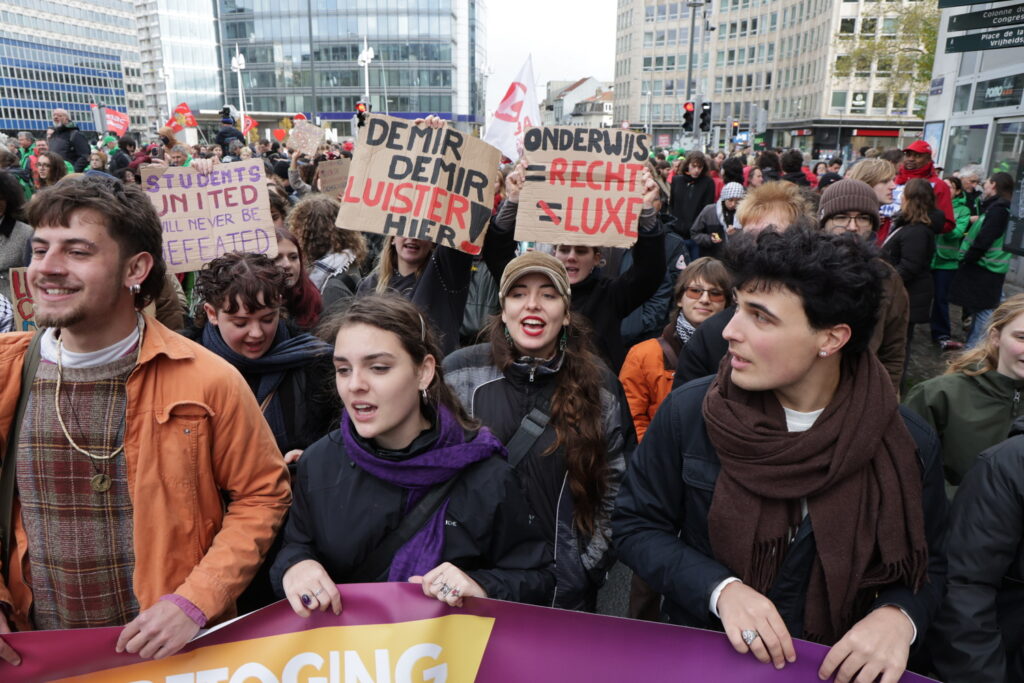
Thousands of students marched through Brussels on Tuesday, joined by trade union members, to protest against austerity measures and worsening study conditions.
The demonstration, organised by the Federation of French-speaking Students (Fef) on International Students’ Day, drew 3,200 people according to police. Organisers said 15,000 took part.
Despite rain and strong winds, pupils, students and teachers began gathering outside Central Station from 11 a.m. They were joined by Flemish students from the Vlaamse Vereniging van Studenten and young people from France.
Strong support from the unions
The march then headed towards the Finance Tower before following the Inner Ring Road to Place Surlet de Chokier, where the Government of the Wallonia-Brussels Federation is based.
Large numbers of workers also joined the protest, including metalworkers and railway staff. The socialist FGTB and Christian CSC trade unions had announced in advance that they would support the students, alongside the Walloon Anti-Poverty Network and members of the Mars Attacks collective.
CSC Secretary-General Marie-Hélène Ska said the union had responded to the Fef’s request for support, partly because organisers feared unrest. She said young people were questioning what kind of future was being prepared for them.
Isis Pohl, a youth organiser with FGTB Brussels, said the unions wanted to show their opposition to austerity measures affecting both students and workers. She described the day as unusual because unions had taken to the streets alongside students and had filed strike notices at the federal level.
Turnout size matters
The march, accompanied by chanting and drums, passed through the capital’s main boulevards without major incident before reaching Place Surlet de Chokier. A few projectiles were thrown at the facade of the Wallonia-Brussels Federation government building, causing no significant damage, while other protesters placed placards at the foot of the barriers surrounding it.
At the end of the march, Fef president Lénaïk Dumont said the size of the turnout mattered because governments had long tried to present workers’ and students’ struggles as separate. She said the demonstration showed that solidarity was stronger than division.
After the student march ended at about 1.30pm, part of the crowd moved towards Arts-Loi and blocked the inner ring road. Some protesters also tried to reach Rue du Commerce, where the headquarters of Les Engagés is located.
Police charged the young demonstrators near Botanique at about 2.30 p.m. Officers used a water cannon and tear gas and made several arrests. The inner ring road was fully reopened to traffic by 3 p.m.
Sharp deterioration in study conditions
The education sector has been criticising for months reforms introduced by Francophone Education Minister Valérie Glatigny, and the Higher Education Minister Élisabeth Degryse.
The Fef says study conditions have sharply deteriorated, pointing in particular to ageing buildings, rising tuition fees and increasing costs for housing, transport and food. It is also calling for equal treatment for all students, including those from outside the EU.
In her closing speech, Dumont said students were constantly being told that education was the key to their future, but wondered what future was being offered if they first had to fight for the means to enter educational institutions.
Other demands were also raised during the protest, especially opposition to austerity measures. Many anti-militarist placards were also carried throughout the march.
Student organisers said the protest movement would continue in the coming weeks. Dumont said they would not give up and had already won battles in the past.
She added that students would also attend Monday’s national demonstration in Brussels.
