
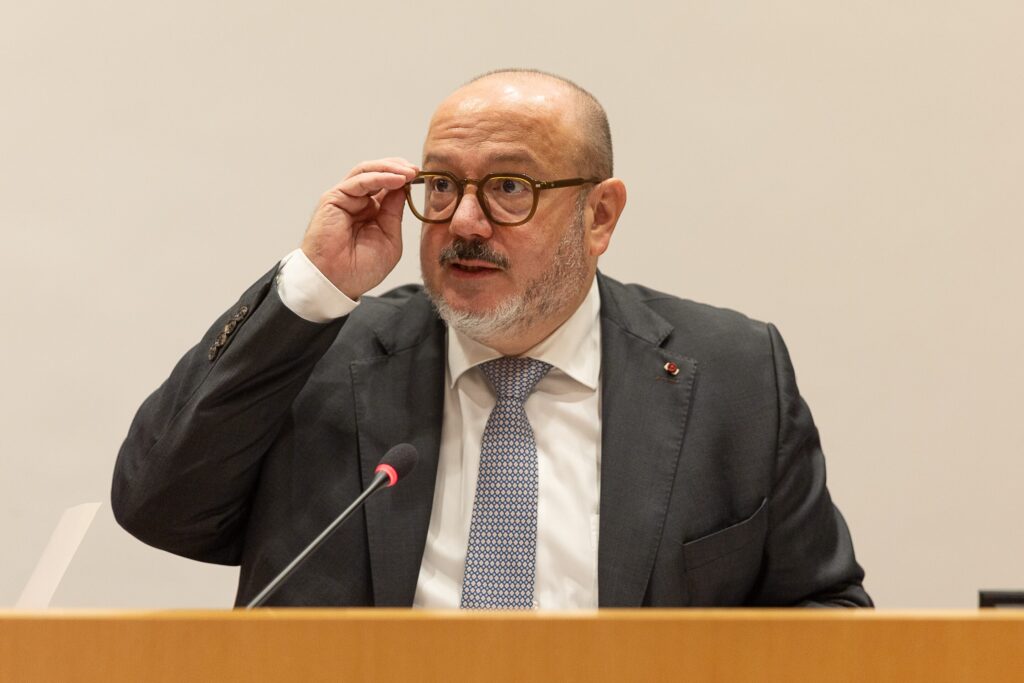
Belgium’s Interior Minister Bernard Quintin (MR) wants to create a fully fledged federal intervention reserve of 1,200 officers, bringing together existing police units and a new militarily trained component being prepared with Defence Minister Theo Francken (N-VA).
Quintin said the new force would be tasked primarily with maintaining public order and would be organised around five command posts across the country.
Francken said on Thursday that he and Quintin were “in agreement in principle” on the creation of what has been described as a “Gendarmerie 2.0." Quintin clarified on Friday how the proposed unit would work, while stressing that it would not mean a return to the former gendarmerie, which was abolished 25 years ago during a police reform following the mistakes made in the investigation into the Dutroux case.
According to Quintin, the new federal intervention unit being discussed with Francken would initially consist of 400 personnel, funded through the defence budget. They would be police officers with police training as well as reservist training.
The unit is part of a broader overhaul of Belgium’s security architecture, including reform of the federal police. As part of that effort, Quintin wants to rebuild what he called a fully fledged federal intervention reserve.
To achieve that, he plans to merge the roughly 400 members of the current Public Safety Directorate and the 400 members of the Intervention Corps. Together with the 400 militarily trained officers, this would create a joint intervention force of 1,200 members.
Related News
- What was the Belgian Gendarmerie, and why is bringing it back so controversial?
- The Dutroux case, 30 years on: How the White March confronted police failures
- The infamous Dutroux case, 30 years on: How 'Le Monstre' dragged Belgium into darkness
“Our ambition is to rebuild a genuine, specialised federal public order force,” Quintin said. “A 1,200-strong intervention force that we can deploy day and night, at any time and on a large scale, in the event of serious public order disturbances. Riots on the sidelines of demonstrations have shown how necessary that is.”
With 1,200 personnel, the force would account for almost 10% of the federal police’s operational workforce. Maintaining public order would always take precedence over other support tasks.
The territorial structure would also be overhauled. At present, the Public Safety Directorate and the Intervention Corps are spread across more than 15 locations nationwide. Under the new model, they would be reorganised into five command posts aligned with the jurisdictions of the courts of appeal: Brussels, Antwerp, Ghent, Liège and Mons.
Quintin said the current fragmentation slows down the process of bringing together units from different parts of the country, making rapid large-scale deployment more difficult.
“With this new organisation, we will be able to deploy people on the ground more quickly and in far greater numbers,” Quintin said. “That will allow us to act firmly and effectively against those who want to destabilise our society.”
The project is now being developed as part of the ongoing reform of the federal police, with Quintin saying he wants to deliver concrete results in the short term.
