
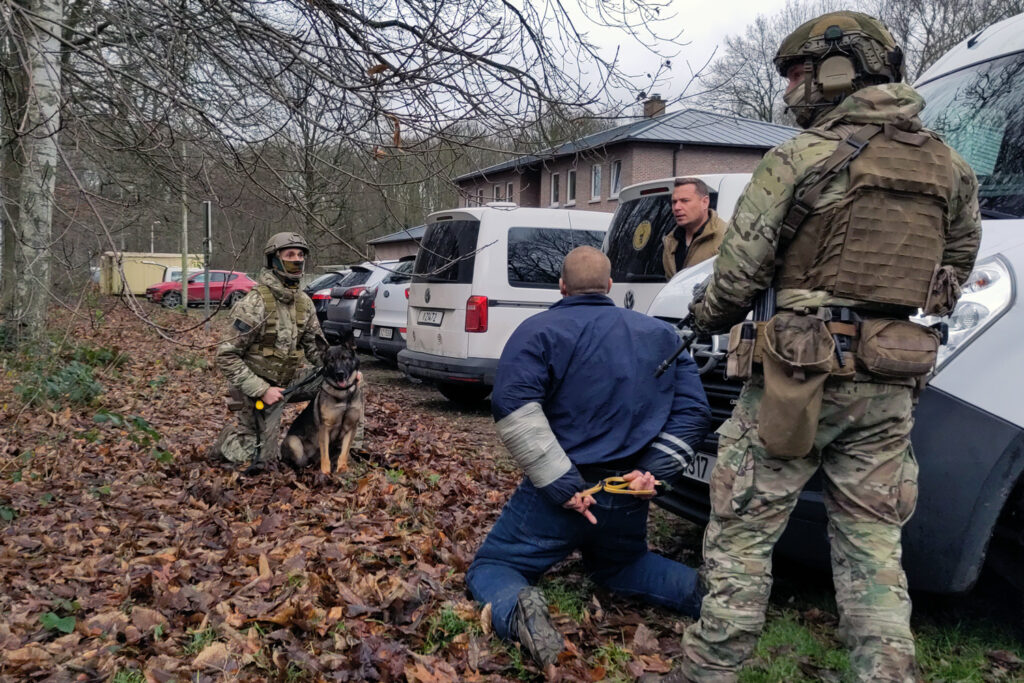
Dog teams from about a dozen countries are taking part in a joint explosive-detection exercise organised by Belgium's Defence Ministry at Hemiksem Abbey, Antwerp Province.
The BELEDD 2026 exercise is an opportunity for the teams to compare methods and prepare for future joint operations under a NATO pilot project.
It is the first time Belgium has hosted an exercise of this kind.
The operation, which runs until the end of the week, is being led by the Belgian armed forces’ 11th Engineer Battalion and the Interforce Dog Unit.
Teams taking part have come from neighbouring countries, including the Netherlands and France, as well as Spain, Lithuania, the Czech Republic, Slovakia, Italy, Norway, Morocco and Jordan.
Their main role is the detection of explosives, including sweep operations at football stadiums, concert venues and freight areas at airports and ports.
“It is an impressive international coalition. In the current security context, cooperation between allies is vitally important,” said Captain Matthias of the Interforce Dog Unit, whose full name was not disclosed for security reasons.
The Interforce Dog Unit, which comes under the Air Force, is responsible for recruiting, training and certifying all canine capabilities across the Belgian armed forces.
Alongside its explosives detection division, the unit has around 230 dogs in total. These are assigned to a patrol section responsible for securing military bases, a tracking section, and a section attached to the special forces.
Although the deployment areas of the special forces dog section are not public, Belgium is known to provide canine training to Ukrainian forces in Germany.
Captain Matthias said the exercise is designed to develop tactical scenarios involving the dogs while gradually increasing the level of difficulty.
After each scenario, instructors will review the teams’ actions in an evaluation meeting. The findings are expected to help form the basis of a future common NATO manual.
However, according to the Belgian Defence Ministry, the current lack of such a guide does not create any major operational problem.
