
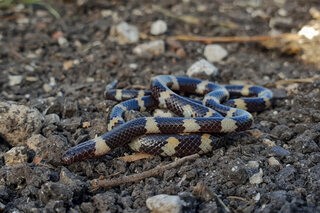
A new family of snakes has been discovered by an international team of researchers led by the University of Helsinki, the AfricaMuseum announced in a press release on Wednesday.
The researchers’ work revealed the existence, within the Elapidea, of a completely new family of snakes, the Micrelapidae. This new family includes four species of snakes, all of which live in East and Northeast Africa and the Near East.
“The discovery of a new family is an extremely rare event in vertebrates,” said Jonathan Brecko, a researcher at the AfricaMuseum and the Royal Belgian Institute of Natural Sciences, who was involved in the research.
The study was based, among other things, on specimens from the two Belgian museums. By analysing data from more than 4,600 genes, the scientists were able to solve the phylogeny of the Elapidea. Phylogeny aims to reconstruct the relationships between species.
The number of genes examined is particularly large: “Such a large dataset makes it possible to establish the relationships with great precision,” explained Jonathan Brecko. “By comparison, most datasets used in molecular phylogeny only take into account about ten genes or so.”
In addition to the genetic data, the scientists performed nanoCT and microCT scans. “After scanning the skull of a specimen, its constituent bones can be virtually isolated and studied one by one. This allows morphological characteristics to be compared between specimens more accurately,” Brecko explained
The Elapidea superfamily includes several families of snakes, in which more than 700 species are classified worldwide. Cobras and mambas are famous representatives.
The AfricaMuseum keeps nearly 17,000 snakes. The Royal Belgian Institute of Natural Sciences houses about 20,000.
