
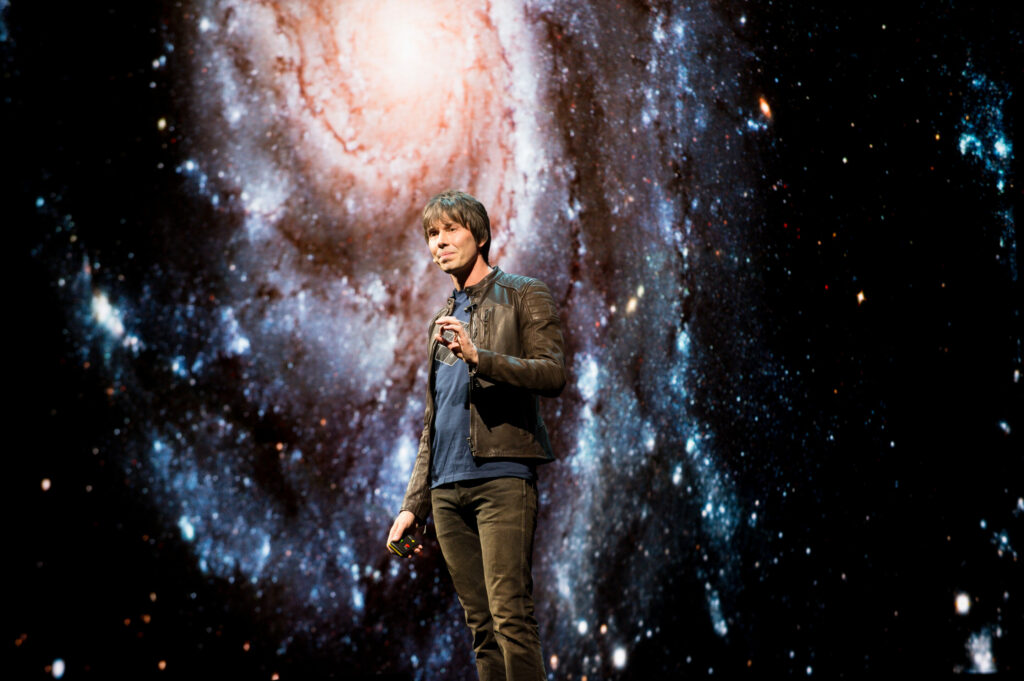
Professor Brian Cox, widely recognised as the foremost communicator for science, cosmology and astronomy in the world, is coming to Brussels on 1 April with his tour 'Emergence'. Ahead of his show, he speaks to The Brussels Times about the shift in his career from music to particle physics, the inspiration for the new tour and why we still need to ask life's big questions.
After performing his sell-out, record-breaking show 'Horizons' to nearly half a million people across the world, Professor Brian Cox is back with a new world tour, 'Emergence', with shows across the United Kingdom, the United States, Europe, Australia and Asia-Pacific.
He never imagined he'd be touring the world talking about the origins of the universe, though. In fact, the professor first ventured, somewhat accidentally, into music.
He was about 12 years old when he developed a love of music, particularly electronic music in the 1980s. He would tape it off the radio, and enjoyed listening to bands such as Kraftwerk, Ultravox, and OMD. "Then I got interested in the hardware; I was pretty geeky, so I quite like synthesisers," he smiles.
Soon enough, he fulfilled the teenage dream of joining a band with a friend who lived up the road. When Thin Lizzy's Darren Wharton moved to the same neighbourhood, they gave him a demo tape. By age 18, Brian had been invited to come and audition for the band.
"I didn't think I was going to actually do it. And then I got this offer to join a real band. So, I just took a year off and didn't go to university. Then we got a record deal, so I ended up doing that for five years," he laughs. "I didn't think it was possible; I was just lucky, really."
Reaching for the stars
But all good things come to an end. After touring the world with rock bands Dare and D:Ream, famously playing the keyboard on the latter's hit track 'Things Can Only Get Better', and recording two albums in Los Angeles, the group split up and Brian decided it was time to return to his roots.
Professor Brian Cox performs his live tour 'Universal: Adventures in Space and Time' World Tour 2019 to a sell out crowd at The SSE Arena, Wembley on 24 February 2019 in London, England. Credit: Nicky J. Sims/Getty Images McIntyre Ents
He applied to the University of Manchester in the UK to study physics with astrophysics. When he was 18, he'd initially been told to focus on engineering. "But by the time I got to about 23," he says, "I thought I just should do what I want. And I wanted to do astronomy."
Having developed a love of astronomy from a young age, he has now built his career on inspiring others and making science accessible for younger generations.
"Pretty much everybody, at any age, is interested in some of the questions that we ask, particularly in cosmology, but also in particle physics, because we're asking questions about the origin of the universe, asking questions about life beyond Earth in the universe," he says.
"The thing that interested me was that I managed to connect these questions to science. And you can get a job in that."
In the 80s, there weren't as many jobs, particularly in building spacecraft, but it's now one of the fastest-growing areas of the economy.
Through his shows, Brian aims to help people make this connection between questions everybody's interested in and the disciplines that are pursuing the answers to those questions.
"There's an element of asking these enormous questions in the publicity for the show, about the origin and evolution of the universe. But it is to show that those things are being investigated systematically, and we're learning more about them. We're uncovering things that are profoundly useful."
This forms the basis of his new tour, 'Emergence' – his "most ambitious tour" yet. Inspired by German astronomer Johannes Kepler's book 'The six-cornered snowflake', the tour is a celebration of the dazzling complexity of the universe and an exploration of the laws of nature that sculpted it.
Professor Brian Cox performs his live tour 'Universal: Adventures in Space and Time' World Tour 2019 to a sell out crowd at The SSE Arena, Wembley on 24 February 2019 in London, England. Credit: Nicky J. Sims/Getty Images McIntyre Ents
The show begins with a scene described in the book: Johannes Kepler was crossing Prague's Charles Bridge in the winter of 1609, when he noticed a snowflake land on his arm, and questioned why it had six sides.
"It's asking these little questions that led us to the modern world," Brian says.
The technologically ambitious tour reconstructs the Charles Bridge and uses the largest and most advanced LED screens available and the best possible light and sound equipment, with live images from the International Space Station.
"I hope the show is an all-encompassing experience, and I hope it leaves everyone, whether they love science or music or history, or simply contemplating the beauty of Nature, with something new to think about," he says.
"It's as far from a kind of a lecture with a projector as you can get."
As well as "looking very beautiful", Brian says he touches more on quantum mechanics than ever before.
"I don't usually talk about that, because it's difficult to visualise. But if you're going to answer the question, why is it that snowflakes have six corners, you have to talk about quantum mechanics, because that's the answer – and that's why Kepler couldn't answer it."
He weaves Kepler's theories together with the Voyager spacecraft to mark the 50th anniversary of its launch. "They're a beautiful example of exploration. The ultimate explorers, in some sense."
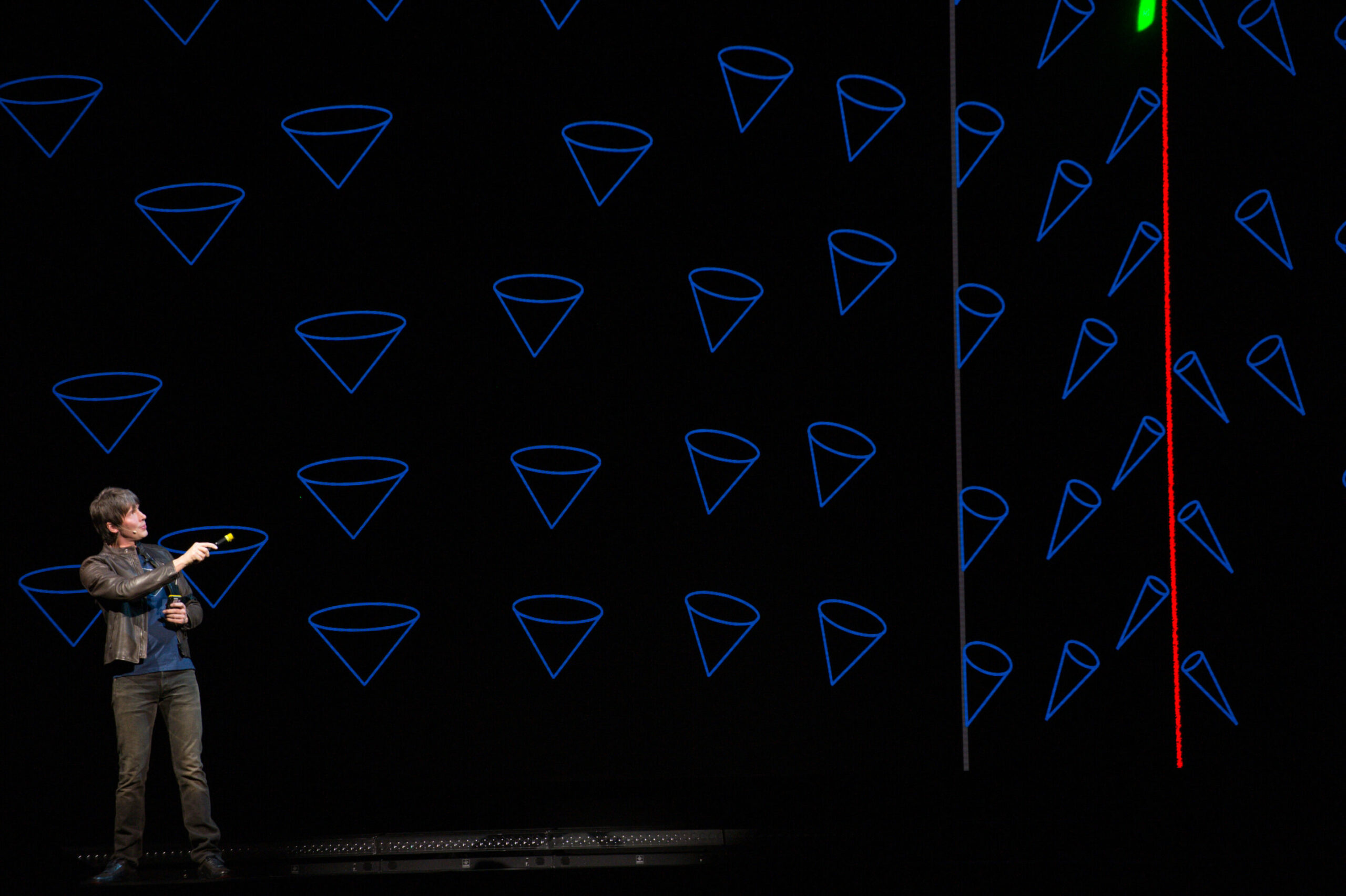
Professor Brian Cox performs his live tour 'Universal: Adventures in Space and Time' World Tour 2019 to a sell out crowd at The SSE Arena, Wembley on 24 February 2019 in London, England. Credit: Nicky J. Sims/Getty Images McIntyre Ents
His show in Brussels on 1 April sold out months ago, but he is hoping to return to the Belgian capital to do more shows.
"The first time I was in Brussels was when we supported the band called Europe on 5 April 1989 at Forest National. It was a tour called 'Out Of This World'," he says, adding that he has returned several times to Brussels and Leuven to collaborate with other physicists. "I love the city."
Accidental fame
As a professor of particle physics at the University of Manchester, dividing his time between live shows, science programmes and podcasts, research and teaching proves tricky. But he has built gaps into the tour to return to the UK to give lectures to students.
"If people ask what I do, my impression of myself is a physicist and an academic. That's what I did for most of my time after I left music," he says.
"It's only relatively recently, in my mind, that I accidentally started doing things like television, and then started doing these lecture tours, wandering around and talking with a projector. And more people came. It's been an accident."
The best part of his job, he says, is simply finding something he doesn't understand and then trying to understand it.
Things can only get better?
But with disinformation and conspiracy theories on the rise, are people now turning their backs on science?
Brian says it's not just science that's a problem: it's how we equip people to detect and seek out reliable knowledge.
"In a world which is increasingly filled with noise, how do you equip people to discover for themselves what reliable information is? Because the filters aren't there anymore. You still can go to quality news outlets, and so on, but there's some suspicion of those outlets now, and there's an increase in reliance on social media."
Around the time of Kepler's snowflake theories, there was a transformation in the way that we think. This led to technological improvements and the Industrial Revolution in just a few centuries. People had grasped what knowledge was and trusted the observation of nature.
"That's the foundation of the modern world. That's why we live in the civilisation that we do, because there's a notion of acquiring reliable knowledge. If that goes away, then you are back pre-1600. You might as well believe in werewolves and witches and things like that."
The foundations of modern science that were discovered four centuries ago must therefore be reinforced, he says, otherwise they are in danger of being forgotten.
He says it's "a simple thing" to get more young people interested in science. The answer doesn't lie in promoting STEM subjects over the arts, as many governments have pushed for: "I really don't like the idea that studying certain things is more valuable than studying other things. I think that education is about equipping people to think. And it doesn't matter how you do that."
Instead, he says, "there have to be positive messages. And the pathways have to be there."
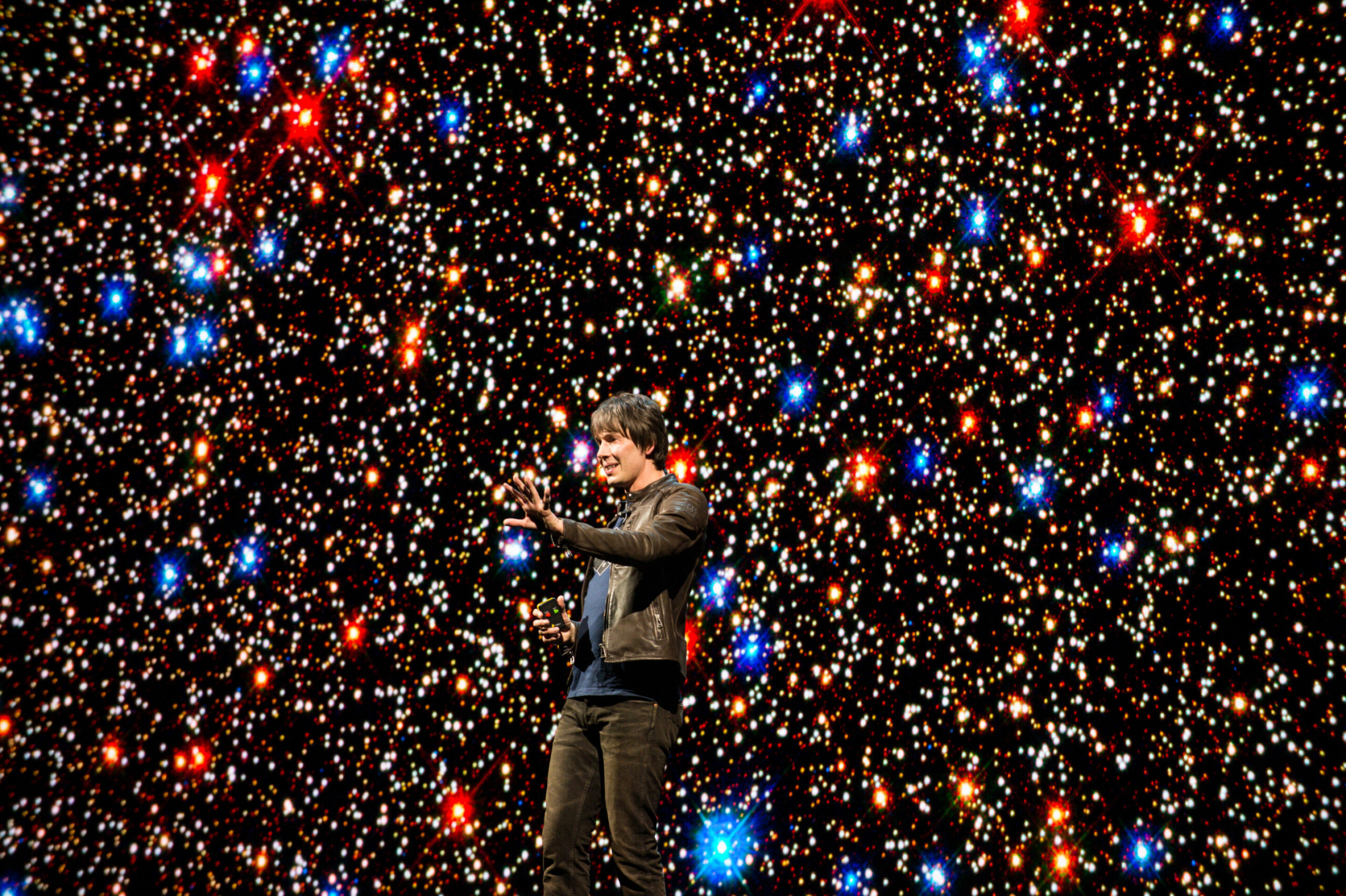
Professor Brian Cox performs his live tour 'Universal: Adventures in Space and Time' World Tour 2019 to a sell out crowd at The SSE Arena, Wembley on 24 February 2019 in London, England. Credit: Nicky J. Sims/Getty Images McIntyre Ents
At a time when there are arguably bigger issues at hand that require our attention on Earth, why should we focus on the stars?
Because understanding the way the natural world works is useful to us, and it benefits us: "The whole modern world rests on curiosity and trying to understand how it works."
He describes anyone who has undertaken research as "little ants on the edge of the known, scurrying around into the unknown". Sometimes they bump into some treasure, like the discovery of electricity or penicillin, but "nobody is smart enough to know which bits of research will lead to revolutionary discoveries."
Any revolutionary discovery, therefore, happened because people were curious about asking questions about nature – and that's how we gain knowledge, make progress, and why we need to keep funding education and looking to the stars.
