
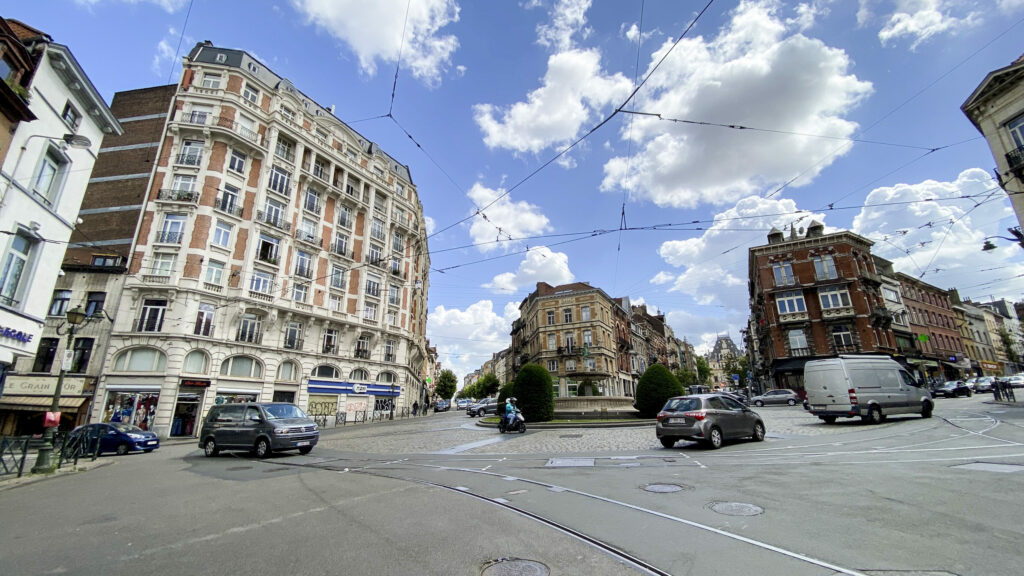
The average annual concentration of nitrogen dioxide (NO2) around the Barrière de Saint-Gilles intersection in southern Brussels is nearly three times the World Health Organisation (WHO) recommendation, according to the latest figures from non-profit Les chercheurs d'air. This poses serious health risks for local residents.
Les chercheurs d'air measured the average monthly NO2 concentrations at 15 points in the neighbourhood of the notorious six-road intersection from June 2023 to December 2025.
The results show that the Barrière intersection was exposed to an average annual concentration of 29.2 µg/m3 of NO2 in 2024 and 28.1 µg/m3 in 2025 – triple the WHO's recommended threshold of 10 µg/m3.
More broadly, all measurement points in the neighbourhood show annual average NO2 concentrations above WHO recommendations. The measuring point on Rue Bréart was the only one to record average concentrations below the threshold of 10 µg/m3 of NO2 in certain months.
'Significant health risks'
Exceeding this threshold of 10 µg/m3 poses "significant health risks," said Pierre Dornier, Director of Les chercheurs d'air.
According to the WHO, air pollution increases morbidity and mortality from cardiovascular disease, respiratory disease and lung cancer. Exposure to air pollution has also been linked to adverse pregnancy outcomes, other cancers, diabetes, cognitive impairment and neurological diseases.
Moreover, hundreds of Brussels residents die prematurely every year due to air pollution from road traffic.
"Estimates show that the burden of disease attributable to air pollution is now comparable to other major health risks worldwide, such as poor diet and smoking; air pollution is currently recognised as the most significant environmental threat to human health," a WHO report found.
What's the solution?
Dornier told The Brussels Times that 41% of NO2 emissions come from road traffic. An ambitious Low Emission Zone (LEZ) is therefore "the most effective tool". Maintaining traffic-calming measures and promoting active and shared mobility, as well as greening, would also significantly improve the situation.
"The streets around Barrière are among the most densely populated in the capital. It is therefore a priority to reduce air pollution there," said Dornier.
He added that over 70% of households in Saint-Gilles do not own a car, so it is "particularly unfair that the air these people breathe is so polluted."
The municipality of Saint-Gilles has plans to renovate Barrière. However, in the Regional Policy Declaration that has just been approved by the new Brussels Government, the traffic-calmed neighbourhoods as envisaged in the controversial Good Move mobility plan are being called into question, Dornier explained.
"There is therefore a risk of slowing down the development of active and shared mobility. We shall see."
He added that he has only been taking measurements in Barrière for two years, so it is too soon to say whether the situation is improving or deteriorating.
Brussels residents can see how their respective neighbourhood fares through this interactive map, which shows the different concentrations of air pollution across the city.
