
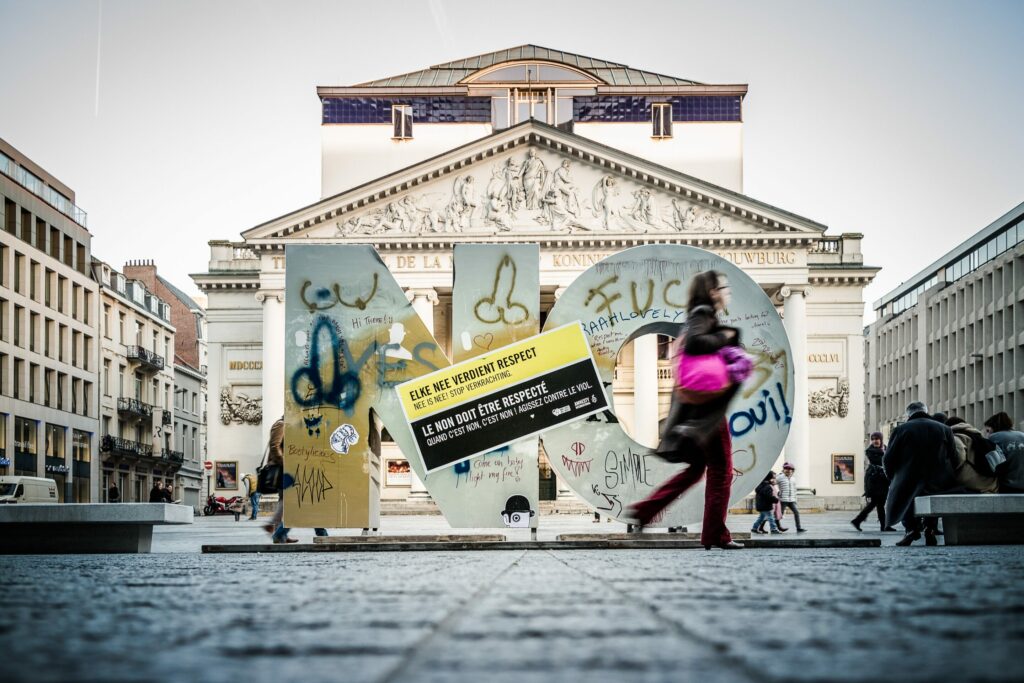
Have you ever been told to hold onto your drink in a bar, been told to text a friend when you get home safe or clutched your keys between your knuckles while walking around town at night? If you're a woman, the answer is most likely yes.
Women's safety is a topic that has come to the fore in recent years off the back of movements such as #MeToo, 'Woman, Life, Freedom' following the death of Mahsa Amini in Iran in September 2022, and stories of gender-based violence and femicide making headlines, such as that of Sarah Everard, a 33-year-old woman who was violently kidnapped, raped and murdered by a police officer in London in March 2021.
On International Women's Day (8 March), The Brussels Times takes a closer look at how safe women feel in the Belgian capital, and what's being done to curb street harassment.
Non-profit Plan International has found that 91% of girls and young women in Belgium have experienced sexual harassment. Only 6% of girls feel able to report it to the police. Furthermore, according to an iVOX survey in 2023, 95% of women "sometimes" feel unsafe on the streets, while one in six "rarely" or "never" feel safe.
"The impact of harassment or sexual violence on victims is very serious, both mentally and physically. Victims may change their routes, avoid certain places, change their phone numbers or email, or delete social media accounts," Véronique De Baets of the Institute for the Equality of Women and Men tells The Brussels Times.
"Harassment affects women's rights to move freely, enjoy leisure, participate in politics, and have equal access to the city."
'The most unsafe city I've lived in'
When speaking to women living in Brussels, it quickly becomes clear how much of an impact street harassment has on their lives.
Shannon, 40, is from St. Louis in Missouri, which has one of the highest crime rates in the United States, but she says Brussels is the most unsafe city she has ever lived in.
"I feel like I sound very dramatic ... I don't like talking about it because it sounds so unbelievable," she says.
In 11 years of living in Brussels, Shannon says she has been physically assaulted three times. "Four if you count being pissed on," she adds.
Six years ago, she was at a friend's house in the EU quarter and walked home in the early hours of the morning. A man approached her to ask for directions, but after sending him on his way, he continued following her and asked for her number, saying he "wasn't one of those creepy guys."
Shannon asked him to leave her alone, and then he attacked her. She hit him over the head with her metal water bottle and ran away. When she got home, she phoned the police, and they said, "what do you expect us to do about this?"
Another time, three years ago, a man followed her home, claiming to live in the same neighbourhood as her in Saint-Gilles. She felt scared, so she rang a neighbour's doorbell instead of going to her house.
"Then he grabbed me and tried to kiss me and stuff. The neighbour answered the door, and then he ran off."
She went to the police the following morning, and an officer told her that pretending to live nearby is a tactic commonly used by men attempting to assault women.
Most recently, around a year ago, a man urinated on Shannon in broad daylight on Chaussée d'Ixelles. "He pissed on my leg like I was a fire hydrant and he was a dog," she says.
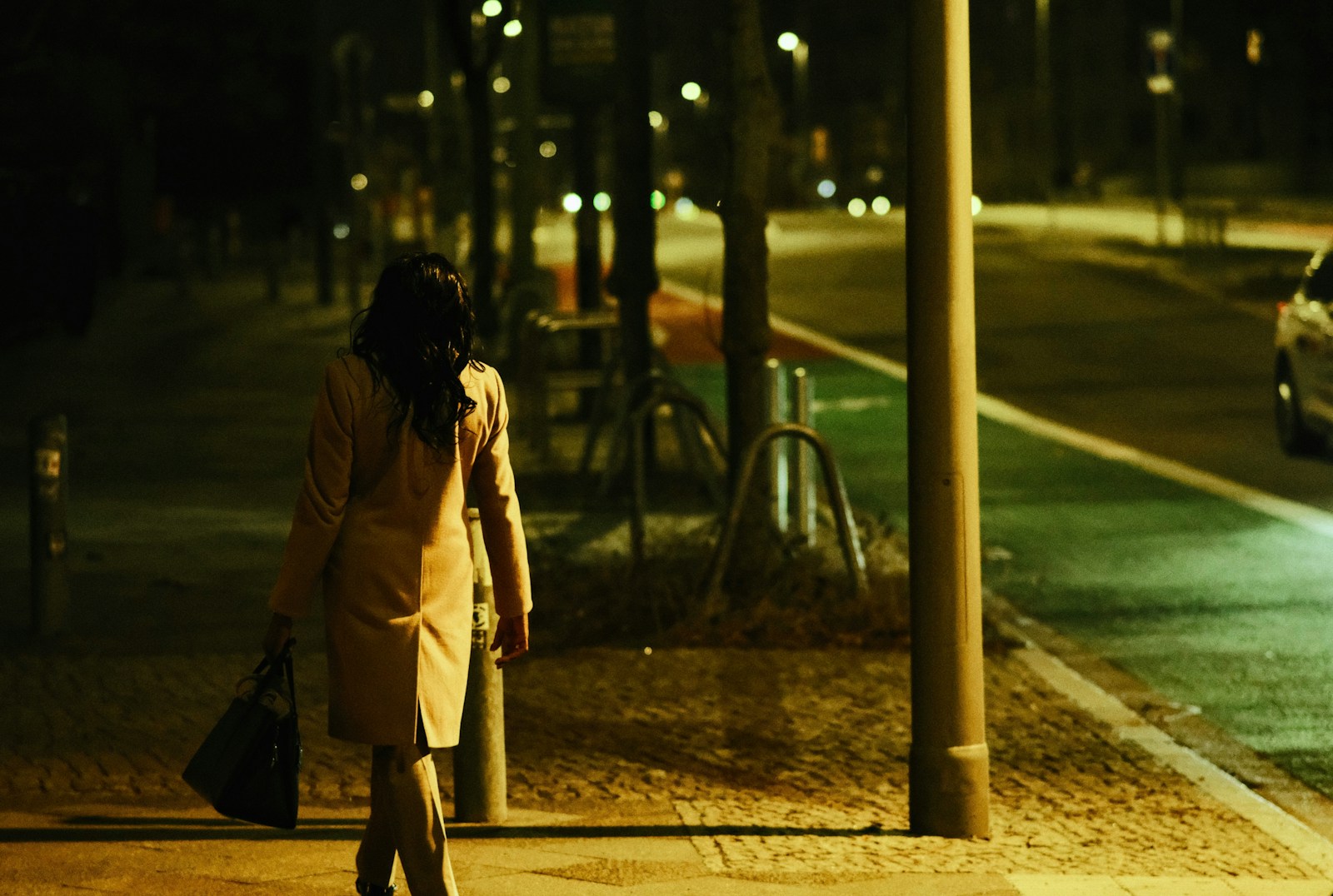
A woman walking alone down a dark street. Credit: Unsplash / Sean Zielinski
Sophie, 30, is from the UK and feels less safe on public transport and in metro stations in Brussels than in London and Manchester. "People behave more erratically here."
When she walks around Brussels at night, Sophie also holds her keys between her fingers in case she is attacked. She has a friend who even carries a pen knife when walking home from nightclubs.
"I have a friend who smashes a bottle she finds on the street. And walks home carrying it at the ready," adds Shannon. "The first time she did it, I thought she was nuts."
What is Brussels doing to curb the problem?
Women are resorting to drastic measures to ensure they feel safe while walking the streets of Brussels. But what's being done to tackle the root cause of the issue?
De Baets says that prevention, education, and awareness, especially for young people and boys, are crucial components in the fight against gender-based violence. She believes that public authorities should invest in teaching about consent and respect for others and highlighting positive male role models.
"We need to stop thinking that harassment and gender-based violence are only women's problems. They are not just women's issues; they are social and political problems in which men have a crucial role to play. Most violence is committed by men, but men can also be important allies and active witnesses."
Belgium passed a law on sexism in 2014, with community service, prison terms and fines of up to €8,000 for anyone found guilty of sexism. The Belgian Penal Code also punishes certain non-consensual sexual behaviours. These include assault on sexual integrity, rape, voyeurism, (sexual) harassment, threats, and distributing sexual images without consent.
In 2025, the Institute launched a campaign on consent aimed at young people in party settings. Federal Minister for Equal Opportunities Rob Beenders (Vooruit) will also launch another campaign at the end of 2026 to raise awareness about sexist comments on social media.
The minister has also asked the Institute to examine whether pepper spray, which is currently illegal in Belgium, could be a solution to improve safety in public spaces.
Leave girls alone
Some Brussels residents have even taken matters into their own hands. Sahra, 32, from Belgium, decided to create her own collective with two friends after being constantly harassed at night. She recalls one specific time a group of men catcalling her friend, who was wearing a skirt, shouting "you've aged like a slut".
The trio had had enough, and around the time of #MeToo in 2017-2018, they came up with a slogan: Laisse les filles tranquilles ('Leave girls alone').
They printed posters and stuck them up around Brussels, made a social media page, and the project grew. Venues around the city approached them, asking to put up their posters, and the former Minister for Equal Opportunities even contacted them to collaborate.
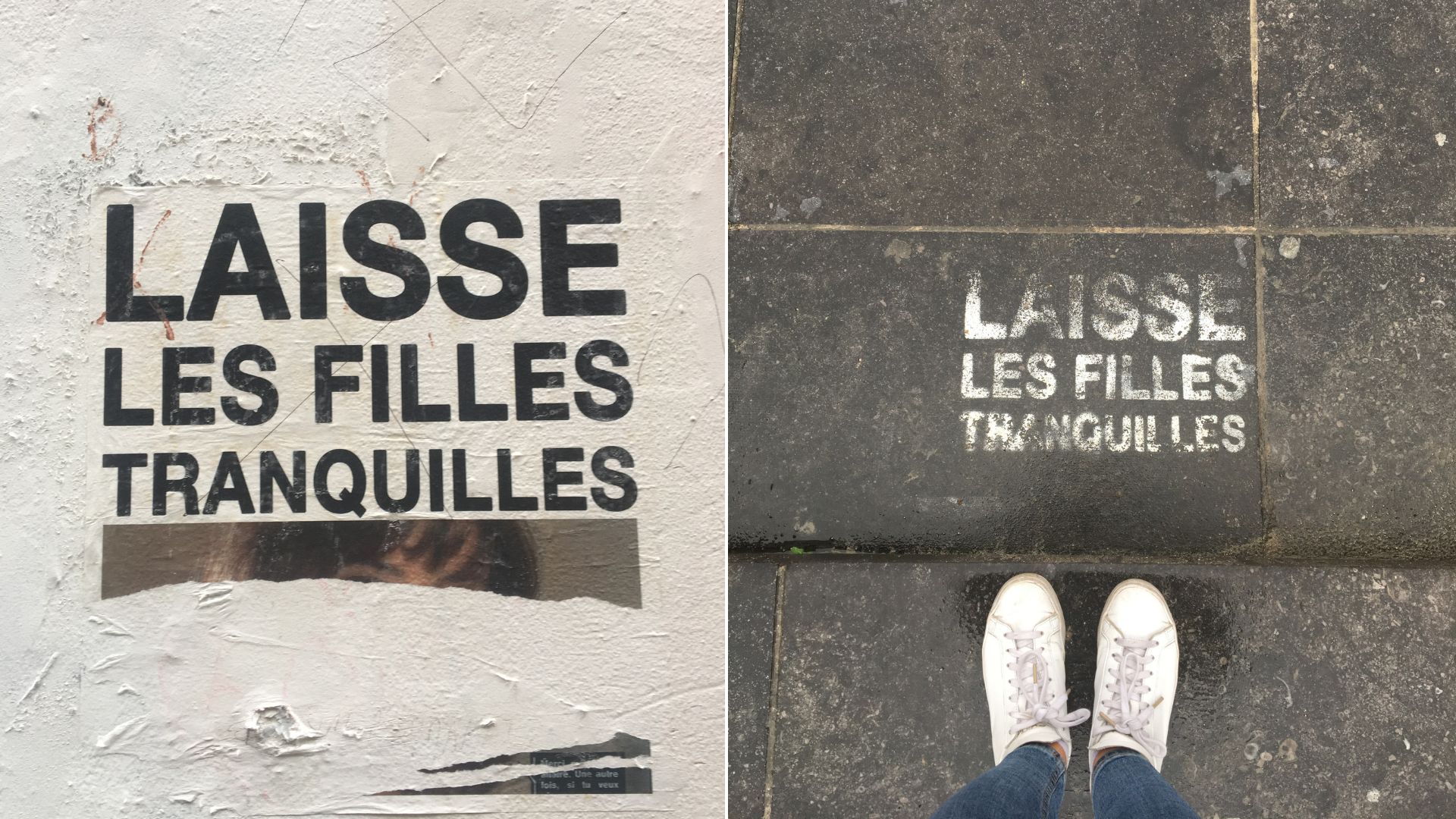
Posters and graffiti spotted in Brussels in November 2018. Credit: Isabella Vivian / The Brussels Times
Women contacted the group to thank them, saying, "I walked down that street that night and saw your poster, and that gave me a sense of security."
The project fizzled out because of the pandemic, but a few years on, Sahra still feels unsafe in Brussels and says more must be done.
"We started something in Brussels because it was something that didn't exist before. Lots of other collectives have sprung up as a result, but even so, it doesn't solve the problem. I don't think enough resources are being put in place to help women," Sahra says.
She continues to adjust her behaviour to feel as safe as possible; she's cycling more and taking taxis when she can – but was even assaulted by a driver on one occasion.
"Of course, I'm sometimes afraid when I take a certain route, or arrive in a neighbourhood where there are too many men. I cross the street and look behind me to see if anyone is following me. It's a constant adjustment. But we're trying to free ourselves from that by reclaiming the streets in our own way."
