
A certain number of civil servants in Wallonia and Brussels will soon be able to work for four days and be paid for five.
While the Belgian government proposed a 38-hour week spread over four, longer days a few weeks ago, this new plan will aim to reduce overall employees' working time.
The requirements to adhere to the four-day working week are: be an agent, contractual or statutory, without higher education, aged over-60 and exercising a what may constitute a "tough" job, Le Soir reported.
The criteria for a ‘tough’ job includes manual labour, long working hours (such as night work), safety-risks, mental or emotional distress, as well as officers receiving an allowance for dangerous, unhealthy and inconvenient work.
Jobs that are eligible include cleaners, road workers, childcare professionals and gardeners. However, the criteria is mostly a set of guidelines - defining the ‘toughness’ of the job will remain under the powers of the local authorities, as they are the best-placed to determine this within their organisation.
The workers will receive the same salary for one day less and the reduction in working time will have no impact on their pension.
In Brussels, Saint-Josse-ten-Noode and Anderlecht have already implemented reduced working hours for workers aged in their fifties and sixties.
In Saint-Josse, the formula was tested at the beginning of 2021 for workers aged 55 and over, “without distinction of function”, the mayor Emir Kir specified. The initiative has already benefited 150 in 700 full-time workers. “It responds to a demand,” the mayor said.
‘Expensive but anticipated’
The new system has allowed the municipality to hire around twenty people. But at what costs? The mayor says it’s worth it, without specifying the figures. “We have fewer absences and the support of workers. This is the future: a better distribution of work.”
Related News
- Unemployment continues to drop in Brussels and Flanders
- 5 of Belgium's largest platform companies do not offer fair working conditions, study shows
- Self-employed should have right to improve working conditions, say MEPs
The mayor of Anderlecht, Fabrice Cumps, shares the numbers: €750,000. “It’s very expensive, but it was also greatly requested by staff.” He has set up a four-day week for low-income workers over the age of 50, concerning 160 people in total. “They are street sweepers, public workers, maintenance staff for green spaces,” he said.
Workers are obliged to take their weekly day off. “The hierarchy finds that this has disrupted the functioning of services, but it is a balance to be found.”
Not for (all) cleaning services
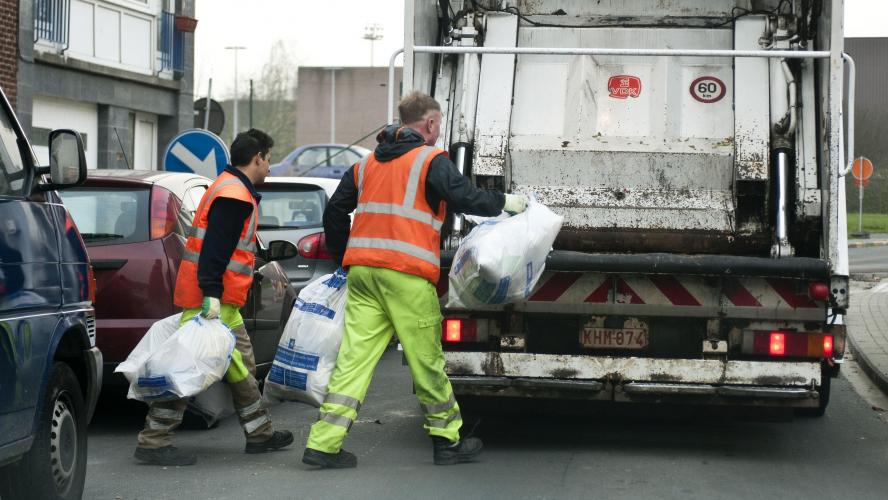
However, it is not always that simple. Net Brussels, the city’s cleaning service, will not adopt reduced working hours. The director of communication, Etienne Cornesse, explains: “It puts our teams, which are always made up of the same people, in difficulty. Our drivers know their routes by heart. If they have to be replaced, it will pose organisational difficulties.”

Credit: Belga
“In addition, there are also security reasons,” he continues. “Our loaders and drivers need to be mindful of other road users while on rounds. Changing teams can be dangerous.”
Another issue is a shortage of workers, for instance truck drivers, which would cause difficulties in recruiting replacements. Cornesse also sees the financial cost as a problem. “Such a reform would have led to an additional cost which was not desirable in the regional budgetary context,” he said. “Between the time the measure was considered and today, the context had changed.”
However, a four-day week is granted to those who work on the weekend at Net Brussels. “These are the cleaning staff and park rangers, which are open on weekends in the Brussels Region,” the organisation's director specified. “At the organisational level, it is simpler: it concerns a limited number of people and these are less complex jobs than loader or truck driver.”
