

Is there such a thing as too much love? Not according to some. While polyamory has long been stigmatised by society, statistics suggest it might be entering the mainstream – and the benefits may even outweigh the challenges that come with having multiple partners.
This article is part of The Brussels Times' dating series, which includes columns and interviews with experts and members of the public on all matters of the heart.
Non-monogamy is no longer a "fringe phenomenon" in countries such as Belgium, says Dr Hubert Van Puyenbroeck, an academic at VUB who specialises in relationships. Around 50% of Belgians have experience with "non-monogamous activities", according to a large-scale study by the University of Antwerp and the Duffel Psychiatric Centre in 2025.
One-third of Belgians have had an open relationship at some point, and one in five young people aged 18 to 25 had had a consensual non-monogamous experience in 2024–2025.
According to Dr Van Puyenbroeck, people are increasingly exploring multiple forms of consensual non-monogamy, such as open relationships. This is when one or both partners have sexual relationships with others outside their primary relationship, but the romantic and emotional connection usually remains with the primary partner, he says.
He underlines that polyamory should not be confused with polygamy. Polyamory is defined as maintaining multiple romantic or emotional relationships with the consent of all involved. It is allowed but not explicitly regulated or recognised by law in Belgium.
The latter refers to the marriage or relationship of one man with multiple women (polygyny) or one woman with multiple men (polyandry). Polygamy is legal in over 50 countries worldwide, but not in Belgium.
Relationships on autopilot
These alternative forms of relationships challenge the "mono-normative beliefs" held by many, the researcher says.
"I think a lot of people are living relationships on autopilot; there is such a strong script," Charles*, 35, tells The Brussels Times, referring to the traditional timeline of dating, cohabitation, marriage and children.
Charles is from Belgium and has one partner in Brussels and another in Vienna. But like many, he grew up believing monogamy was the only relationship type available to him. "That's what you see in your family. That's what you see in movies. That's what you see in books. Everything implicitly tells you that that's how things are supposed to work," he says.
It took him around 12 years to realise that polyamory was for him, but even then, he felt a lot of shame, guilt and self-loathing when his first experience ended badly in 2014.
"There was the inability to reciprocate confessions of love from one of the people, because I told myself what kind of sick bastard would say, 'I love you too', when you're busy shagging someone else at the same time."
He has since read widely on the topic and attended group meet-ups, and believes that "love isn't a finite resource" – just as parents with several children can love them all equally.

Credit: Canva
Belgian-Italian Janine*, 38, says she also started asking herself, "Why are we doing monogamy as a default?" several years ago.
She says that, for many people, monogamy "is not a conscious reflection or choice". She therefore likes the idea that her relationships are more "intentional" now, where she has explicit conversations with people about what they need.
Autonomy, emotional or intellectual growth, and opportunities for self-improvement are some of the many psychological benefits of practising consensual non-monogamy, Dr Van Puyenbroeck says.
He adds that it also enables people to "fulfil specific sexual, emotional, or logistical needs through multiple partnerships".
Like clockwork?
Multiple relationships do not come without multiple challenges, however, with jealousy and time management being two of the main issues often raised.
Janine believes balancing multiple partners is much like making time to see close friends regularly, while for Charles, it is a "major challenge".
"The running gag in the polyamorous community is that the most important thing is knowing how to use Google Calendar," he says. "Love is not a finite resource, but time is."
The more partners polyamorous individuals have, the more complicated it is to balance their time – and when they reach their limit, they become 'polysaturated'.
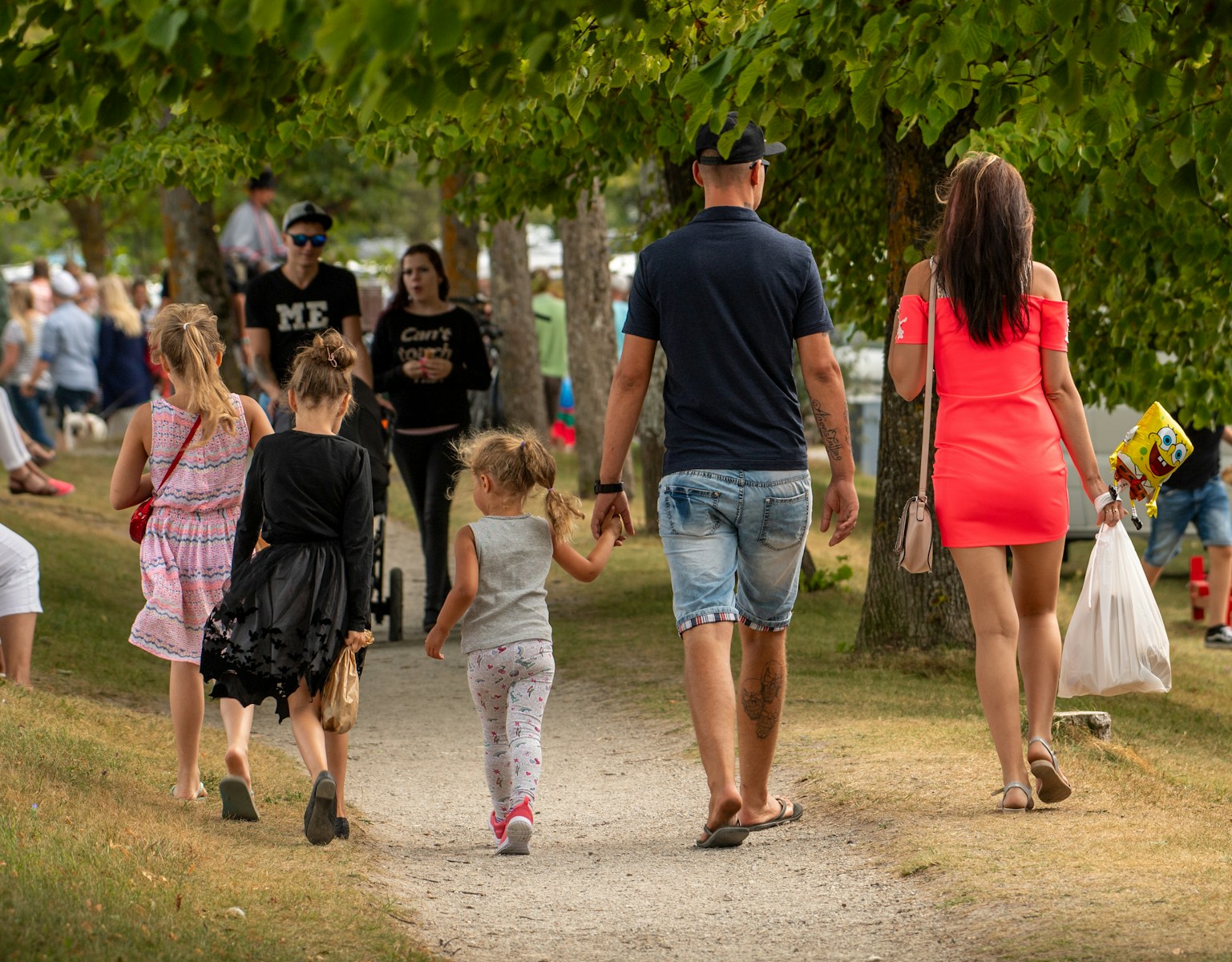
Family walking in a park. Credit: Margo Evardson / Unsplash
Charles' partner in Brussels has an "anchor" or "nesting partner" (whom they live with) and a child, which adds another layer of complexity.
Polyamorous people avoid creating a hierarchy by using terms such as "main partner", he says, because although someone will naturally spend more time with their nesting partner out of logistics, they want to ensure other partners don't feel "secondary".
However, Charles says he has managed to find a good balance with his two partners. "I'm in a place where I'm fortunate enough that I have the energy and the resources and the time for everyone that I do want to spend time with. But it is sometimes very easy to overextend yourself."
Three's a crowd?
For Thibault*, 38, also from Belgium, the green-eyed monster took hold.
He was in a consensual non-monogamous relationship with a married woman last year after they met at a BDSM event. The husband said he always liked it whenever his wife and Thibault spent time together. "He would even encourage it", and "come and watch whenever his wife and I would get intimate".
Although Thibault "knew perfectly well" what the situation was, he became overwhelmed with feelings of jealousy as it dawned on him that he would never be "first place in her life".
"She had already built up her life with her husband, and everything revolved around that. She was never planning to include me in her life in that way," he says. "I would never meet her parents; I would never live with her. That made me feel jealous and sad."
Eventually, it ended, and Thibault vowed he "would never get into a polyamorous relationship" again.
Thibault is now in an open relationship with someone new, which feels different as he doesn't "have to worry about constantly sharing my partner or being left out".
Janine, meanwhile, says she has experienced more envy than jealousy: envious of what someone else has rather than wishing it were hers.
"Sometimes the feeling of jealousy is not even so much about being jealous of the person. It's more about being jealous that they're spending that type of quality time together."
Related News
- 'Women ask me to order them taxis and buy them flowers': A man's perspective of dating in Brussels
- 'I'm sick of having my heart broken': The over 50s looking for love (and good sex) in Brussels
- 'I'm scared of dating in Brussels'
Charles says he has also felt envious sometimes, but he "is not typically the jealous sort of person – at least not in the possessive sense".
He remembers the first time a previous partner said she had had a fling with someone else. "I could see this sheepish look on her face, where she was waiting to see how I would react […] but I felt absolutely fine," he says, adding that it ended up bringing them closer together.
"It was the first [experience] of many to show me that this sort of way of having relationships was possible and was one in which love and trust could thrive."
He describes this as 'compersion', a word used on the poly scene to mean the opposite of jealousy. "It's an emotion where you are happy for someone else's joy."
However, complications can arise, he says, when a polyamorous situation becomes closed off and turns into a 'trio', or 'throuple' (a romantic or sexual relationship between three people). "It is logistically more of a challenge. It's like a literal love triangle," he says.

Credit: La Fabbrica Dei Sogni / Unsplash
He says a classic example of this is when a couple invites in another person to "spice up their relationship", but it often leads to issues.
"The third person often ends up essentially being the other person's fantasy, rather than being treated as an actual equal partner in the relationship."
Just a phase?
Janine believes that the biggest misconception of this relationship structure is that people assume polyamory is always the problem if a relationship breaks down.
"If someone is in a monogamous relationship and the relationship goes awry and ends, nobody will tell them to stop monogamy because that's the problem," she says.
"Sometimes you don't feel like you can say that there are issues in a polyamorous relationship because the answer from the other side very often is that the problem is the poly, rather than whatever you're describing as the issue."
Charles says there's also a lot of "slut-shaming", with people assuming he just wants more sex or doesn't want to commit.
"People think that it is some form of frivolity or indecisiveness. But polyamorous people are some of the people who think the most about commitment because they think a lot about what it means to be in a relationship."
In general, Janine says there is still a lack of understanding of non-monogamy and societal stigmas persist: "What I've encountered as a common reaction is, 'it's probably a phase'. They don't take it seriously sometimes."
If you have a story to share of dating in the city, get in touch! i.vivian@brusselstimes.com
*Name has been changed to protect the speaker's identity.
