
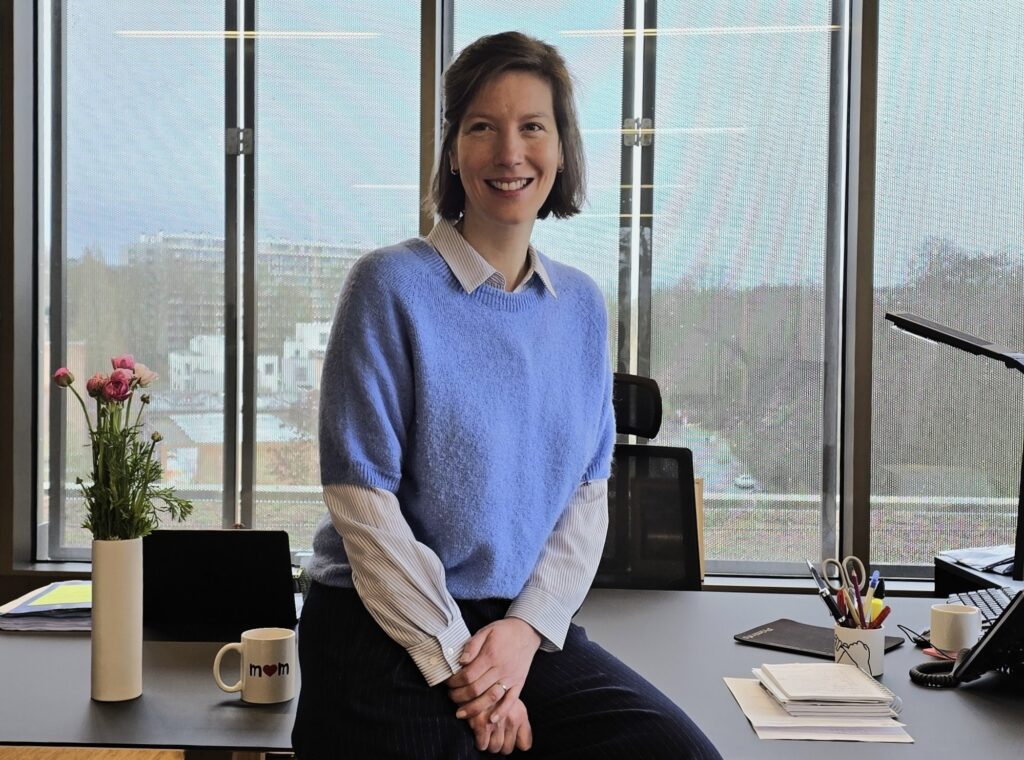
Uccle Mayor Valentine Delwart (MR) has criticised the Federal Government for "imposing" the decision to host a new asylum seekers' reception centre in her municipality.
A former nursing home Armonea in Rue Beeckman in Uccle has been revamped by Fedasil, the federal agency responsible for the reception of asylum seekers, into a new reception centre. It was ready to receive up to 230 people starting 14 July, but the opening date has been postponed pending a court appeal ruling.
With Fedasil's lease for its asylum centre in Koekelberg recently coming to an end, it now plans to relocate 230 people from the former centre to a new building in Uccle, the agency confirmed to The Brussels Times.
The transfer will be carried out under the auspices of the municipal homeless non-profit, Samusocial. It will also ensure a team of 35 full-time employees will supervise the centre, which is open from 06:00 to midnight, with a permanent staff presence.
While 60% of these asylum seekers are primarily single-parent families with one or two children, the rest are single men and women and three lone children, Samusocial confirmed to Bruzz.
However, local residents say they were not properly consulted on the matter. They are now protesting to the authorities by taking the matter to court and demanding an urgent hearing. An online petition has already gained 1,417 signatures by the time of writing.
"Residents of Uccle were informed only a few weeks before the planned opening of a reception centre for 230 people, without being given access to the documents relating to the necessary permits, any impact studies, or the operational arrangements for the project," read the petition. "No prior public debate was held, nor was comprehensive information about the project made available."
Faced with a fait accompli
The decision to designate the centre's new location in Uccle was not the mayor's. In an interview with The Brussels Times, Delwart regrets that, as a locally elected politician, she is unable to oppose such decisions emanating from the federal level – in this case, Fedasil.
"We were not consulted beforehand," she says. "Fedasil doesn't ask municipalities for their opinion because it knows it would almost always receive a negative answer. So it proceeds with a fait accompli."
Delwart joined the residents in their demand. She explains that the issue for her and her citizens is not the arrival of asylum seekers.
She recently asked the police to look into a fierce wave of online trolling and hate speech alluding to "an invasion". Police were asked to determine whether any comments represented a credible threat to the future residents, neighbours or the centre itself.
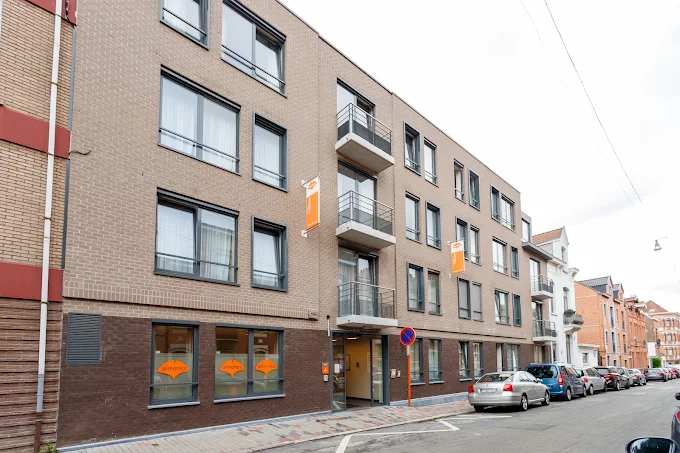
Former nursing home Armonea. Credit: Maison De Repos Tilens.
Furthermore, in an 86,000-inhabitant municipality, 230 people is not a staggering figure, underlines Delwart. "It is not 230 people spread across Uccle, it's 230 new residents in a street where fewer than 100 people live today. That is where the challenge lies".
The Uccle mayor agrees that Belgium has a duty to give asylum seekers somewhere to stay. In fact, under the 12 January 2007 act, people seeking international protection must be given basic support, including accommodation, food, medical care, social support and legal help while their case is processed.
The system is also linked to Belgium's wider obligations under the 1951 Refugee Convention. However, Belgium has been condemned hundreds of times for failing to provide asylum seekers with their legal rights.
Delwart, or any other locally elected politician in Belgium, has little room to intervene once a federal decision is made on asylum reception, which is handled at the federal level, through Fedasil, under Belgian law and EU rules.
"I think this policy has major flaws," she explains. "Even people who understand the need to provide proper reception feel that a decision has been imposed on them without consultation or prior warning. That inevitably increases the level of concern."
"If I had been involved earlier, I certainly would have taken the time to explain the project to residents," she says. "I wouldn't have taken the decision alone, but we could have prepared the neighbourhood instead of announcing it once everything had already been decided."
Delwart says that it is not only a matter of her deciding whether a centre should open or not, but also determining how she can best fit it into her municipality.
Financially prepared
Uccle finds itself in a comparatively strong financial position. The municipality recently closed its 2025 accounts with a budget surplus of €1.38 million, increasing its reserve fund to more than €14 million.
Rather than viewing the surplus as spare cash, Delwart says it allows Uccle to continue investing in public infrastructure while limiting the need for borrowing.
The reserve fund finances road maintenance, flood prevention works, green spaces, schools, nurseries and sports facilities, including energy-efficiency renovations to reduce any future operating costs.
Delwart says, for that matter, the debate surrounding the asylum centre has never been about whether Uccle has the financial means to accommodate it. "The issue exposes a broader weakness in the way Belgium establishes large reception centres."
Fait accompli
Fedasil's spokesperson, Benoît Mansy, confirmed to The Brussels Times that municipalities are informed only once the Federal Government has approved a new reception centre. The final decision rests with Asylum and Migration Federal Minister Anneleen Van Bossuyt (N-VA), after potential sites are assessed.
Mansy explains that there is no deliberate lack of transparency, but that prior consultation reflects the distribution of powers in Belgium. He notes that local authorities are rarely enthusiastic about hosting facilities such as reception centres or even prisons.
One of the residents' concerns centres on capacity. Armonea housed around 80 elderly, and the new reception centre will accommodate 230 asylum seekers. Mansy explains that figures cannot be compared because "they are not governed by the same standards and regulations".
He is aware that mayors often feel they are being presented with a "fait accompli", but added that the reaction in Uccle is "not unusual". According to him, similar concerns and opposition emerge almost every time a new reception centre is announced, regardless of where it is located.
Mansy said residents often have questions about the project's impact, but argued that "tensions generally ease once the centre opens and dialogue is established with the municipality and neighbourhood."
The opening of the Uccle centre also comes amid a shift in Belgium's asylum policy. Federal has repeatedly said it wants to reduce the country's reception capacity as part of a broader tightening of migration policy.
However, Mansy said the Uccle site is therefore not an expansion of Belgium's reception network, but a relocation of the existing Samusocial-operated centre in Koekelberg, which has a similar capacity.
Delwart says she is now working with Samusocial and Fedasil to ensure the centre's arrival causes as little disruption as possible.
A neighbourhood charter is expected to be drawn up by the parties involved, covering security and coexistence, among other concerns.
