
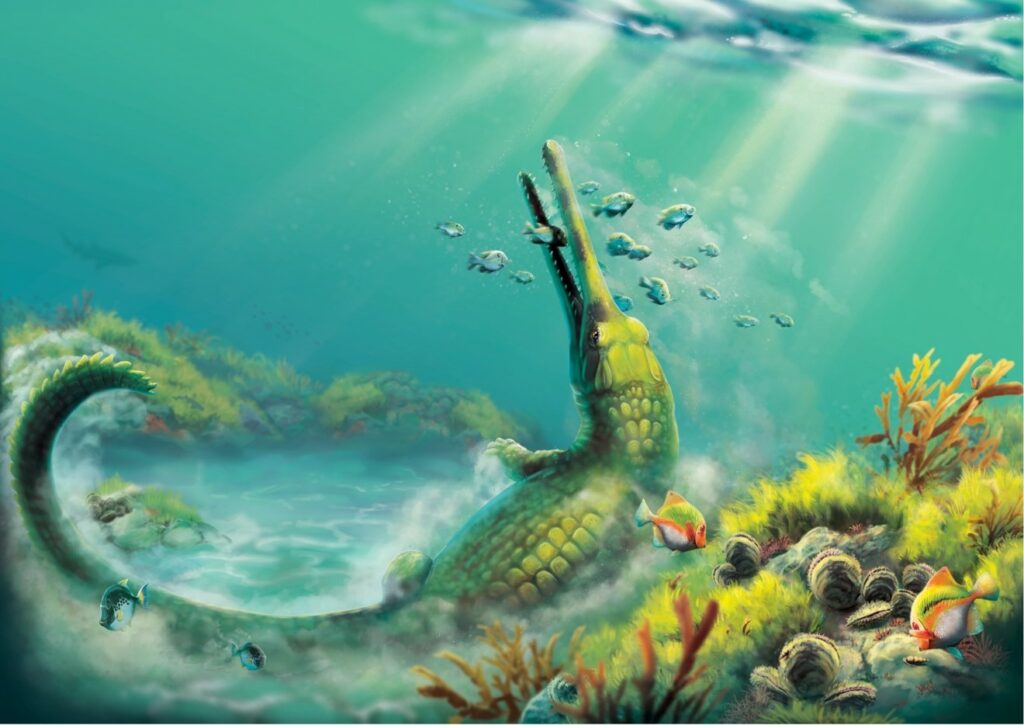
Belgian researchers have found new clues that an ancient crocodile-like animal might have travelled across the Atlantic Ocean millions of years ago.
KU Leuven scientist Sophie Boerman coordinated with a team of researchers from France, Sweden, and the United States to gather clues that revealed how thoracosaurs, animals that lived between 80 and 60 million years ago, spread from the North American coast to Europe.
“The Atlantic Ocean looked a lot different back in those times,” Boerman told The Brussels Times. North America and Europe were narrowly separated by extensive shallow seas and a small stretch of deeper water.
The Royal Belgian Institute of Natural Sciences, based in Brussels, used CT scanners to look inside fossilised skulls of thoracosaurs, animals that looked somewhat like modern crocodiles but had extremely long and narrow snouts.
Their fossils have been found on both sides of the Atlantic, including in Europe and North America. However, until now, scientists have struggled to explain how the animals became so widely dispersed.
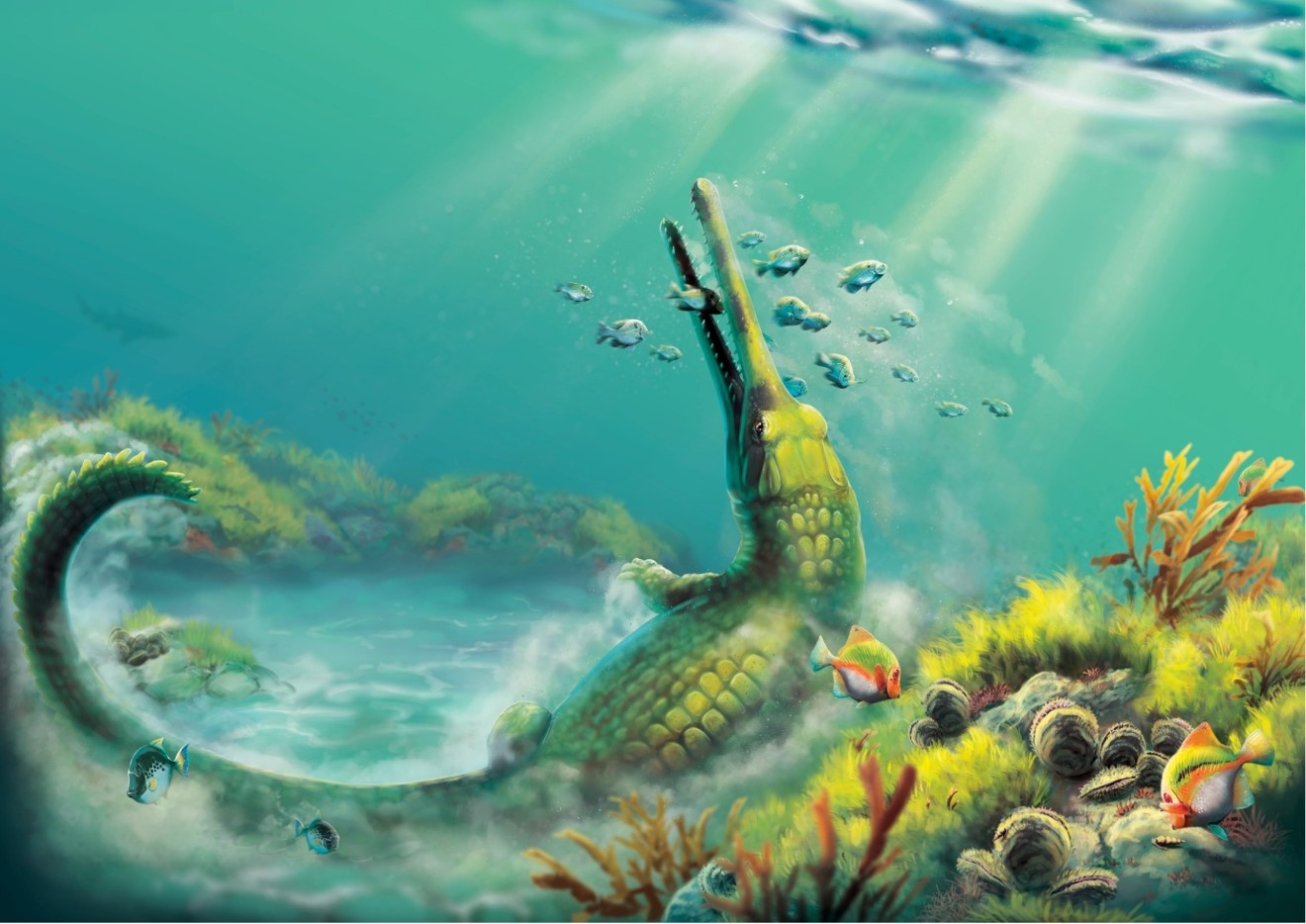
Credit: KU Leuven.
Researchers scanned three fossilised skulls from northern France, southern Sweden, and the southern United States.
Much like how a medical scan lets doctors see inside a patient's body, this technology allows researchers to examine parts of the skull hidden inside the fossils without damaging them.
“The difference is that this CT technology produces much higher-resolution images of small objects,” Boerman explains.
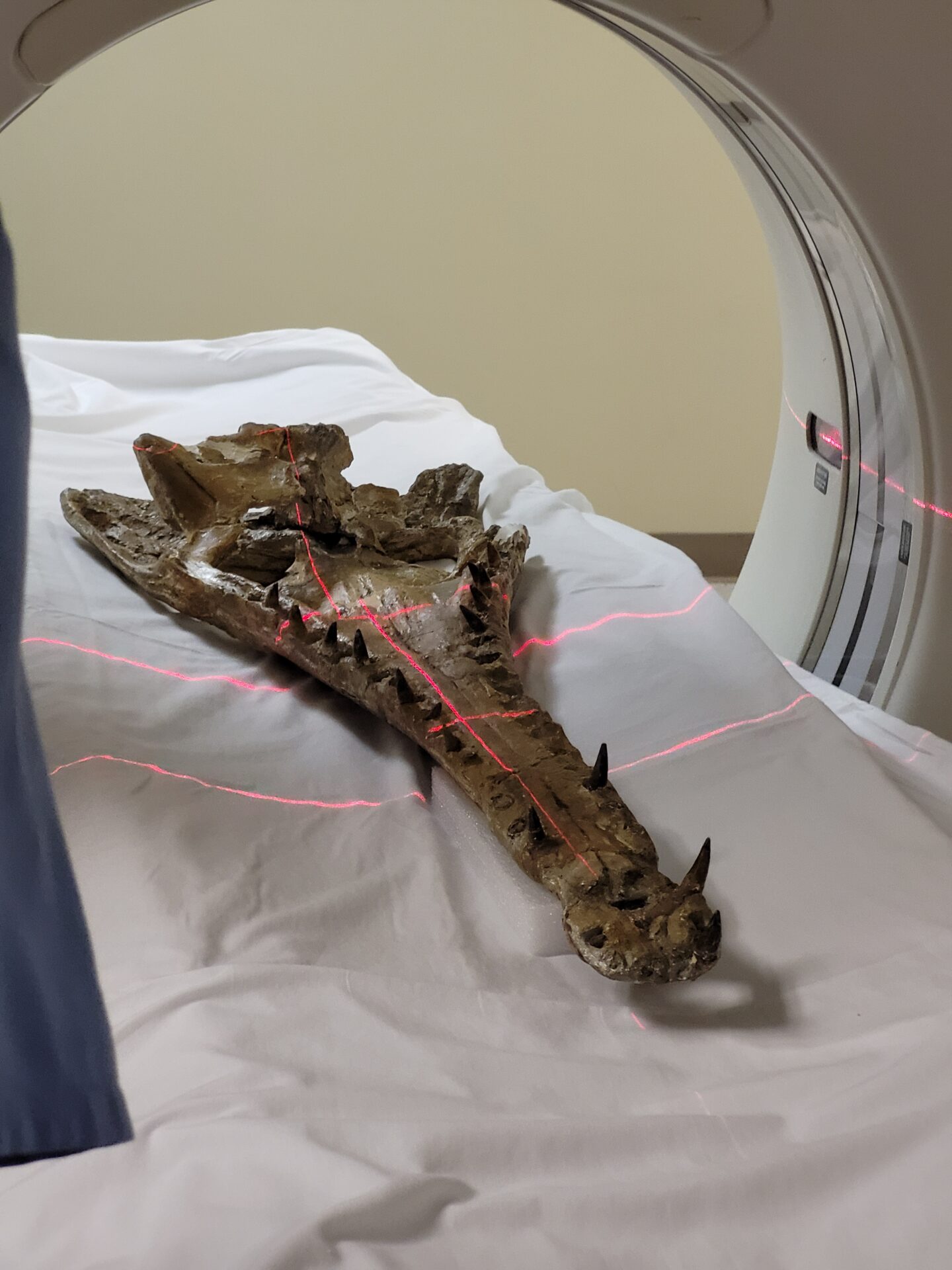
The skull of the North American Eothoracosaurus mississippiensis being CT-scanned at Mississippi State University in the United States. Credit: Mississippi State University
What they found surprised them
Near the animals' eyes were large cavities connected to the nasal area that are not found in crocodiles living today.
These cavaties may have contained salt glands, organs that allowed for the filtering of excess salt, as they have been previously found in extinct marine reptiles that spent long periods in seawater.
However, the glands themselves have not survived fossilisation, meaning researchers cannot prove that thoracosaurs possessed them.
“We do not have concrete evidence for salt glands,” Boerman says. Instead, several pieces of evidence point in the same direction: the cavities resemble those associated with salt glands in other marine reptiles.
But the shape and location of the cavities suggest the animals might have been largely better adapted to life at sea than previously thought.
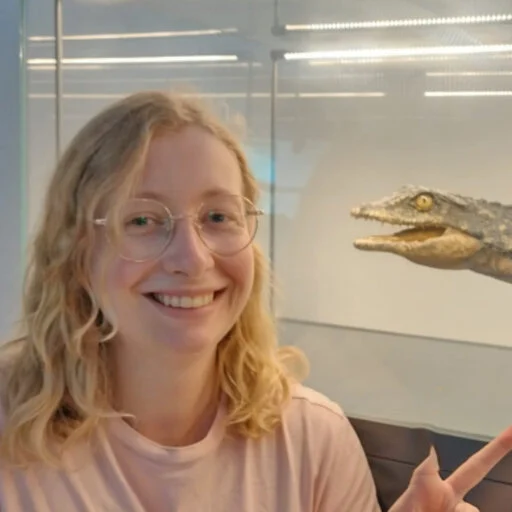
Rather than excitement, Sophie Boerman says her first reaction to the discovery was fear that other scientists would not believe her findings. Credit: KU Leuven.
That could also help solve another mystery: why fossils of the same group of animals have been discovered in both Europe and North America.
If thoracosaurs could tolerate salt water for long periods, they might have been able to travel enormous distances through the sea.
Other parts of their skulls point towards a life spent largely in water. Their inner ears, for example, have features associated with aquatic animals.
However, they were probably not deep-sea divers. Researchers found large air-filled spaces inside their skulls that would have made diving to great depths difficult.
Scientists are now also looking into another possibility: some of these spaces may have helped thoracosaurs produce or hear sounds underwater.
What has been found so far shows that fossils discovered more than a century ago can still reveal entirely new information when examined with modern technology.
