
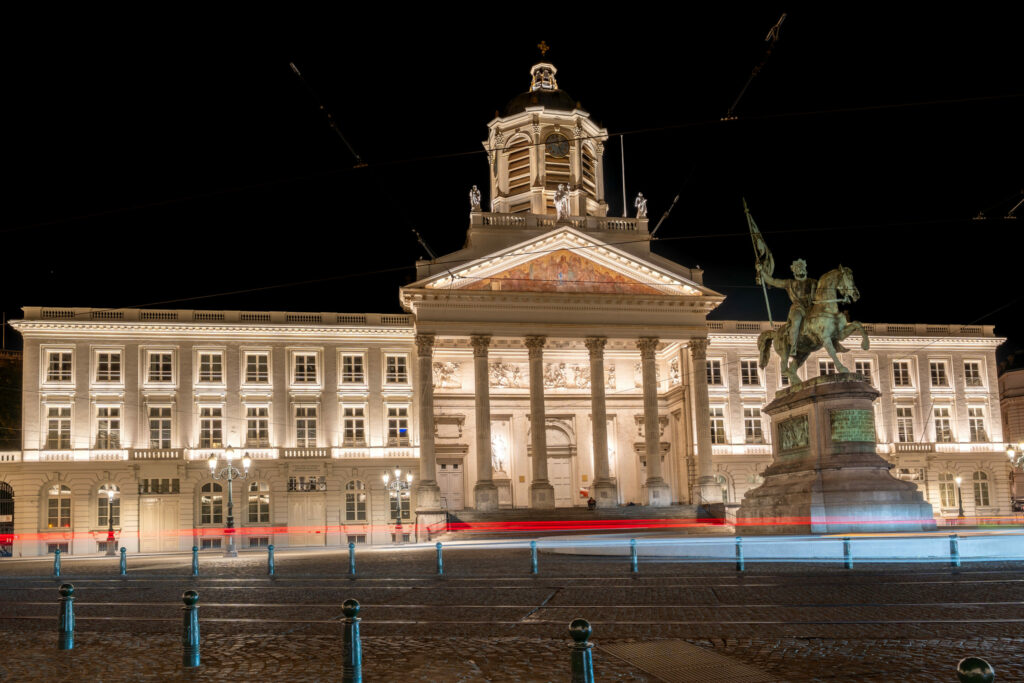
Place Royale, one of Brussels' best-known cultural landmarks, has a new glow after dark, as the renovation of the square has been completed with the addition of new nightlights meant to bring out the square's prominent features.
The lights are meant to bring out the historic features in and around the square, highlighting prominent buildings and statues. The city invested €2.6 million in its new nightly facade.
The lighting follows a €6.3 renovation of the square completed earlier this year, aiming to make Place Royale safer and more accessible to pedestrians. The two projects have changed both how the square is used during the day and how its historic buildings appear at night.
The project was developed in consultation with the City of Brussels and heritage authorities to preserve the historic character of the square.
Place Royale had always functioned as a large roundabout, with traffic occupying much of the public space. The renovation concentrated vehicle movements into a clearly defined area, freeing up more than 85% of the square's surface for pedestrians and other active road users.
Tram and bus stops were also made safer, while new pavements, cobblestones and street furniture were introduced.
The redesigned benches were inspired by the surrounding neoclassical architecture, using Belgian blue stone similar to the pavements.
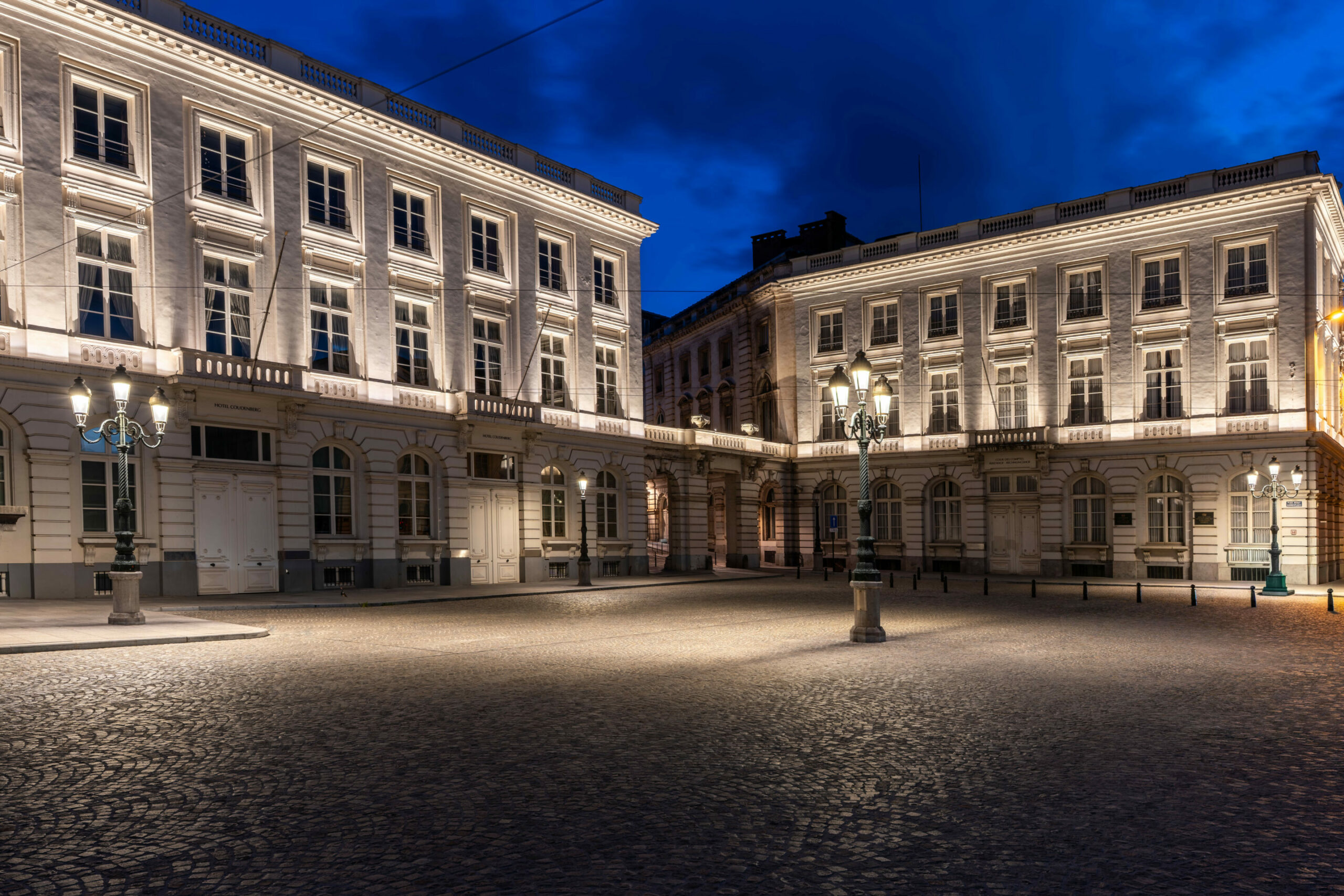
Historic buildings around Place Royale in Brussels illuminated in the evening on 28 September 2026. Credit: Thomas Melhan.
Beneath the surface, another significant part of the works involved renewing the waterproofing above the archaeological remains of the former Coudenberg Palace, which was largely destroyed by fire in the eighteenth century.
The waterproofing works were intended to protect this historic site from water damage. Its underground remains are still accessible to visitors today.
A new look for Brussels' historic centre
On Tuesday evening, Federal Interior Minister Bernard Quintin (MR) and Brussels Mayor Philippe Close (PS) toured the newly lit edifices alongside representatives of Beliris, the federal public works agency responsible for the project.
The improvements cover more than Place Royale itself. Among the buildings receiving new lighting are the Church of Saint Jacques-sur-Coudenberg, the Court of Audit, the Royal Museums of Fine Arts of Belgium, the Palace of Charles of Lorraine on Place du Musée, the Musical Instruments Museum and Bozar.
The installation also extends to The Whirling Ear, the sculpture overlooking Mont des Arts, and the staircase of the Hôtel Ravenstein.
Beliris says the result is intended to create a warmer and more welcoming atmosphere for residents, visitors and tourists exploring Brussels' cultural quarter after sunset.
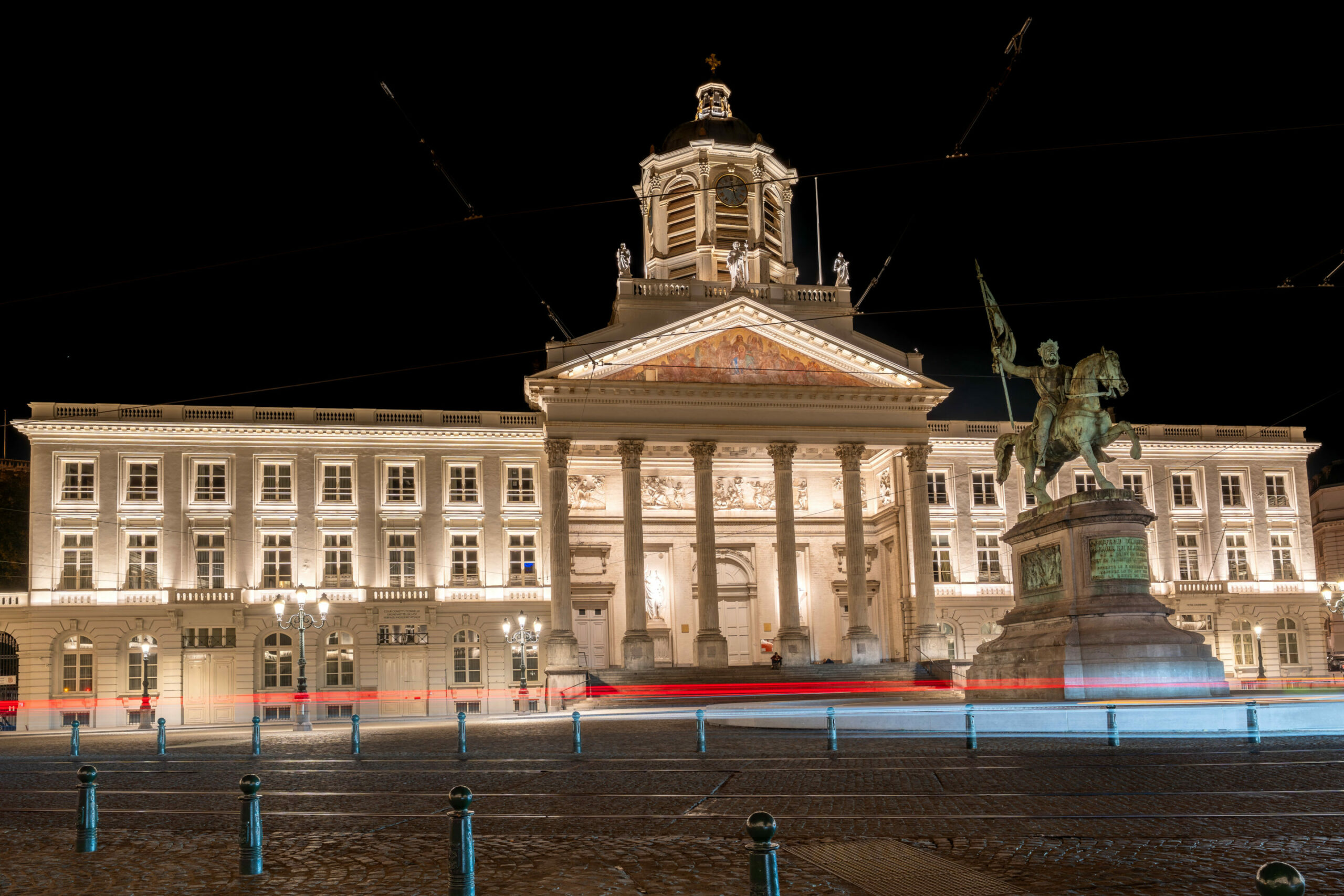
Place Royale in Brussels illuminated in the evening on 28 September 2026. Credit: Thomas Melhan.
The investment involves more than simply attaching lights to the façades. Public procurement documents published in 2024 show that the contract covered the supply, installation, connection, testing and commissioning of new lighting equipment across six sections of the historic quarter.
These included Place Royale and Saint Jacques-sur-Coudenberg, the Court of Audit and Royal Museums of Fine Arts, Place du Musée and Rue du Musée, Bozar, the Musical Instruments Museum and the Ravenstein site.
The works also involved adapting or removing existing lighting equipment and modifying electrical installations.
Following the seasons
While Beliris has confirmed that the installation cost €2.6 million, including VAT, its annual running costs remain uncertain. De Swaef said LED lighting had been selected to limit electricity use. She also confirmed that the façade lighting was not intended to remain switched on throughout the night.
The exact switch-off time is still being considered by the City of Brussels, taking into account how the surrounding public space is used.
Beliris spokesperson Elien De Swaef told The Brussels Times that the system is automated and can be programmed according to the seasons, with the lights switching on when darkness falls.
De Swaef could not immediately confirm when the lights would be switched off overnight, or how much electricity and maintenance would cost each year.
The automated system offers two possible approaches: switching the lights on and off at predetermined times, or using an astronomical clock that adjusts their activation according to sunset.
This means the lighting can be adapted to changing requirements, although the final overnight operating schedule has yet to be established.
