
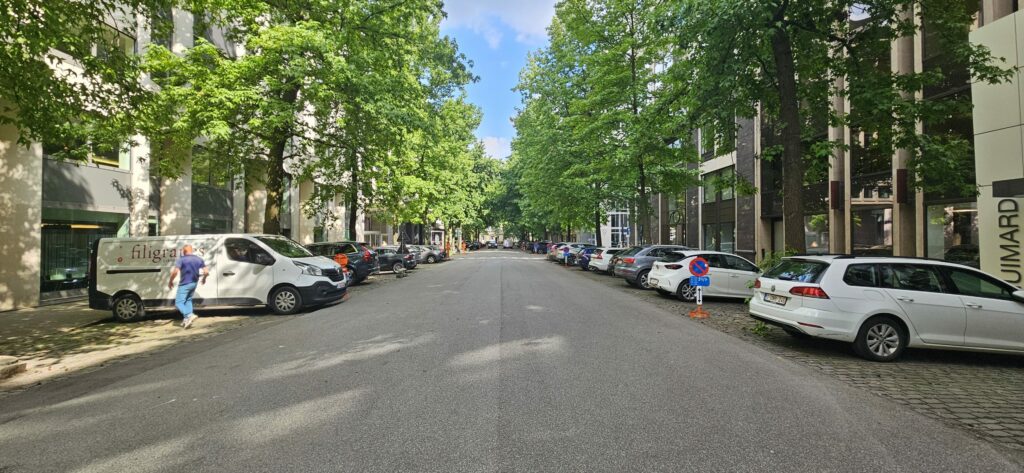
Brussels' European Quarter will soon become greener as the grey asphalted Rue Guimard, in the heart of the district, will be redeveloped to become "a green artery" with trees and plants.
The street is an important connection between Brussels' city centre and the Leopold district. Currently, the space is mainly taken up by the 85 transverse parking spaces. Between those parking spaces, 35 tall trees have been planted in minuscule planting areas.
The trees suffer from a lack of space for their roots, which causes them to push up the street, affecting their health. Now, urban.brussels has granted planning permission for the complete redevelopment of the street.
"Rue Guimard currently has a 'mineral' look, but it will become a new green oasis that connects the city centre and the European district," said outgoing Brussels State Secretary for Urban Development and Heritage Ans Persoons (Vooruit). "This is an important first step towards a pleasanter European district. Our ambition is to transform the district into an attractive place to live, thanks to a high-quality public space full of trees."
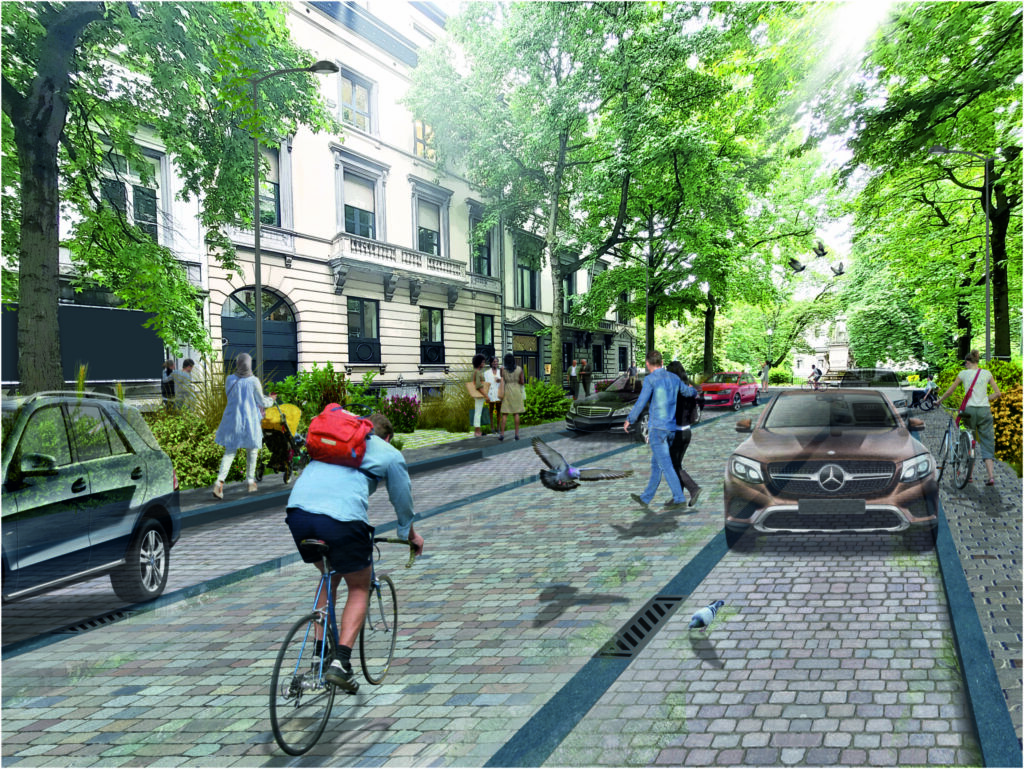
Projet Guimard. Credit: Aménagements urbains VBX
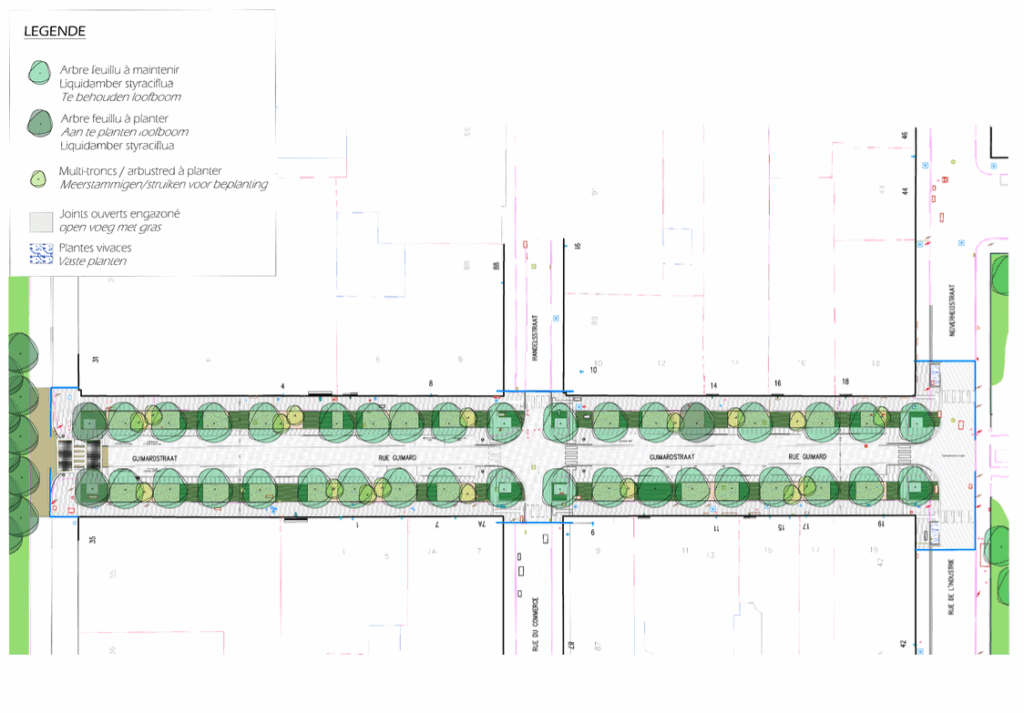
In the project, the parking spaces will first be arranged lengthwise, allowing the pavements to be widened and fully-fledged green areas to be created around the trees. In addition to the parking spaces, there will be reserved spaces and a 12-metre delivery area.
The direction of travel will also be adjusted; currently, there is two-way traffic in the entire street, but in the future, the section of the street from Rue du Commerce to Square Frère-Orban will become one-way. During the redevelopment, 30 bicycle racks will also be installed.
Credit: City of Brussels
Rue Guimard will be the first street that the City of Brussels is redesigning according to its 'Masterplan for the greening of the European Quarter.' The masterplan defines how certain streets should be redesigned to structurally green the public space in the historic district.
"With the redevelopment of Rue Guimard, we are setting the tone for a neighbourhood that is no longer dominated by concrete and cars, but a mixed neighbourhood where it is pleasant to stay," said Brussels city councillor Anaïs Maes.
"More than 1,000 m² will be de-paved – that means less flooding, more biodiversity and a pleasanter street for everyone. This project shows how urban renewal can also be an ecological and social gain," she said.
Maximum de-hardening
The green areas will be supplemented with perennials (small flowering plants), ornamental grasses and shrubs to increase biodiversity. The plants were selected based on factors such as colour, flowering period and landscape value, with special attention to species that are attractive to butterflies and bees.
A greater variety of flowers ensures a richer supply of nectar and pollen, essential for the reproduction of these insects.
The permeable surface in the street currently consists of 26.7 m². The project provides for a de-hardening of 679 m² with another 434 m² that will be semi-permeable. This will allow a large part of the rainwater to infiltrate the soil naturally.
The footpaths and semi-permeable zones are constructed in paving stones, called "platines". The parking spaces are constructed in porphyry stones. The roadway is constructed in sawn porphyry stones with a water ditch in blue stone. The use of these high-quality materials ties in with the heritage of the Leopold District and enhances both the public space and the surrounding buildings.
