
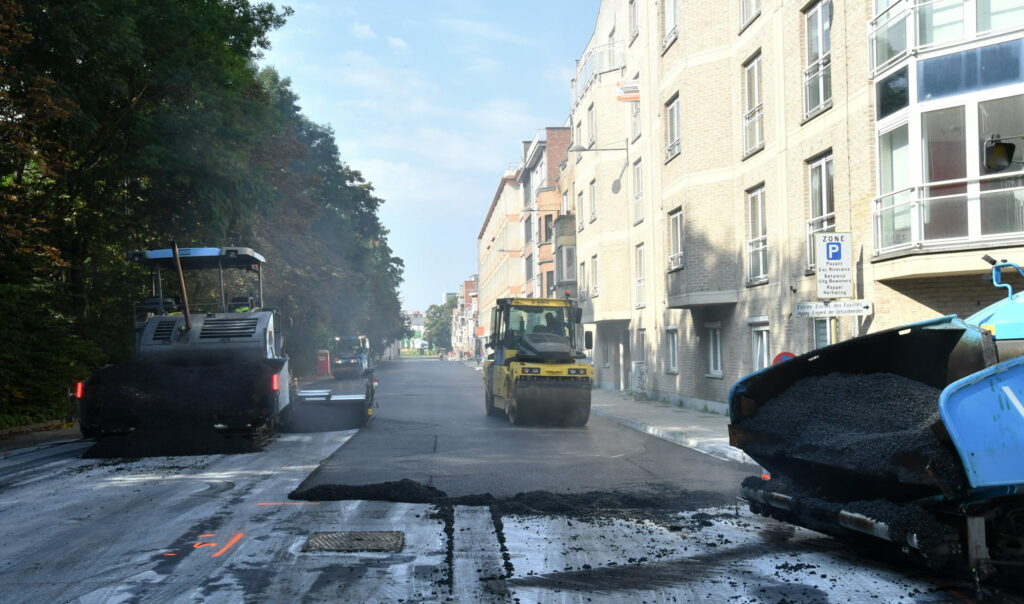
As temperatures are rising and there is less rainfall, road resurfacing works in Brussels are resuming. For the first time this year, however, the resurfacing programme has been drawn up based on an AI scan of the road network.
This year, an additional €10 million has been allocated for the maintenance of regional roads – doubling the 2025 budget.
"This year too, we are investing in the maintenance of our roads and cycle paths: it is an essential measure for road safety, but also for the comfort of all road users: pedestrians, cyclists, motorcyclists and motorists," said Elke Van den Brandt (Groen), Brussels Minister for Mobility and Public Works.
As far as possible, work is being planned for entire sections of road, rather than carrying out smaller, localised repairs. Where possible, this is combined with minor improvements that enhance road safety.
Naturally, local repairs that pose a danger to road users will always remain a priority.
In addition to this maintenance, Van den Brandt continues to invest in road safety, she stressed. "Speed bumps, ochre-coloured cycle paths, new bollards... These are all investments to protect those who prefer active modes of transport."
Plans based on AI analysis
The condition of the regional road network was mapped using a comprehensive AI scan – a first for Belgium. Indeed, this is the first time that a road authority has mapped the entire road network using AI in the country.
First, inspection vehicles equipped with dashcams captured images with GPS coordinates. Specialised AI software analysed the images for deformations, cracks and potholes in the road surface: automatically identifying poor road sections.
Based on this, Brussels Mobility drew up the resurfacing programme for 2026. This list was first checked against locations where redevelopment is planned to avoid overlap.
"The use of artificial intelligence is an excellent opportunity to speed up and further professionalise our services' interventions," said Van den Brandt. "Projects of this kind enable us to monitor the condition of our roads even more closely and to respond ever more quickly to ensure the safety of all road users."
A busy programme
Brussels Mobility's 2026 resurfacing programme kicks off on Monday 23 March with the comprehensive refurbishment of Rue des Charbonniers in the North District, which is in particularly poor condition.
Firstly, the cobblestones will be removed, so the sub-base can be completely renewed. Finally, a new asphalt layer will be laid, and road markings will be created.
Once the work on that street is completed, the roads to follow are Avenue Jules Bordet, Chaussée de Gand, Boulevard Général Jacques, Avenue de la Reine, part of Boulevard Léopold III and Chaussée de Ninove, Avenue d'Auderghem, Avenue de Roodebeek, Chaussée de Tervueren, Boulevard du Midi, and many more.
Where possible, a number of improvements to road safety will also be introduced at the same time: safer pedestrian crossings and cycle paths, adapted road markings, and traffic islands, among others.
As soon as the exact dates for the resurfacing works per street are known, the works will be announced via road signs, door-to-door notices, on a dedicated webpage and via Brussels Mobility’s social media channels.
To minimise disruption to traffic, work will be carried out at night and at weekends wherever possible.
The resurfacing programme will run until the autumn.
