
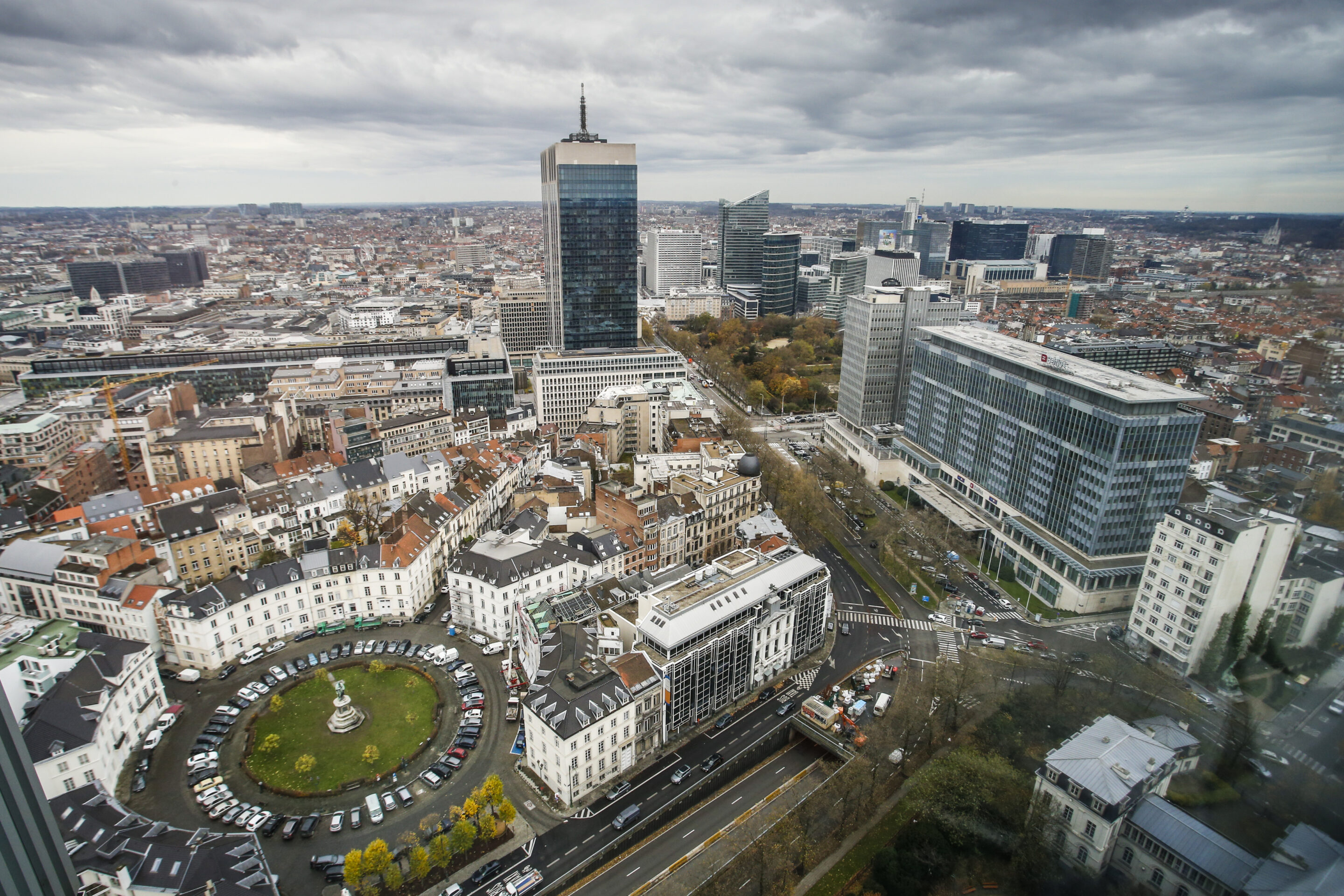
While some might dream of Brussels becoming a 15-minute city, the Belgian capital's recurring transport nightmares and uneven resources risk keeping this mobility dream out of reach.
The '15-minute city’ model has made headlines around the world since it was first introduced in 2016 by Carlos Moreno, a Franco-Colombian researcher and professor at the Sorbonne University in Paris.
The concept envisions cities where residents can reach basic amenities, like supermarkets, cafés or pharmacies, within a 15-minute walk or bicycle ride.
Although the urban planning model has been controversial in the United Kingdom, partly due to misinformation and conspiracies of "climate lockdowns”, elsewhere the concept has been hailed as a framework to improve quality of life, public health and sustainability.
Reacting to car troubles and crisis
Despite only recently making its way into the zeitgeist, the thinking behind the '15-minute city’ is not entirely new. “It's based on proximity-based living,” explains Dr Samyajit Basu, professor and senior urban mobility researcher at the Brussels University VUB.
“If we all talk to our grandparents, they will often say how they used to interact with the community around them, how life was really local, more in the rural side but also in urban places,” he says.
According to Basu, it was largely the introduction of cars that shifted the way people lived. As cars became more affordable and made travelling longer distances more accessible, infrastructure developed to accommodate motorists. In Brussels, the legacy of the city's car-centric policies are still visible throughout the region.
The popularity of Moreno's idea is partly a response to traffic congestion and long daily commutes, which in Belgium are close to 60 minutes on average, according to Basu. “This is a trend throughout Europe,” he adds.
Other possible explanations, according to the researcher, include environmental and health impacts of cars, such as noise and air pollution, as well as recent global crises.
“When Covid came, what were you doing? You were relying back on your local shopping etc. so this also has some psychological effects on us. We started thinking more locally due to this disruption, that we should be resilient locally.”
Embracing proximity in Brussels
In the Belgian capital, the idea of a '15-minute city’ is built into the 2020-2030 Regional Mobility Plan Good Move.
But the regional vision focuses more on creating a "city of proximity” based on local needs rather than beating a 15-minute timer, according to Kätti Rob, project manager at the regional development centre, perspective.brussels.
"The closer the amenity, the more frequent it is used or it addresses the most fragile public in terms of walkability, such as kids, elderly people, for example,” says Rob.
According to the project manager, Brussels “already possesses many of the qualities associated with the model”, with “many neighbourhoods already providing access to daily needs within walking distance, supported by a dense public transport network".
While perspective.brussels’ studies show "most residents” can reach commercial and many basic services in under 20 minutes, Rob says this is not always the case when it comes to reaching amenities that address "climate challenges", such as public water taps, and services that promote more sustainable ways of living, like repair services.
Additionally, the region still struggles with “unevenly distributed” resources. “Access to green spaces, social and healthcare facilities, cultural infrastructure and some educational services varies significantly between neighbourhoods,” says Rob.
“The challenge for Brussels is therefore less about creating proximity from scratch and more about preserving, strengthening and balancing an existing proximity model across the entire region,” Rob adds.
Resisting EU gentrification
While the region wants to bring services closer to residents, it is "wary” of viewing a city of proximity just through the lens of time, according to Els Wauters, spokesperson for the Regional Mobility Minister Elke Van den Brandt (Groen).
“A service 10 or 15 minutes away is not truly accessible if its prices are out of reach,” says Wauters. "So the real test is genuine, affordable access for the people who actually live in a neighbourhood.”
Guaranteeing affordability is particularly important for housing, given the higher risk of gentrification Brussels already faces due to the high-earning short-term workers that the European institutions attract, according to Basu. “It's already happening,” he adds.
For the regional mobility minister, mitigating the risk of widening inequality requires "proximity” to be delivered across the whole region, not just in "well-served central areas".
Part of the solution, according to Van den Brandt's spokesperson, is the region's urban-renewal contracts, which help ensure “less advantaged neighbourhoods” benefit from improved spaces and services.
Moving away from cars
Mobility is, of course, one of the pillars of a "15-minute city", as the model aims to encourage people away from using private motor vehicles, like cars.
For Brussels to thrive in this way, Basu explains that the region needs to improve its walkability, bike infrastructure, and the integration of public transport. The latter refers to reducing the number of lines passengers need to take to reach their destination, while reducing overcrowding and improving affordability.
As the region addresses this, however, Basu underscores the importance of not viewing accessibility as an afterthought so as not exclude the elderly and those with disabilities or reduced mobility.
Additionally, security will remain a crucial topic for Brussels as it promotes the city of proximity vision given that the model is based on people spending more time outdoors, according to the VUB researcher.
A growing, diverse city
Realising the proximity-based vision will further see the region contend with challenges that come with changing populations, and the different needs of multi-cultural Brussels residents, according to VUB's Basu.
“Sometimes you have businesses which cater to certain communities placed around only a few zones, so then if someone needs services or products from that business, and he or she doesn't live in that zone, then he or she needs to travel very far,” he explains.
Despite all the challenges ahead, for Rob, brussels.perspective's project manager, it is not a question of if, but how Brussels will truly become a version of a '15-minute city’.
“How can the region preserve and strengthen its existing qualities of proximity while ensuring that every neighbourhood benefits from them equally?” she asks.
The Brussels Times contacted Brussels’ Secretary of State in charge of urban development, Audrey Henry (MR), for comment, but has yet to receive a response as of the time of publication.
