
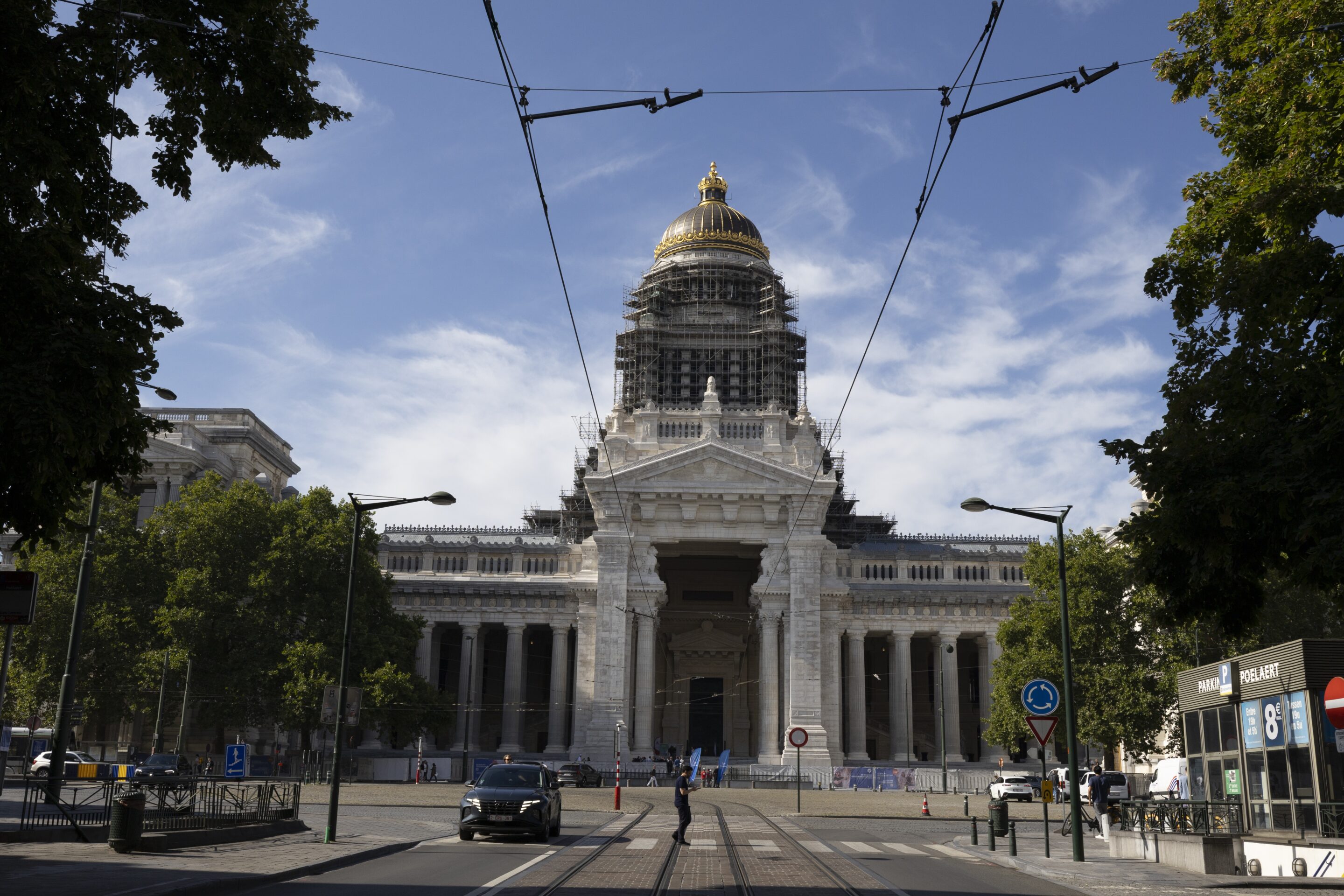
For more than 40 years, Brussels’ Palace of Justice was hidden behind scaffolding, a monument to neglect as much as to justice. Now its grand façade has finally re-emerged. Paul Meller meets the stonemasons, sculptors and craftsmen painstakingly restoring one of Europe’s most extraordinary buildings – and asks whether Brussels can finally learn to love its troubled giant again.
Luc the fox needs a new home. Named after the late Flemish singer Luc De Vos ('vos' means fox in Dutch) by workers at the Palace of Justice, Brussels’ oldest building site, he has lived here longer than anyone can remember.
Other animals reportedly include a stone marten and, inevitably, pigeons, already staining the newly scrubbed stonework of the main façade facing Place Poelaert – now, thrillingly, free of the scaffolding that shrouded it for four decades.
“We are thinking of employing a falcon to scare them away,” says Albertina De Pelsmacker, an architect with Artes, the contractor managing Phase 1 of this vast restoration.
For most Brussels residents, the Palace of Justice has been almost inseparable from its scaffolding. The first structures went up in 1984 and, for decades, so little happened behind them that the metal poles seemed part of the monument.
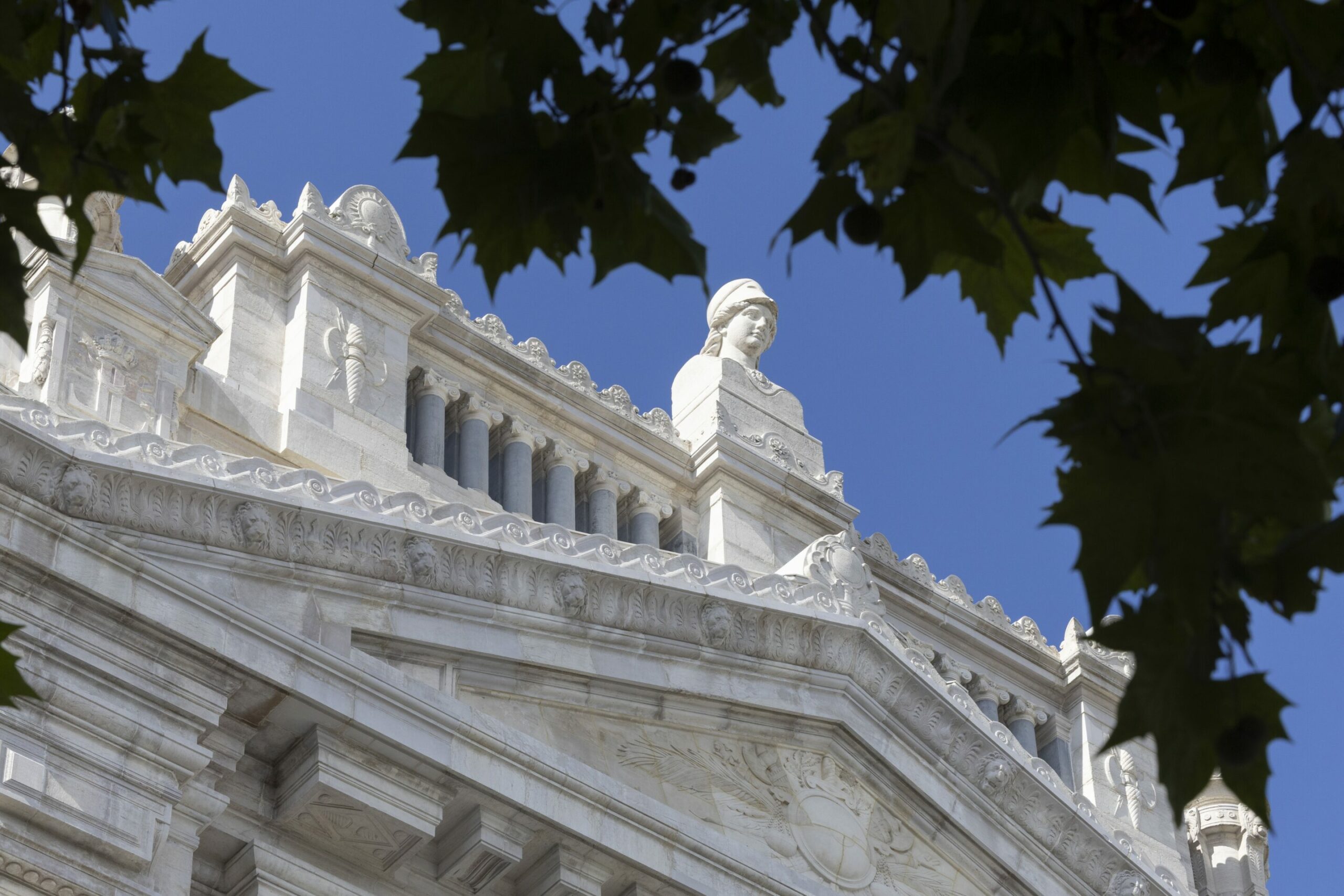
Brussels Justice Palace during a press moment to mark the completion of the restoration of the front facade of the Brussels Courthouse (Palais de Justice/Justitie Paleis), on Thursday 27 August 2026. Credit: Belga/Nicolas Maeterlinck
The front façade remained wrapped in metal and plastic, hiding monumental staircases, statues, giant oak doors and neoclassical columns – part of the “mountain range of stone” and “forest of columns” evoked by German writer W.G. Sebald in his novel Austerlitz. In the quiet spaces behind the sheeting, wildlife moved in.
That changed as the restoration finally gathered pace. In recent months, between 50 and 100 stonemasons, carpenters, marble restorers, architects and others have been at work on the site on any given day. For Luc, life has become considerably more complicated.
Then, at the end of June, Brussels saw something it had not seen in more than 40 years: the Palace of Justice emerging from behind the scaffolding.
Removing the structures from the main façade marked far more than the completion of Phase 1. After decades in which the scaffolding had come to symbolise political neglect, false starts and an apparently endless restoration, the cleaned frontage facing Place Poelaert is now visible again. Its Minerva bust, owls, Medusa and other details high above the entrance have been painstakingly restored.
At the end of August, ministers and officials made that change formal, cutting the ribbon as the restored front and main portico were opened to the public. The three-year first phase cost €31.7 million and covered 22,750 m² – almost five football pitches – including the peristyle and courtyard of honour.
Ancient craft and high tech
The work mixed new technology with old-fashioned craft. Before restoration began, detailed scans and Building Information Modelling mapped the façade down to the millimetre.
Damaged stone was replaced with custom-cut blocks, including Comblanchien limestone from the Burgundy quarries used by Poelaert in the 19th century and Belgian blue stone from Soignies. Two four-tonne corner blocks were replaced 28 metres above the ground.
Joints were renewed to keep out water, while 140 windows and 60 doors were restored, along with roofs, floors, monumental bronze doors and the marble statues around the entrance.
For Justice Minister Annelies Verlinden, the unveiling was “much more than a simple repair of stones and facades”. She called it a visible success that offered “hope and perspective” – while acknowledging that the dilapidated interior, plagued by leaks and other problems, now urgently needs attention.
Vanessa Matz, the minister responsible for state buildings, said Brussels was “finally turning the page”. But only the first page: work on the base of the dome is due to begin in 2027, followed by the side and rear façades. The target is to remove all the current scaffolding by 2030, the bicentenary of the Belgian Revolution.
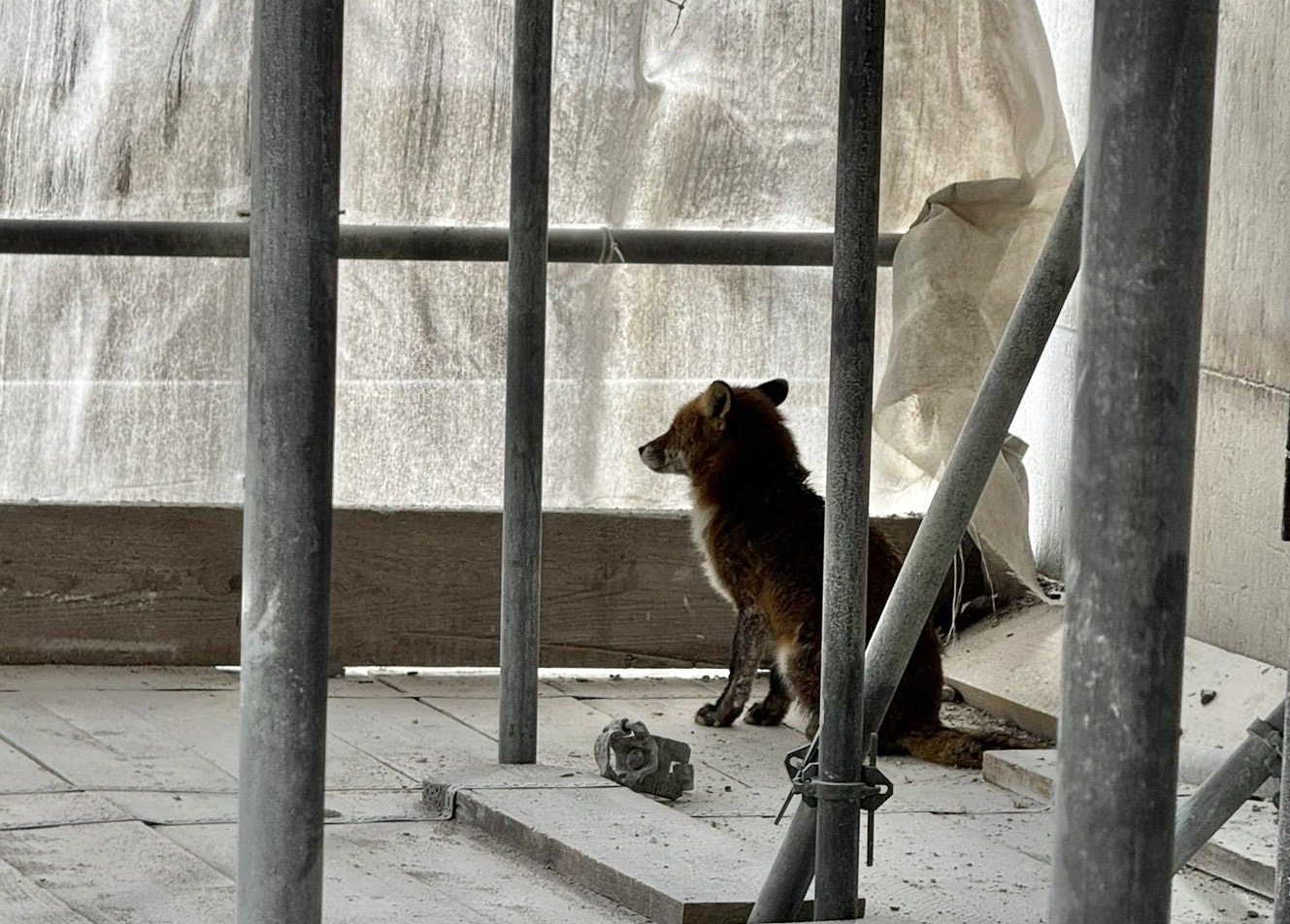
Luc the fox.
Luc is in luck, though. The disappearance of the front scaffolding does not mean the Palace is finished. Far from it. The remaining three phases of the exterior restoration are expected to take another nine years, if all goes to plan. Next comes the giant plinth supporting the gold-bedecked dome that sits above Brussels like a crown.
After that, attention turns to the remaining sides and the courtyards designed to aerate the depths of this cavernous building. The interior is another story. So, assuming all this activity does not scare him off, Luc should still find somewhere to live on the site.
The Palace’s original construction took just 17 years to build – less than half as long as the restoration has already taken. Architect Joseph Poelaert’s magnum opus, completed in 1883, four years after his death, was the largest building erected anywhere in the 19th century. Belgium was then the world’s second-richest country after Britain, and the Palace was designed as a monument to that wealth and ambition.
Chiseller on the roof
Sophie Verheyen is a stonemason from Ghent. She has worked on other major buildings – Bozar and Antwerp’s Handelsbeurs, for example – but nothing like this. “It’s one of the biggest buildings in Europe. I’m glad to be part of this project,” she tells me on my first visit, as we climb to her perch 40 metres above street level on the fourth deck of the scaffolding.
Giant blocks of Comblanchien limestone, quarried near Dijon, are roughly carved by robots working around the clock in Bruges, finished by hand in the atelier, then transported to Brussels, hoisted by crane and fitted into gaps where the original stone is beyond repair. Each block is numbered. “It’s a bit like Lego,” De Pelsmacker jokes.
“On site we place the blocks and, where needed, carve or adjust final ornamentation for fit and finish,” Verheyen explains, laying out her tools and thermos in a makeshift tent. The first time I visit the site, it is a cold, wet February morning, and rainwater runs down the inside of the black protective sheeting.
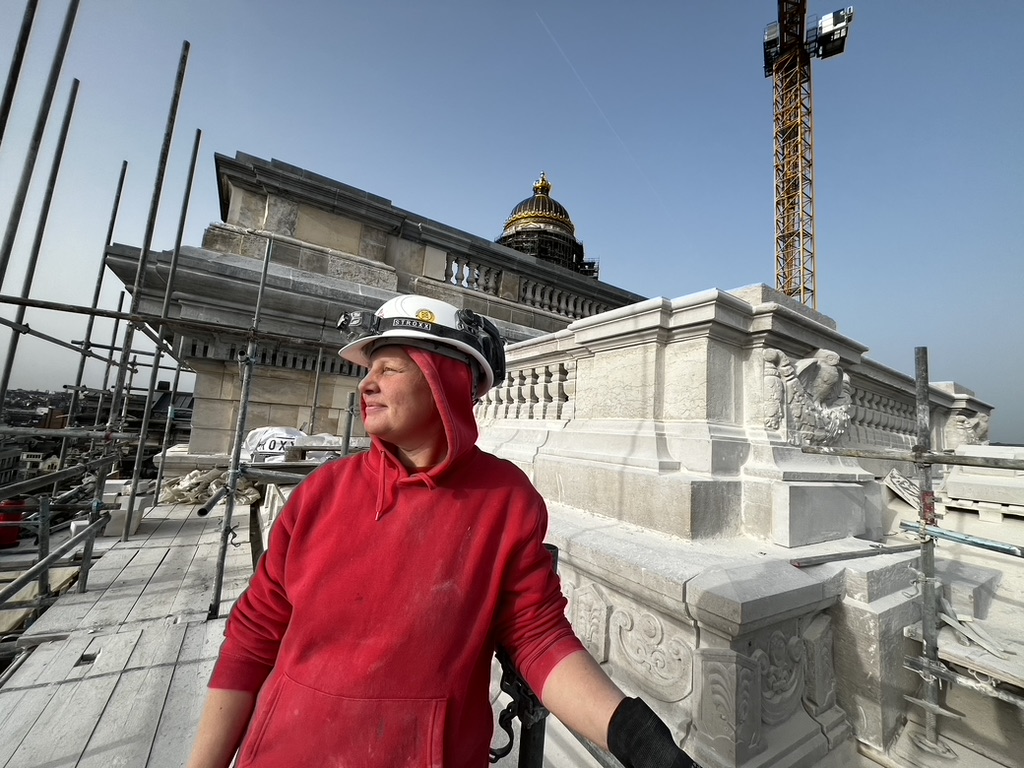
Sophie Verheyen.
“Weather is a big challenge. We protect ourselves in our tents but if it rains very heavily that can stop work,” Verheyen says. It is heavy work, lifting stone and constantly climbing the scaffolding. “I’m doing physiotherapy for my back,” she says. She is the only woman stonemason on the project. Many of her colleagues are from Central Europe, mainly Romania, and are quick to help with heavier lifting.
Why choose such strenuous work? “My love of stone came from visiting Florence when I was 18. I saw Michelangelo’s Unfinished Slaves – the figures emerging from the stone. It blew me away,” she says.
Verheyen studied sculpture at art college in Antwerp, followed by a year in restoration and conservation before starting work in architectural restoration.
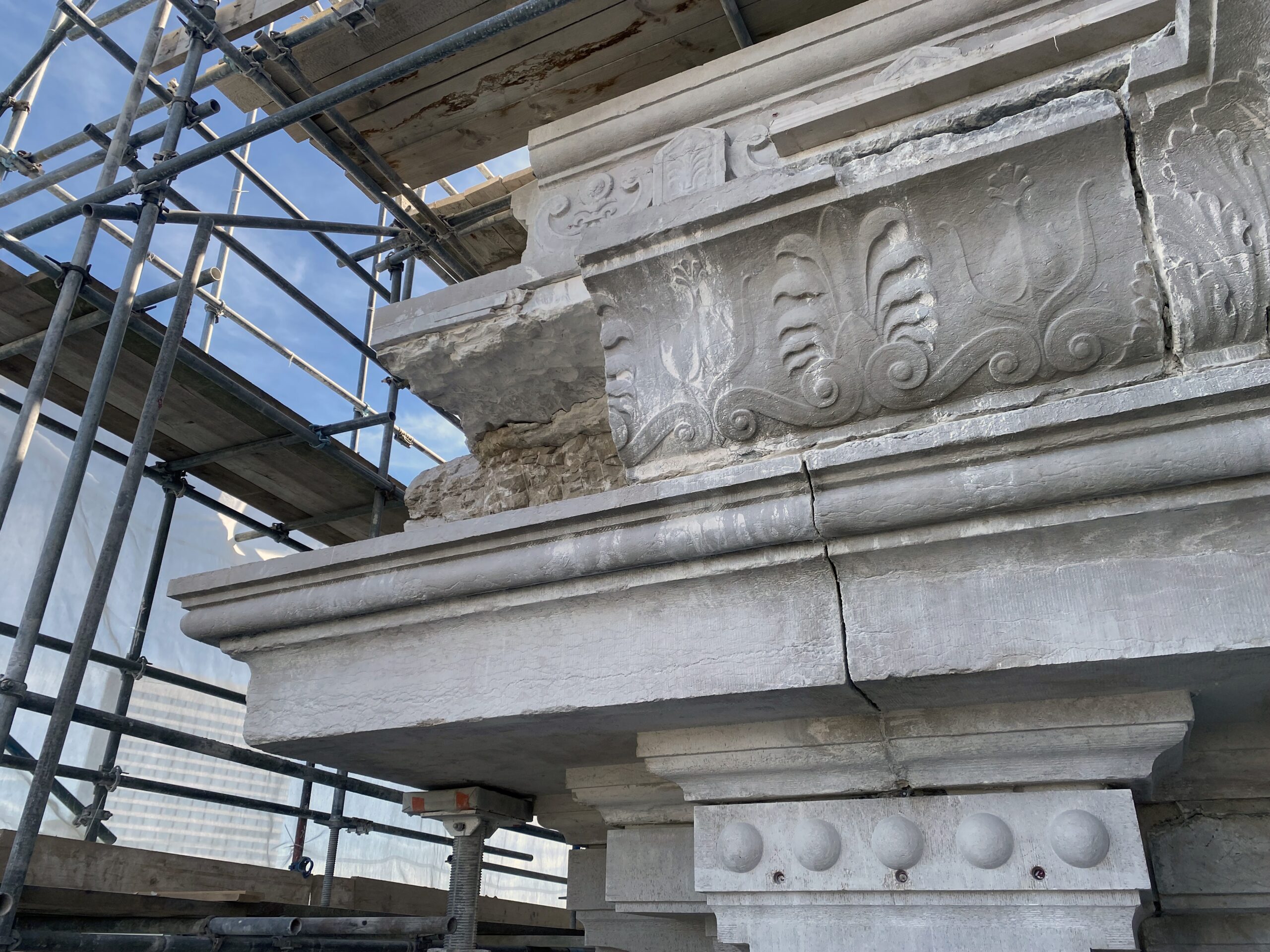
A visit to the renovation works of the Brussels Justice Palace is organized on Friday 19 September 2025. Credit: Belga/Sarah Van Hecke
After four years in construction, she saved enough to spend four months in Carrara, Tuscany. It is almost a rite of passage for an aspiring European sculptor, and she recalls it fondly: choosing stone from a quarry with a friend and making small sculptures.
But real life intervened back in Belgium. She started a family and lost one construction-site job because, she says, her employer assumed her responsibilities at home would make her unreliable. After her second son was born, she hung up her hard hat and moved into orthopaedics, making plaster models and silicone prosthetics. “That was also craft work,” she says.
Four years later, she returned to restoration. Then the Palace job came along. “I really wanted to be part of a major project,” she says.
Most of the Palace exterior is Comblanchien, with Savonnières limestone from ancient quarries in Lorraine and Belgian blue stone. Verheyen has sculpted local fauna – dragonflies, butterflies and birds – in blue stone for a Ghent park, but her favourite material is marble.
“I don’t have the qualifications to work on the marble statues. I’ve offered to help restore marble lettering. I’d love to do that,” she says.
Toes and togas
Samuel Coomans does have those qualifications. On a return visit in April, I meet him working on four larger-than-life marble statues guarding the two enormous staircases rising from the peristyle around the Palace’s main entrance.
Coomans, from Beauvechain in Walloon Brabant, is repairing Demosthenes’ broken left big toe and chipped toga. The Athenian orator and politician stands opposite Lycurgus, the Spartan lawmaker. Across the peristyle stand Cicero, the Roman lawyer and philosopher, and Ulpian, the influential Roman legal scholar.
The toe has proved troublesome. The broken piece was lost, and the first replacement was too flat, so it had to be reworked to point slightly upwards.
Coomans attached the new marble toe with bio-epoxy resin; to match it to the foot, he will use a tinted silicate stain and mortar. “There’s no oil-based resin here or anywhere on these statues,” he says.
“Many of the techniques we use date back to the birth of mathematics; the compass, for example – we are still using basically the same instrument in sculpture and restoration today.”
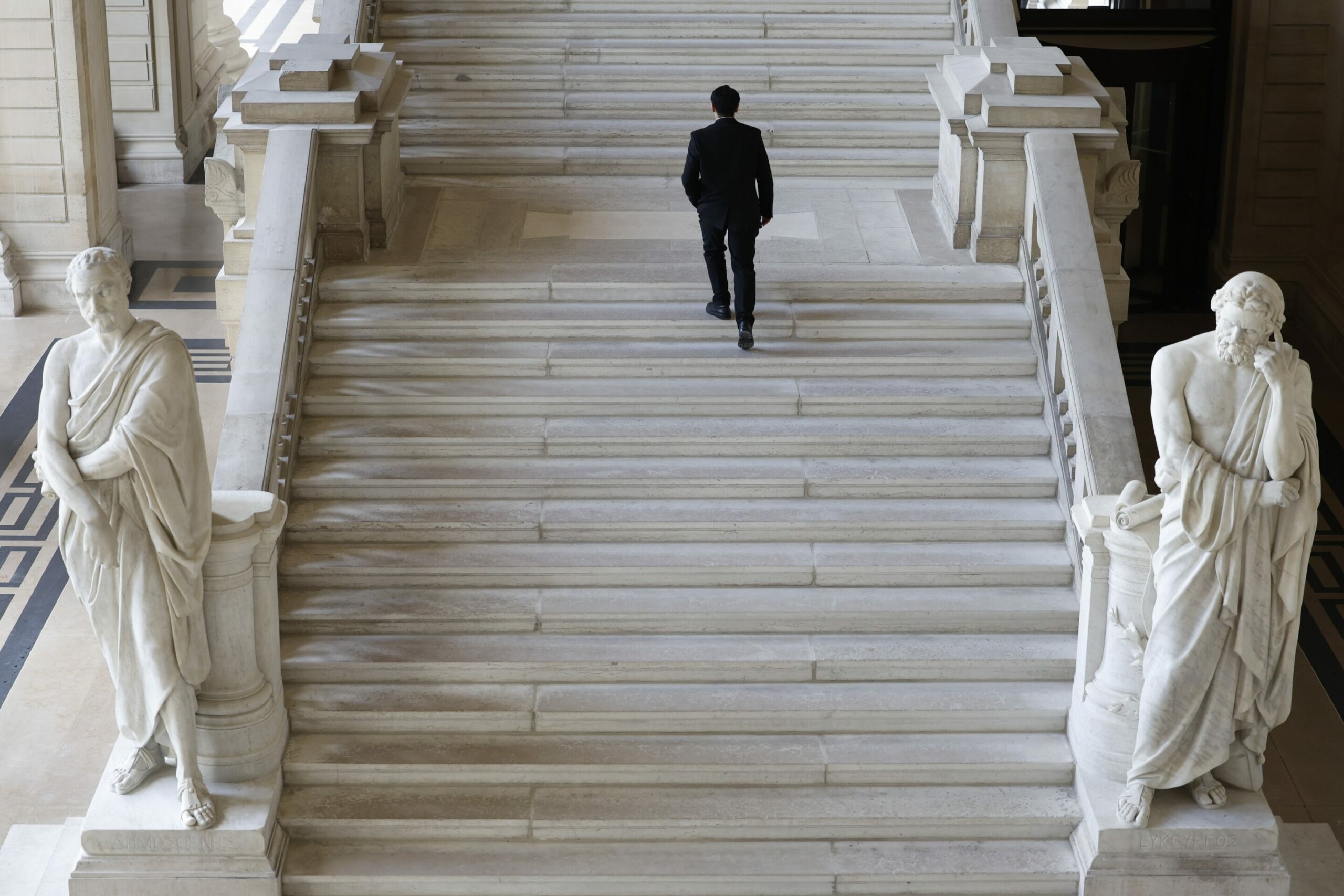
Stairs of Brussels justice palace pictured after a press briefing to mark the completion of the restoration of the front facade of the Brussels Courthouse (Palais de Justice/Justitie Paleis), on Thursday 27 August 2026. Credit: Belga/Nicolas Maeterlinck
Modern techniques – robots carving large blocks, 3D printers and the like – are useful, he says, but only go so far. The final few centimetres must be done by hand. “You don’t want it to look too perfect. Perfection is a barrier – it becomes soulless,” he says.
Like Verheyen, Coomans has moved between restoration and art. He studied at Brussels’ Royal Academy of Fine Arts, spent a year in Carrara and returned to complete a master’s in sculpture, intending to become a full-time sculptor.
Financial necessity steered him towards restoration, which helped pay for his studies. Fatherhood pushed him further towards a reliable income. “When the kids arrived, it was clear I would move towards restoration,” he says during a cigarette break.
Working on the peristyle’s marble statues was a rare opportunity. “It’s not often you get to work on a project so big. The building has been criticised for being too big, too expensive, a whim of King Leopold 1, the building that broke the Marolles district, but you can’t deny it’s a building of great historical value,” he says. “Architecture is important – it gives a city an identity. This building does that for Brussels.”
Wood instruments
A stone’s throw away, I meet Ionut Ciprian Hutuleac and Marius Adelin Ciobanu, two Romanian carpenters repairing one of the massive oak doors leading from the peristyle into the building.
Marius followed his carpenter father to Belgium for work in 2021; Ionut came too. In Romania they made doors for private houses. “It’s the same thing here, only bigger,” he says. At more than six metres high, the Palace’s doorways are indeed taller than a double-decker bus.
I meet at least six Romanian stonemasons during my visits. Is it becoming harder to find masons in Belgium? “Young people aren’t being attracted to the craft. That’s why there are so many Romanians here,” says Isolde Verhulst, an architect with Perspectiv, which has overall responsibility for the restoration.
Coverage of the restoration of Notre-Dame in Paris focused heavily on traditional craftsmen and techniques. Verhulst says the same is true here, although she does not particularly like the comparison – perhaps because Notre-Dame was restored in five short years.
“This is a much bigger challenge than Notre Dame,” she says. “Not only is this building far bigger – cranes can’t reach much of the site – but also, the Palace has been occupied throughout the project, which complicates our work.”
Palace fees
Vanessa Matz, Minister for Public Administration and Modernisation, whose responsibilities include state buildings, estimates the full exterior restoration will cost €100 million. She says this forms part of €600 million in government investment in judicial infrastructure, including courts and prisons.
No budget or timetable has been agreed for the much-needed modernisation of the Palace interior, but in written responses Matz says that too will require “significant funds”.
“Of course, a project of this magnitude is necessarily long, complex, and costly,” she says. “It is an iconic building, which is not only an architectural masterpiece but also a symbol of the rule of law. Today, we are working to restore this monument to the status it deserves: that of a vibrant, functional building serving the justice system and the public,” Matz says.
Legal foundations
Jean-Pierre Buyle has been pleading cases inside the Palace since the first scaffolding went up. A lawyer and co-founder of the Poelaert Foundation, he has lobbied hard for both its restoration and the preservation of its role as a building dedicated to justice.
“I feel good working in the Palace, when you plead there, you have a sense of serenity, the spaces in the building are magic, with large enough dimensions to permit that justice is carried out in excellent surroundings,” he says in a telephone interview in French.
Not everyone shares his enthusiasm. In 2010, during Belgium’s EU presidency, a Europe-wide competition invited ideas for the Palace’s future. One popular entry proposed demolishing it and reconstructing the Marolles roads and alleys that existed before it was built.
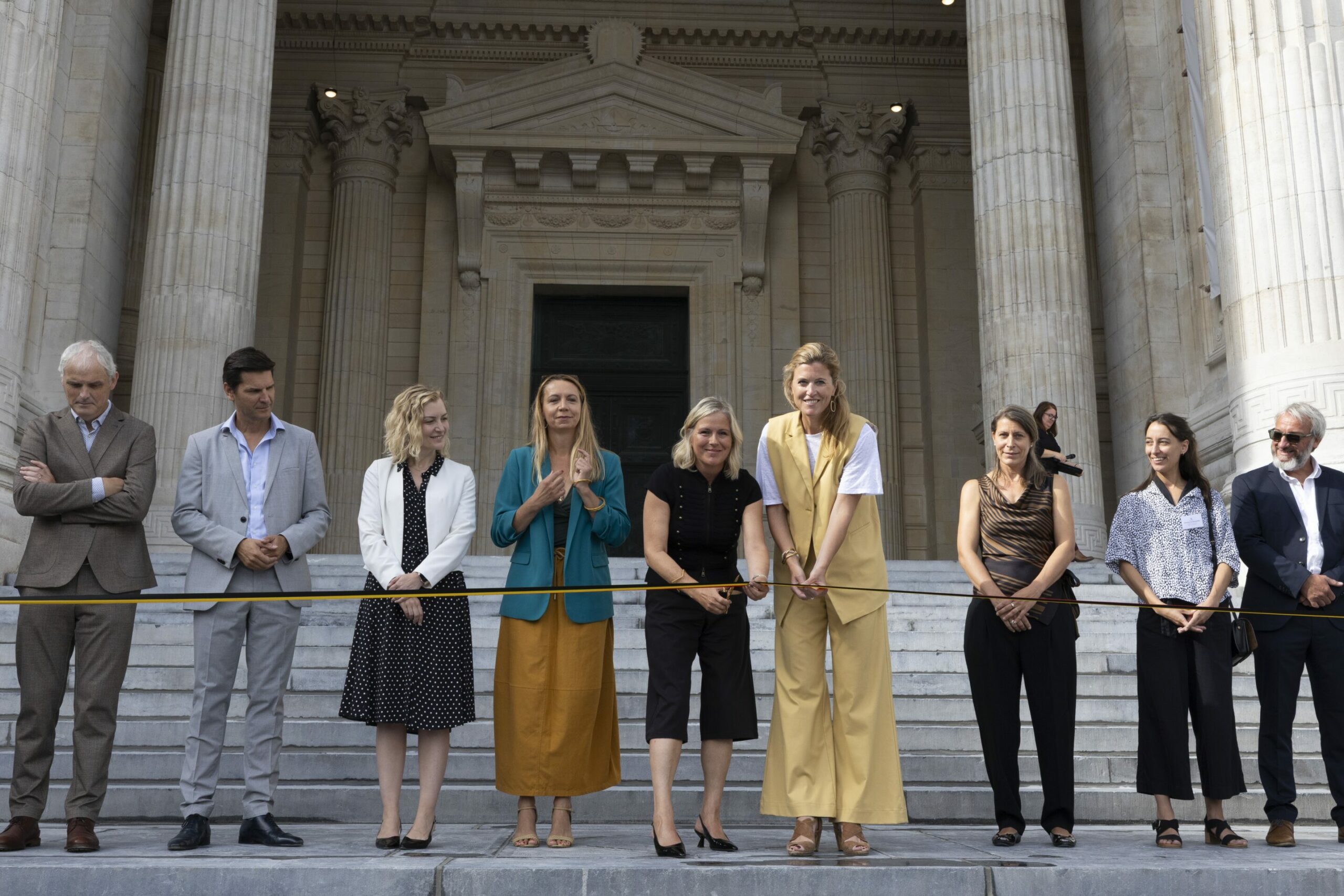
Brussels region State Secretary Audrey Henry (3L); Brussels region state secretary Ans Persoons; Minister of Public Modernisation Vanessa Matz; Minister of Justice Annelies Verlinden during a press briefing to mark the completion of the restoration of the front facade of the Brussels Courthouse (Palais de Justice/Justitie Paleis), on Thursday 27 August 2026. Credit: Belga/Nicolas Maeterlinck
To this day, many Marolliens curse the building looming over their district.
Brussels dialect even has an insult inspired by Poelaert, who chose the site and became a figure of hatred for the homes destroyed to build it: if someone in a bar loudly calls you a “schieven architect” or “skieven architek” – literally a crooked or shameful architect – the room may go quiet, and it may be time to leave.
For decades, the Palace was unloved and neglected, its scaffolding the most visible emblem of the failure to restore it. Buyle cites two reasons. “First, we haven’t had a Bruxellois justice minister for a long time – it’s always been a Fleming or a Walloon, so there hasn’t been anyone with real conviction pushing for the restoration. And second, ministers have been afraid to tackle the project, afraid of the cost.”
The June unveiling therefore carried unusual symbolic weight: for the first time in a generation, Brussels could see that restoration was no longer merely promised but visibly under way.
Shrine to justice
I arrived in Belgium in 1996 shortly before the scandal erupted over Marc Dutroux, the serial killer and child molester. The country was enraged by the failures of its judicial system. Grief and anger culminated in the White March that October, one of those rare moments that seemed to unite the country.
My first close-up glimpse of the Palace was of a shrine: thousands of bouquets, teddy bears, cards and photographs of the four murdered girls, piled on its steps. Four small smiling faces amid the mountain of stone and forest of columns. The contrast was shocking; the absence of justice seemed to burn.
Buyle agrees it was a dark period in Belgian history, when confidence in justice was weak. “Back then magistrates were selected according to their political allegiances. That has now changed, they are now selected based on their academic merit,” he says.
Architecturally, there is plenty to celebrate: after more than four decades, the return of the main façade to public view has transformed one of Brussels’ defining landmarks.
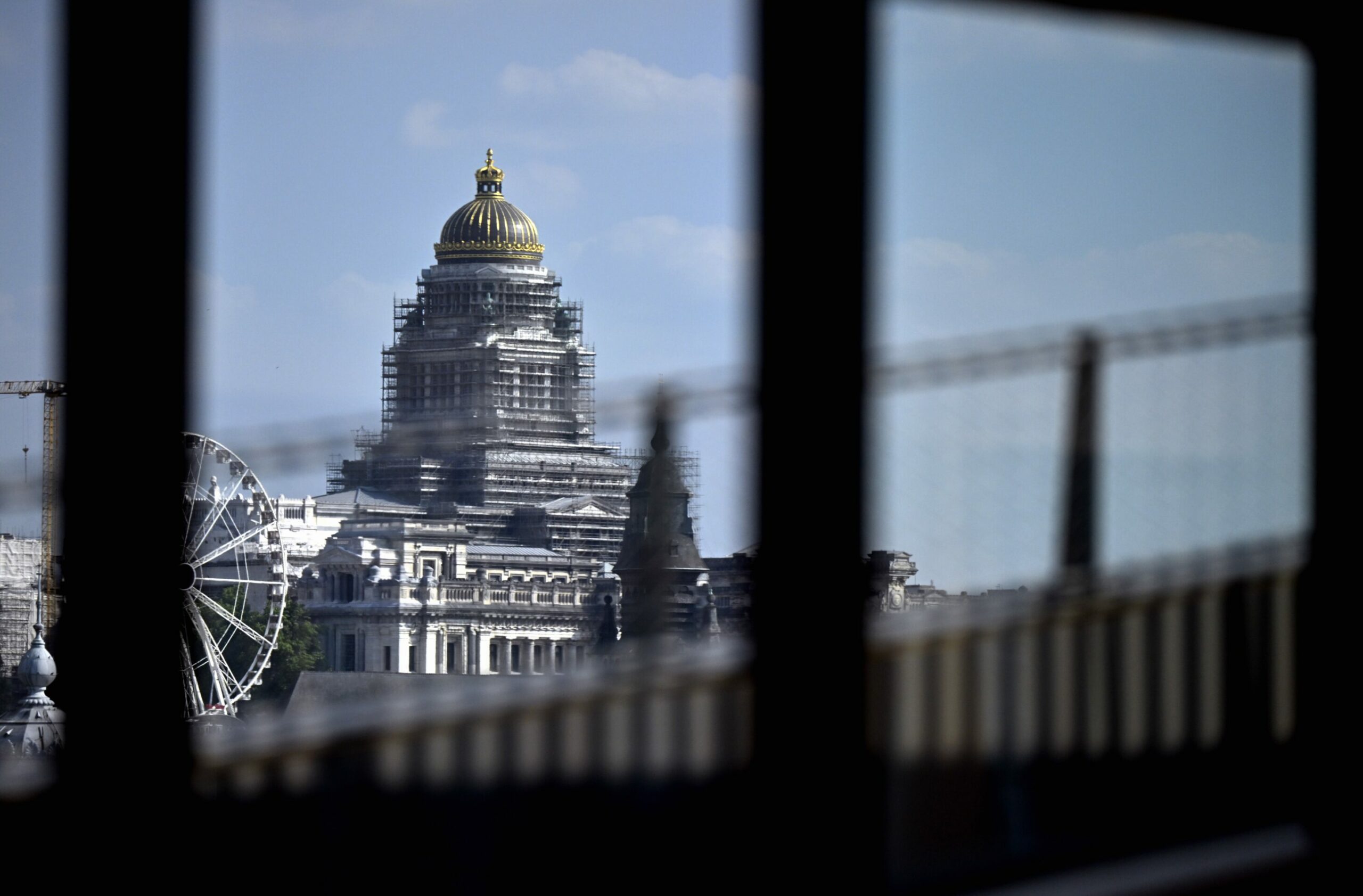
Picture of the Palace of Justice taken from the 58 rooftop, in Brussels, on Wednesday 18 June 2025. Credit: Belga/Eric Lalmand
But the Palace is more than a monument. Does Belgium’s justice system deserve a celebration too? Critics would point to chronic prison overcrowding, court delays, under-investment and growing pressure from organised crime, from the port of Antwerp to the streets of Brussels.
For Buyle, however, the restoration is about reconnecting the Palace with the city. “The aim of this restoration is for citizens to reappropriate this building. It was hidden in a sarcophagus of scaffolding, unloved,” he says.
“We want to give this building back to the people, we want people to fall in love with it again, so in a sense the renovations are like St Valentine for the Palace of Justice.”
St Valentine – an idea for a new statue, perhaps? I offer an alternative: Sisyphus, eternally pushing a boulder up one of the grand staircases. “Yes,” he chuckles, “that could be a symbol of the struggle we’ve had over the years on behalf of the building.”
