
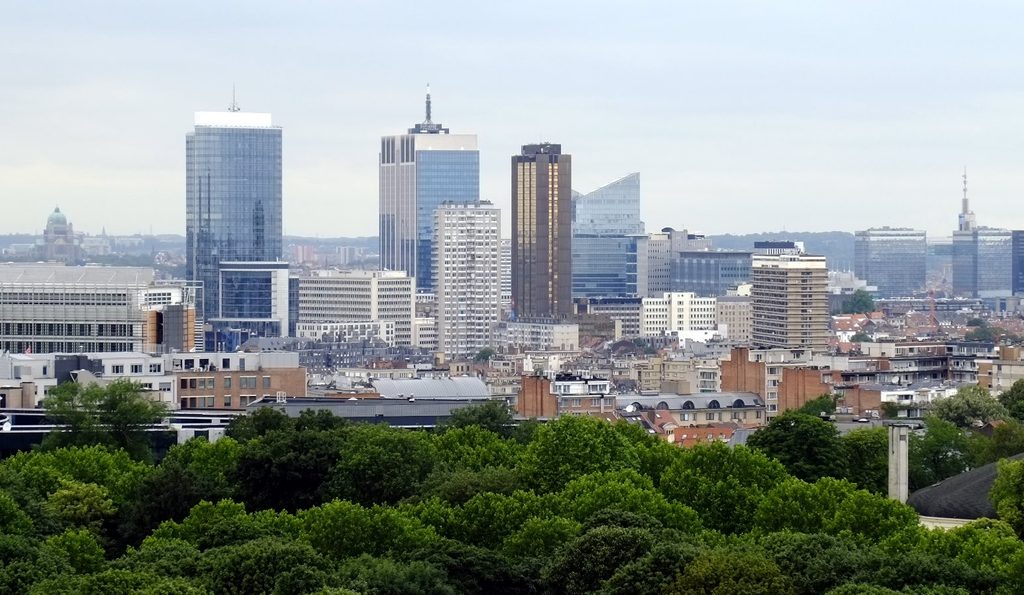
Local property taxes have been rising across the Brussels-Capital Region, setting up a potential exodus of businesses to neighbouring Flanders as office leases come up for renewal.
Last year, 1,687 VAT-registered businesses left Brussels for Flanders – 424 more than went the other way, according to figures released by Belgian statistics agency Statbel this week. Similarly, there was a net loss of 463 firms leaving the Brussels-Capital Region for Wallonia.
The trend is not new, but the gap between those leaving and arriving has widened since the Covid-19 pandemic.
"These figures must be viewed objectively," a spokesperson for Brussels Minister for the Economy Laurent Hublet (Les Engagés) told the Brussels Times.
His office highlights the growing number of businesses starting up in Brussels, as well as higher income for both industry and business services firms this year.
"The negative migration balance should therefore not be mistaken for a general decline in entrepreneurship in Brussels. Our challenge is to strengthen this momentum while removing the obstacles that may lead some businesses to leave the Region."
High property tax to blame for businesses leaving Brussels
Thierry Geerts, CEO of the business representative body Beci, told The Brussels Times that property taxes levied by municipalities are a key driver of businesses leaving Brussels, as they have risen significantly in recent years.
Beci had already warned about property taxes, as a lag exists between increases and when businesses choose to move, since they often wait for a trigger such as a lease renewal or the need to expand.
"That's why governments say, 'well, the companies are not moving because of taxes'. That's true and false. It is true that they are not moving for tax, but at the moment they consider moving it's a very important element of the puzzle," Geerts said.
"We had already complained about it one year ago, as it was increasing year by year for a while, but now we see an explosion."
Municipalities levy a range of taxes on business property, including their own share of property tax, alongside an office-space tax. These sit alongside a regional non-residential floor space tax. Businesses are facing rising property-related taxes, including higher communal office-space levies and increased surcharges on property tax.
In the City of Brussels, the annual office-space tax rose from €9.58/m² in 2021 to €24 in 2025, a 151% increase.
More recent above-inflation increases were recorded in Anderlecht (from €17 in 2025 to €24 in 2026), according to data from business consultancy Ayming.
Overall, eight Brussels municipalities also increased their property-tax surcharge between 2025 and 2026 by roughly 20% on average.
Ayming shows that among communes raising their property-tax surcharges in 2026, the average increase in Brussels was higher than in Flanders (15%) and Wallonia (10%).
"You can accept that to be in the centre of this magnificent city, which is the European capital, you have an additional cost that's acceptable," argued Geerts. "So let's say you pay 30% more in the centre of Brussels than in Flanders, that would be okay. But not 100% more, not 10 times more."
'This Region is killing itself'
Municipalities in Brussels are increasingly reliant on raising their own funds through taxes, following a decline in funding from other levels of government. This may partly explain recent increases in property tax rates.
The push by communes to raise funds creates a potential tension with the Region, which is focused on economic competitiveness and keeping businesses in Brussels.
Just last week, Hublet launched Oxygen Brussels, a plan to make life easier for SMEs and support their development. This was part of his wider All.In plan which aims to revive the Brussels economy and inject it with greater dynamism.
However, such plans can't escape Brussels' geographic reality: firms can move to neighbouring municipalities just over the border in Flanders, depriving the Region of tax income.
"Most of the companies are not quitting Brussels," argued Geerts. "They technically quit the Region of Brussels Capital, but they stay in the Brussels Metropolitan Region."
Colliers, a commercial real estate management company, warned in 2025 that Brussels was at risk of becoming just an administrative hub with new tech and smaller companies leaving.
"Unless office taxes are harmonised and eased, Brussels will keep losing business and its energy to neighbouring regions," they argued.
Geerts gave the example of real estate companies that can't rent out office space because the local tax is too high. "So this Region is killing itself in a way."
