
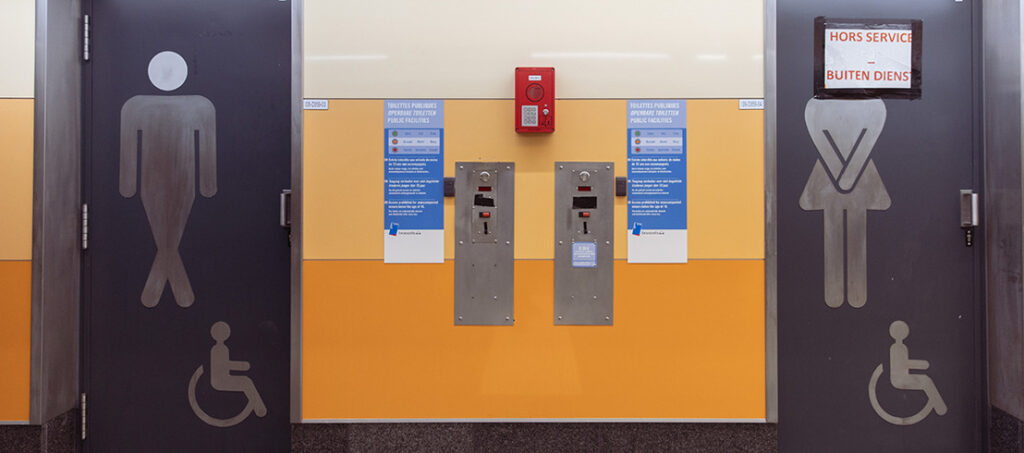
Public transport operator STIB operates dozens of public toilets in and around its stations. Due to closures and dirtiness, they often lie unused, but turning this situation around is not as simple as it sounds.
STIB has a total of 43 toilets, of which nine are located in Metro stations and 34 on the above-ground network, of which 26 are accessible to people with mobility issues. Based on a brief survey focused on STIB's Metro station toilets, Vooruit.brussels MP Els Rochette argued that the findability, access to and cleanliness of STIB toilets leave much to be desired. They are used 1,150 times every year on average, or three times a day.
"Use is low. It is doubtful that toilet visits in busy stations such as Bourse are proportional to the number of passengers," Rochette said. "Yet it is wrong to conclude on that basis that there are enough toilets."
The lack of toilets was also highlighted in a recent study which showed that, with one toilet per 11,000 inhabitants, the current provision of public toilets in the centre is limited. It found many are often inaccessible.
Physically and financially accessible
According to Rochette, the lack of people using STIB's toilets is down to people not knowing about them, in part due to them being poorly signposted. "People above ground know that there is a toilet in underground stations," said Rochette.
Guy Sablon, spokesperson for STIB, noted that within the station, there are plenty of signs indicating where the public toilets are located." But we are also going to add this information to neighbourhood plans and include it on the website to inform more people," he told The Brussels Times.

Porte de Namur Metro. Credit: Belga / Paul-Henri Verlooy
She added that the toilet at Bourse, for example, is often closed. "Such a busy metro station should simply offer more facilities, in proportion to the number of passengers." Sablon said STIB carried out 26 temporary closures in 2021 and 2022, mainly to carry out repairs.
Rochette also argued that the fact people have to pay for using these toilets is a deterrent, and is also excluding the vulnerable.
"Measures such as tokens for homeless people so that they can use the toilets are still missing. While that would be a quick-win and is an answer to a real problem." The fact they are often dirty or littered also contributes to low usage.
Human presence and control
Rochette stressed that a human presence and more social control would make STIB toilets more attractive. "Additional staff could show the way. Yet there are no plans for this."
Sablon said STIB has looked into hiring people to monitor the toilets. "We have already investigated this solution, but this was impossible because such a job is not profitable, and there were no takers."
As is the case in its stations and with its vehicles, the toilets operated by STIB are regularly vandalised, which is noticeable during the regular screenings of the toilets. "They require a lot of management, as they are often tagged with graffiti, partly broken or littered."
He stressed that the stations, including the toilets, are cleaned once a day, and the busiest even three times. '"But just one hour later, it is often dirty again. It's like sticking a plaster on a wooden leg."
Related News
- 'Like zombies': What is driving the crack crisis around Porte de Hal?
- Brussels to tackle drug and homelessness crisis in Metro stations
- Police station to be set up inside Brussels-Midi station, Interior Minister confirms
The number of toilets on the network will grow in the coming years, as the installation of additional toilets has been anchored in the 2024-2028 management contract for STIB. "Every time we carry out a major renovation of a station or a new station is added, such as on the Metro 3 route, we will add a toilet," Sablon explained.
But this does not solve the problems faced by STIB when it comes to managing these facilities. Rochette also recognised that an overarching policy, agreements and a shared urban vision on the regional level are needed for better access to free public toilets in the Brussels Region.
