
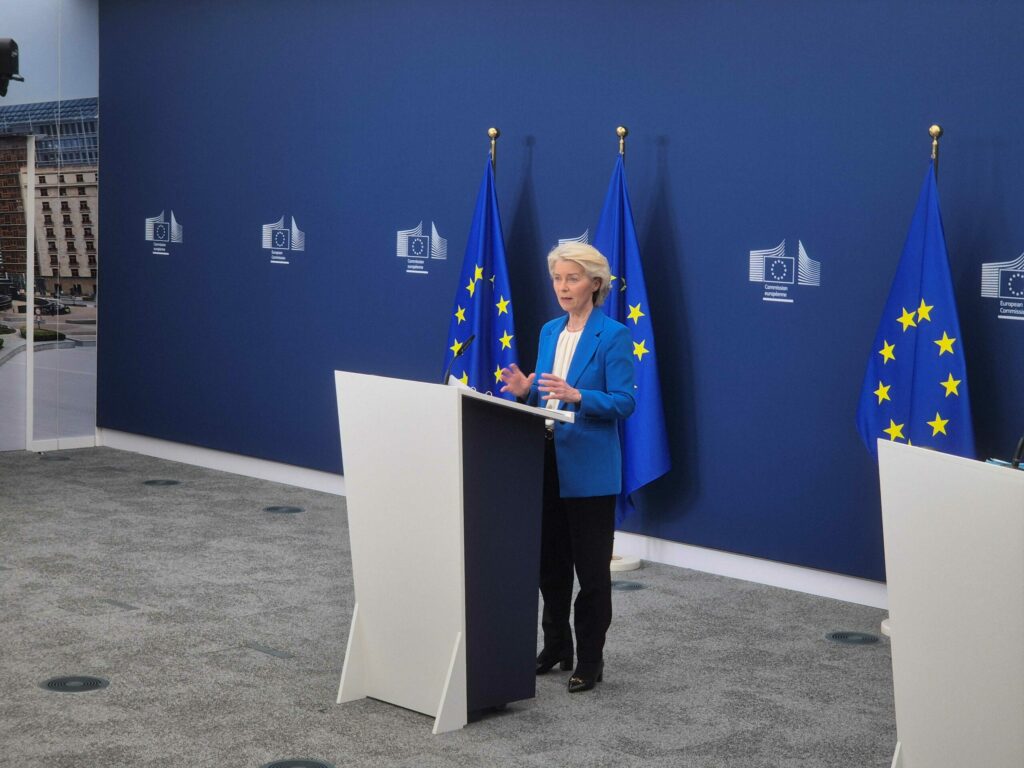
At a press briefing on Monday, European Commission President Ursula von der Leyen announced a series of measures to deal with the economic impact of the situation in the Middle East, notably the closure of the Strait of Hormuz, on the EU.
Her statement followed an orientation debate in the College of Commissioners. She started with commenting on the war in the Middle East and the failed talks in Islamabad mediated by Pakistan.
“These past six weeks have reminded us that peace cannot be taken for granted. We also know that negotiations have been stalled now, and we have to see how things go on now. Any agreement will have to address the concerns raised by Iran's nuclear and ballistic missile programme, and its actions obstructing the navigation through the Strait of Hormuz.”
“The ongoing closure of the Strait of Hormuz is greatly damaging, and the restoration of the freedom of navigation is of paramount importance for us. We are also worried that the continued strikes on Lebanon threaten to derail the entire process.”
“A key lesson of the past weeks is that security is indivisible,” she added. “You cannot have stability in the Middle East or the Gulf while Lebanon is in flames. So, we call on all parties to respect the sovereignty of Lebanon and to implement a complete cessation of hostilities.”
The EU continues to stick to its position in the beginning of the war that the main issues that triggered the war must be resolved by diplomacy and not by military means. Among those issues is an end to Iran’s destabilising activities in the region. Von der Leyen did not mention Iran’s military and financial support to its main proxy, Hezbollah in Lebanon, and the need to disarm it.
It is still unclear what the EU can do to make the US and Iran to resume talks, which collapsed after only one day, and to contribute to achieving a lasting and comprehensive agreement.
Economic impact on energy
The main purpose of the orientation debate was not to discuss how the EU can contribute to a diplomatic solution of the conflict but how it should deal with the economic repercussions on the EU’s energy supply and prices. Overall, von der Leyen was optimistic that the EU would weather the energy crisis.
But the starting point is worrying. “Since the beginning of the conflict – 44 days ago – our bill for fossil fuel imports has increased by over €22 billion. 44 days, €22 billion – not a single molecule of energy in addition. This shows the enormous impact this crisis has on our economy.”
The measures how to tackle the crisis will be presented at the informal European Council meeting in Cyprus next week (23 – 24 April). Among the immediate measures, von der Leyen listed the need of “robust coordination” among EU Member States, referring to the 2022 energy crisis with the EU Energy Platform.
“This is basically about how to approach the different measures that Member States might apply to better protect vulnerable households and sectors from high energy prices. It is very important as went through the last energy crisis three or four years ago. And we really learnt the lesson from this energy crisis.”
The Commission will show the Member States some typical best practices on how to design income support schemes. Already this week, it will also consult them on more flexible state aid rules to give them more space for temporary State aid support in the most exposed sectors.
Another element in the plan is reduction of the demand. “Because the least expensive energy is of course the energy we do not use. We should reduce demand, while fully respecting the free choice of consumers. We are looking at energy efficiency levers, such as renovation of buildings or renewal of equipment in industrial operations.”
There is also a need of more structural measures to bring down energy prices and give relief to citizens and businesses. “We already had constructive discussions in the last European Council on the four cost components for the energy bill,” she said. “The biggest chunk is of course the energy source itself. But then you have the grids charges, the taxes and levies.”
“The Strait of Hormuz is essentially closed, and immediately citizens feel the impact at the gas station, in the supermarket and on the household bills… there is one thing that all these events are making clear: we are paying a very high price for our overdependency on fossil fuels. And the grim reality for our continent is: fossil fuel energy will remain the most expensive option in the years to come.”
Source: Eurostat
Luckily Europe also has assets: that is electricity produced in Europe from renewables and nuclear. “And therefore, our strategy to decarbonise has not only been confirmed in the last years but is growing in importance day by day. And our objective is clear: we need to scale up the homegrown, affordable, reliable energy.”
According to the Commission president, the EU has made progress in growing renewables and nuclear in Europe – they both now account for over 70% of its electricity generation. “But of course, we need to go much further. And these clean energy sources need better integration in the energy system. At the moment, huge volumes of clean power remain unused or even wasted.”
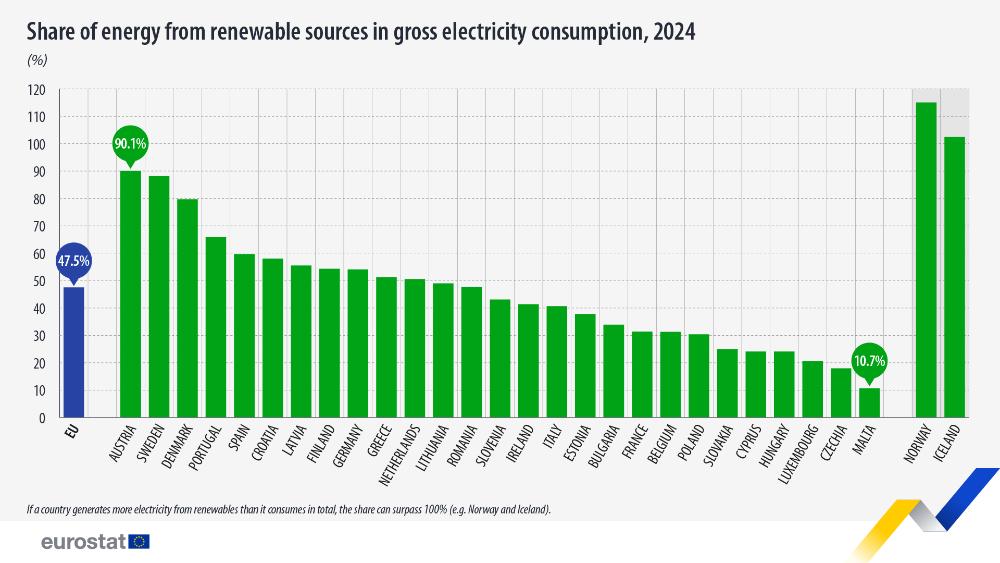
According to the latest figures from Eurostat, renewables (excluding nuclear power) accounted for nearly 50% of EU electricity in 2024 and varied widely by country. Wind and solar expansion drove the growth in renewables, with wind providing 39% and hydro 30% of the total renewable energy in 2024.
Her last point was investment. “Regarding public money, I will again encourage the Member States to make better use of the EU funding we have, for example the Cohesion Funds. The money is there, you can invest it – in grids, in storage, in batteries. Please use that money now, because we need to improve our energy system.”
