
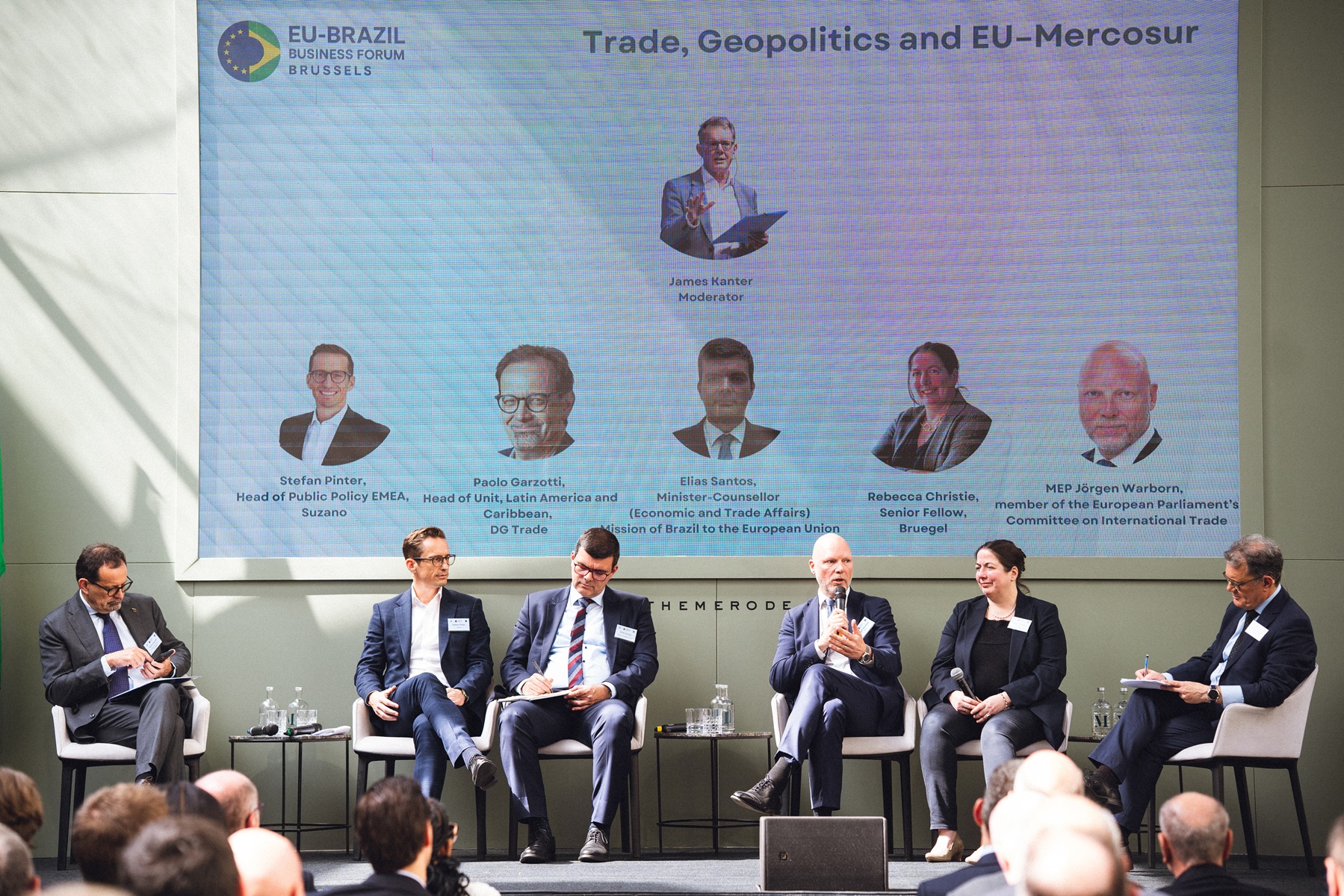
Europe must update its impressions of Brazil. This was one of the key messages that Brazilian company representatives were eager to convey last week to EU policymakers and business leaders at the EU-Brazil Business Forum 2026 in Brussels.
“People still ask about Pele, which is great, right? But he played up to the 70s,” remarked Paulo Macedo, global managing director of international relations at Brazilian energy company Raízen. Highlighting that the vast South American country of more than 200 million people has transformed over the past 50 years, he urged the forum’s attendees to “get to know our companies, research all the certifications that we have –the compliance groups”.
He wasn’t a lone voice. At the forum, representatives from some of Brazil’s biggest companies noted that the country’s environmental and governance regulatory framework compares favourably to the so-called ‘gold standards’ that the EU seeks to implement.
Stefan Pinter, Head of Public Policy EMEA at Suzano, highlighted Brazil’s forest code as an example, noting that in parts of the Amazon landowners are required to preserve up to 80% of native vegetation on their land. Indeed, as Rebecca Christie, a senior fellow at think tank Bruegel, observed, the ‘Brussels effect’ – the “shining example of how other countries would try to act” – can lose its gloss once legislation forged by the European Commission makes concessions to the demands of the Council and Parliament.
Brazil’s trade with the EU – which already in 2024 amounted to €89.5 billion, making Europe its second-largest trading partner – is poised for further growth. Signed in January and set for provisional application at the start of May, the EU-Mercosur Agreement is expected to boost trade and investment between Europe and the Mercosur bloc of Brazil, Argentina, Paraguay and Uruguay. The deal eliminates tariffs on 91% of EU exports to Mercosur, while opening up European markets to South American exporters.
According to Christie, Brazil represents a “particularly interesting ally for Europe to start working closely with, because there isn't this same dependence on exports that you see with some of the other partnerships across the Atlantic. There is also a sense that Brazil, because of its role working in the G20, working with BRICS, working around the world, is a country that wants to be a serious player, a responsible player. And Europe is not just looking for what sort of mineral deals we can secure, or what sort of market access can we get for our farmers, although those are very important…It's also looking at how can we find serious people to work with who aren't going to mess up our supply chains.”
She suggested that it was no coincidence that the Mercosur deal was finally concluded after more than a quarter of a century of negotiations at a time when the reliability and approach of longstanding major partners, namely the US and China, has come under question. Indeed, in his keynote speech that began the conference, Leopoldo Rubinacci, Deputy Director-General of DG Trade, emphasised the importance of regulatory cooperation and predictability in trade. Calling the Mercosur agreement “one of the most consequential trade agreements of the first half of the century”, he said that “now it is time for both sides to actually reap the benefits”.
Brazil’s Ambassador to the EU, Pedro Miguel da Costa e Silva, echoed this sentiment and praised the agreement for ending Brazil’s “comparative disadvantage” in Europe and opening paths for value-added exports, clean energy and digital collaboration.
A new era of dialogue and investment
The EU-Brazil Business Forum was organised by The Brussels Times and the Brazil-EU Business Network, a platform aimed at fostering dialogue between Brazilian businesses and EU policymakers in Brussels, which was officially launched at the event.
The forum comprised three panel discussions and several high-level keynote speeches that focused on trade and geopolitics, misperceptions about Brazil, and energy, climate and the emerging bioeconomy.
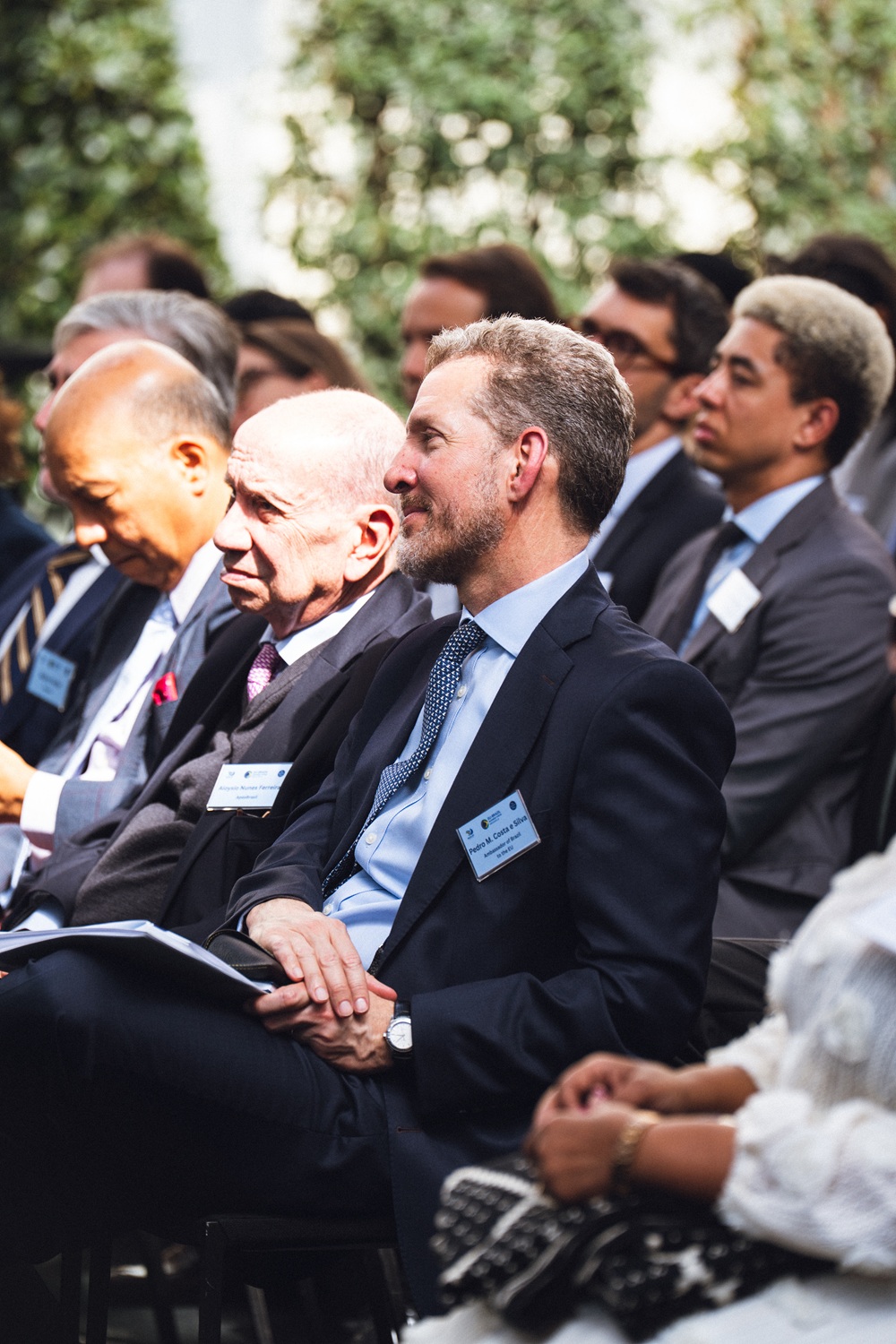
Brazil’s Ambassador to the EU, Pedro Miguel da Costa e Silva, and former Foreign Minister of Brazil, Aloysio Nunes Ferreira, attend the EU–Brazil Business Forum 2026 in Brussels, where they were among the keynote speakers. Credit: The Brussels Times / Gilles Njaheut
During the discussions, Mark Wolthuis, managing director Europe at Brazilian (and world's second largest) corn ethanol producer Inpasa, took the opportunity to correct some misconceptions about Brazil. For example, he pointed out that 93% of Brazil’s electricity grid is from renewable sources, while stating that the country’s corn ethanol production has doubled without using additional land. Brazil’s green credentials surpass public perception, he said.
This view was supported by Olga Baus Gibert, deputy head of unit, country programmes for Latin America and the Caribbean, DG INTPA. She noted that Brazil has a diversified industrial base and has one of the cleanest energy matrices among major economies.
While collaboration between Brazil and the EU can thrive around bioeconomy, materials and chemicals, according to Aurel Ciobanu-Dordea, Director for Circular Economy, DG ENV, he stressed compliance with sustainability criteria must be a focus to ensure fair competition. Nevertheless, Nicolas Kuen, an advisor to the Director General, DG ENER, noted that Brazil and the EU are natural partners in decarbonisation due to complementary strengths: Brazil’s renewables and Europe’s technology and financing.
Providing a country-specific perspective, Hugo de Rijke, a senior policy advisor to the Dutch government, said Brazil is viewed as a key supplier of sustainable bioresources, which are supporting Europe’s energy transition. He pointed out that the Netherlands has signed memoranda of understanding with the country focusing on chemical and material value chains.
Walmir Soller, VP of North America, Europe, and Asia, at Braskem, said the Brazilian petrochemical company has been producing bio-based polymers for more than 15 years, with Europe representing one of its strongest export markets. He argued that bio-based plastics, which capture carbon, can compete on price with fossil-based materials when true environmental costs are factored in. However, while transitioning to bio-based production is technically simple, he called for clear regulation, market incentives and investment support. Partnerships with Europe could help scale the bioplastic sector and create jobs and innovation, he said.
Additionally, Brazil can support Europe’s shift to electric arc furnace steelmaking using renewable energy and green hydrogen, according to Luciana Brum, global head of external affairs at Brazilian iron ore, pellets, copper, and nickel producer, Vale. She noted that developing midstream processing in Brazil would create industrial value locally while supporting EU decarbonisation.
In his concluding remarks, Aloysio Nunes Ferreira, former Brazilian Minister of Foreign Affairs, and head of strategic affairs at ApexBrasil, reaffirmed that Brazil is “transforming in an increasingly sustainable way through the efforts of its workers and its companies”. He underscored Brazil’s role in biofuels and critical raw materials as key to sustainable growth and more resilient global supply chains, while calling for active private-sector engagement in Brussels to turn diplomatic frameworks into real business outcomes.
The final words on the sunny spring day in Brussels were reserved for the city’s new minister for economy and employment Laurent Hublet, who joked that the sun always shines in Belgium’s capital. He also concluded that “Brussels, Belgium, Europe is a pro-business region” because “business is still the best way to bring prosperity and shared progress.”
