
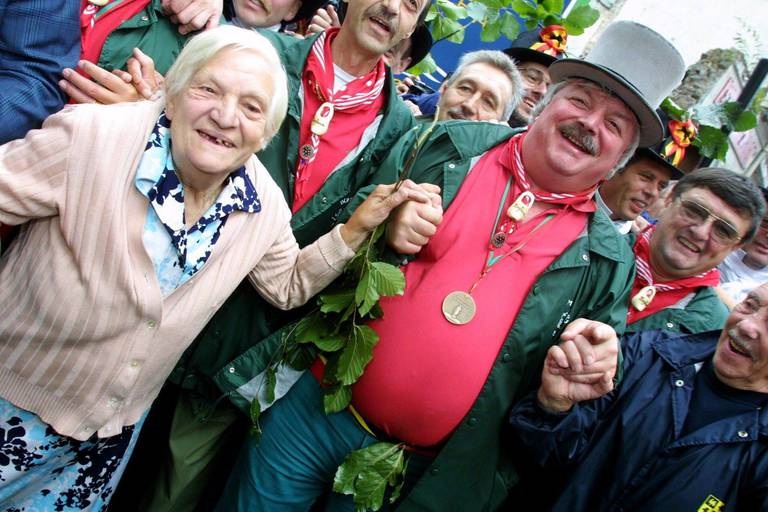
Freddy Thielemans, who died in January aged 77, was mayor of the Brussels city commune for 13 years between 1994 and 2013.
Dear Fred, my friend,
They say in Belgium that when people go to heaven, they eat rice pudding with golden spoons. But neither you nor I believe that is what you are doing. You are no longer here, but you remain here with us as long as you live in our thoughts and our hearts. And the least that can be said is that you did more than enough to stay there for a long time.
You once gave an interview on the RTBF to a Dutch-speaking Brussels native. The interview was a sweet blend of French and Dutch, which revealed the two sides of your personality, the mayor and the artist.
As an artist, you were saddened to see politicians divide the culture, the history and the identity of this country along basic community lines. You called this “een verarming” (an impoverishment ) and “een verenging” (a diminution).
You said it was impossible to declare a mother tongue: your mother, with whom you always spoke in French, was from Antwerp. With your paternal grandparents, you spoke Brusseleir and with your maternal grandparents, you used an Antwerp dialect. Your father spoke to you in French but did his math in Dutch.
As an artist you thought that culture is not national – that that is an outdated concept – and any decent contemporary artist is global. Your identity was plural, as it should be. You defined yourself, first as a Brussels native, then as Brabantish, then as Burgundian and ultimately as Belgian.
You asserted your roots in all three regions of the country. Cécile, your wife, told me that you didn’t meet in her native Wallonia but in Mechelen where you were showing your art with your friend Jan Wellens.
There was a time when the main European Union summits were held in rotating capitals: the week before each meeting, all the different opposition groups would descend on the city in question and chaos would ensue. Then the decision was made to hold all the meetings in Brussels, and as mayor, you decided with the police chief to change the dynamics of the event.
You proclaimed officially: “If you oppose European policies and you want to express your views, you can come to Brussels. We invite you, we will give you a place to stay, like a campground, we will tell you where you can protest, and if you respect the agreements we make together, we will help you to organize your show of opposition.”
Other governmental bodies at all levels in Belgium and all across Europe thought you were nuts and foolish to offer this. But it was a great success. It was the possible best way. It’s much smarter to speak with people than to go to confront them.
The last Brusseleir
When you said that you were the last mayor of Brussels to speak Brusseleir, this was not the misguided nostalgia of the 10th generation that forgot to move out to the suburbs. You were also the mayor who spoke more languages than all your predecessors put together. And with your knowledge of phonetics, you could greet visitors in their own language even if you didn’t understand them. Sometimes this worked too well: some of these visiting dignitaries actually thought you spoke their language and started talking to you volubly in their own tongue.
You were firmly rooted in the history, the culture and the folklore of Brussels. At the same time, you were a citizen of the world, looking to the future. There was no space, no gap, between your authentic Brussels and your cosmopolitan stance. You were the best possible advertisement for three generations of investment in the socialist movement in Brussels and the Brussels public education system. And doubtless, one explains the other.
I remember when we were together one Saturday morning in the Hôtel de Ville, in the ornate neo-Gothic marriage hall. You officiated the weddings, as you did every Saturday morning as mayor. The first wedding was between academics from one of the local universities. For them, you wore academic robes and spoke very intellectually.
The next was an older couple who were reaffirming their vows after 50 years or so. For them, you dressed in your normal clothes and began the ceremony in French but then switched to Brusseleir and asked the wife who was the boss at home and naturally she confided that it was she who ran things.
Following them was a young couple and since the bridegroom was a motorbike rider, you put on a leather jacket to officiate. You adapted yourself to each couple’s situation showing them respect on this important day.
Fred, you were a gentleman, for what you did and for the lessons you left with us. We cannot forget you and we won’t forget you.
