
In a desolate, windswept corner of the Brussels North business district, an empty glass tower rises above 34 Boulevard Roi Albert II.
The Möbius II tower — a 100-meter-tall ellipse — is impeccably maintained: its lights stay on, its windows are cleaned, yet as far as anyone can see, no one is ever inside.
“Does anyone actually work here?” a commuter wonders as she passes by on her way to work.
The answer is twofold: officially yes, in reality no. One thousand Belgian spies are supposed to work there.
The Möbius II tower was purchased in 2021 by the Belgian government for use by its domestic spy agency, the Sûreté de l’État, for €217 million from Immobel, Belgium’s largest listed real estate company. After the splashy acquisition, however, the building’s sleek, all-glass design failed to meet the spy agency’s basic security requirements. And as renovations were deemed too expensive, Belgium’s spies were kept down the road at their old offices on 6 Boulevard Roi Albert II.
With its 23 floors and 34,000 square meters of office space, the building’s emptiness exemplifies how the Belgian government increasingly supports ‘hidden vacancy’ in Brussels. Officially, it is not vacant — it’s neither for sale nor for rent. Instead, it rests in the steady hands of the state, a frequent buyer or long-term tenant that often steps in when markets soften and vacancies loom.
In doing so, it helps bail out struggling owners and props up office valuations, raising questions about accountability and the broader public return on such interventions.
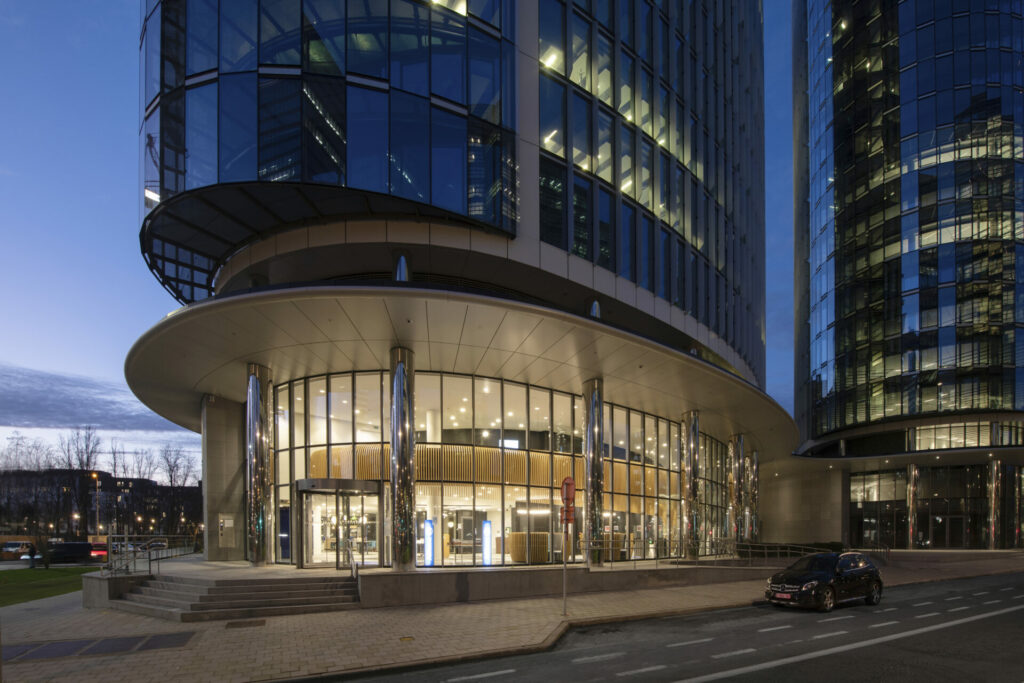
The Möbius I and II towers
Belgium consistently ranks among the worst performers in the Eurozone when it comes to budget discipline, routinely spending well beyond its means. As government debt balloons and borrowing costs climb, political pressure is mounting to reign in waste, inefficiency, and misuse of public funds — including in areas like real estate where billions are paid annually for office space that frequently sits empty.
“The Belgian government is often a key player in major office real estate deals in Brussels, with the intention to step in and support the market when necessary,” said Pepijn Kennis, a former member of the Brussels Parliament and a visiting professor of urbanism at the Free University of Brussels.
“But its attempts are often short-sighted and amid some of the largest and most sophisticated real estate companies in the world, it doesn’t always get the better end of the deals, let alone long-term value for taxpayers money, he tells The Brussels Times.”
Befimmo is Belgium’s largest non-listed office real estate company and owns approximately 850,000 square meters of office space across the country.
In 2006, the Belgian government sold 62 buildings to Befimmo in a sale-and-lease-back deal worth €576 million. Today, Befimmo retains 36 buildings in Brussels, representing some 600,000 square meters of space, which it values at over €1.5 billion.
Around 55% of Befimmo’s Brussels portfolio is leased to Belgian federal and regional governments, as well as European institutions.
At an average rent of €200 per square meter, revenue from public tenants in Brussels alone would approach €65 million per year. By any measure, the implied yield on this portfolio remains significantly above the European average.
Befimmo itself is owned by Brookfield Asset Management, a Canadian listed investment firm with €800 billion of assets in portfolio worldwide, making it one of the largest and most sophisticated investment firms in the world. Brookfield, in turn, is owned by a gathering of the deepest pockets in global finance — ranging from pension funds, insurance companies to hedge funds and global investment houses. It’s the archetypal example of what the financial world sometimes refers to as “smart money.”
“They are our biggest client,” said Jean-Philip Vroninks, CEO of Befimmo, in a phone interview, referring to the Brussels-based governments.
“Brussels is known as a very stable, defensive office market, precisely for the presence of all these government institutions. Government tenants usually sign contracts for fifteen years, whereas private companies would sign shorter contracts, typically six or nine years on average. And so, that naturally creates enormous stability,” Vroninks told The Brussels Times.
"We are actually a bit of a reflection of the Brussels market,” Mr. Vroninks continued. “We have a very stable, defensive portfolio that is leased out long-term. On average, the duration of our contracts is ten years. So we have a synchronized cash flow and of course, that also means that historically, we’ve had a very good relationship with the government.”
The role of different governments in the Brussels office market should be no surprise. Brussels has long been a seat of power and administration — from its role in the 15th century as a key center of the Burgundian Netherlands and home to institutions like the Rekenhof (Court of Audit), to its current status as the political capital of Belgium and the European Union.
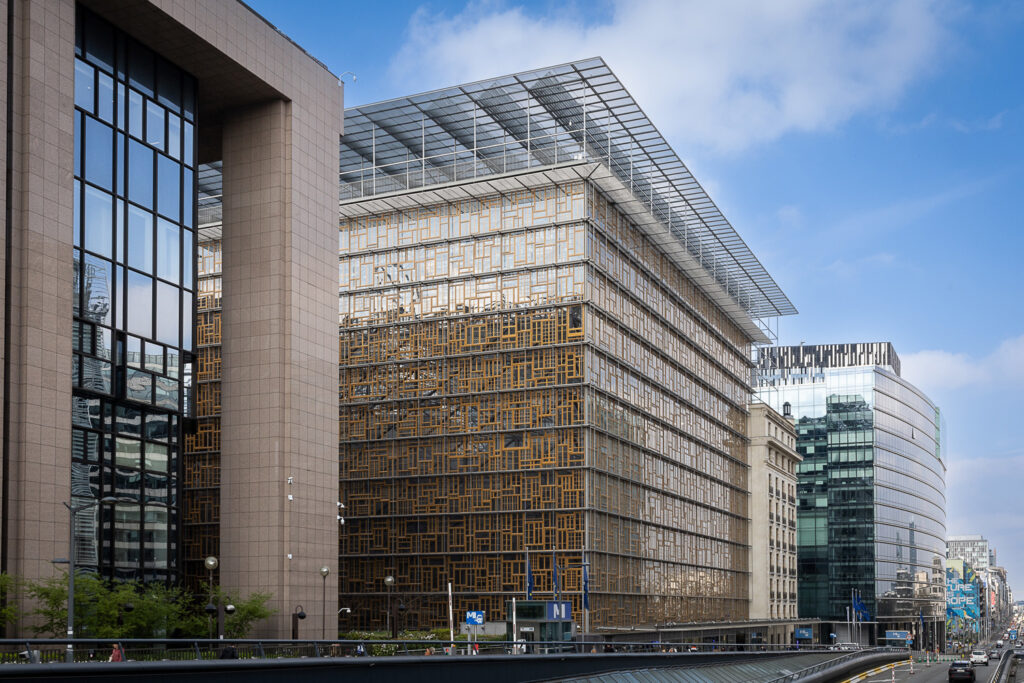
Rue de la Loi in the European Quarter
Taken together, public authorities and international institutions take up about one third of office space in Brussels, experts estimate. And a 2024 study by CBRE showed that public sector transactions accounted for over a third of office market activity, underscoring their role in sustaining demand.
Last year, the European Commission sold 23 office buildings in Brussels — totaling around 340,000 square meters — to the Belgian government for approximately €900 million.
The Commission employs about 24,000 people in Brussels, who are required to work in the office at least two days per week. Hybrid working policies introduced after COVID have significantly reduced actual occupancy, diminishing the need to maintain — let alone own — such extensive office space, a senior EU official involved in the transaction said, speaking on condition of anonymity to The Brussels Times.
The sale included the Madou Tower in Saint-Josse-ten-Noode, the Albert Borschette Conference Center, and several buildings along Rue de la Loi. The federal government’s strategy for these properties remains unclear.
The Régie des Bâtiments, the agency managing real estate for the Belgian government, did not respond to a request for comment. After one week, a spokesperson replied minimally to a follow-up mail “we have received the questions and will discuss them internally. We will keep you informed.”
According to people familiar with the transaction, who spoke on condition of anonymity, some of the buildings are being resold, others are earmarked for renovation and repurposing — but many remain fully or partially unoccupied.
Brussels has approximately 12.5 million square meters of office space, of which 8.7% is considered “officially vacant,” according to Louis De Grady, a spatial analyst at the Brussels regional government and co-author of a recent report on vacancy rates.
While this figure is seen as healthy and stable by several office real estate experts, it conceals a much larger volume of unaccounted-for vacancy — believed to be several times higher.
Hidden vacancies reshape the urban landscape
There are two types of “hidden vacancies,” according to Mr. De Grady, the government analyst.
“First, there is simply ‘hidden vacancy’” he explained. “This refers to space that isn’t being marketed. Some owners have buildings that are entirely or partially empty, but they don’t put them up for rent or sale. There are various reasons for this: they may have a project in the pipeline, lack the funds, or face other constraints. These buildings are completely empty or partly empty, but not for rent or sale, and thus invisible to the market.”
“Then there’s a new type of vacancy, which has appeared especially since COVID, that we call ‘grey vacancy’” Mr. De Grady continued. “These are office spaces that go unused on certain days of the week. For example, on Fridays, many buildings are virtually empty. The same spaces may be busy on Tuesdays and Thursdays, but on other days they serve no purpose — that too is a kind of vacancy.”
There are no official statistics on the true vacancy rate in Brussels — or in many other European cities, for that matter. But Mr. De Grady, along with many other experts interviewed for this article, agreed that a simple walk through the Brussels North business district, around Schuman, or near Gare du Midi, allows one to peer into the windows of many large offices and conservatively estimate the true vacancy rate between 25% and 35%.
The phenomenon is global. A recent report by Urbanite Advisors, based on a survey of 100 major global companies representing 3 million employees, found that office attendance has stabilized at around 40%. On average, companies are allowing 2.6 days of remote work per week.
The study projects that by 2030, up to 120 million square meters of office space could be added to the current vacancy in Europe, highlighting an urgent need for space optimization and innovative real estate strategies.
“The way of working has completely changed,” said Olivier Carette, CEO of the Belgian Real Estate Association, an industry group representing major property owners and developers in Belgium.
“In order to attract and retain employees today, buildings need to have more eye for community: They need kitchens, open spaces for informal interaction between colleagues, and less individual fixed workplaces. There should be interaction between coffee corners, the garden, and spaces in different buildings.”
Owners of older, outdated offices face many challenges, Mr. Carette said, “we are at the very bottom of the cycle in the professional real estate market, especially the office market.”
“Older office buildings need to modernize and diversify their purposes. Besides office space, there should be space for leisure, restoration, food, retail etc. Some commercial buildings will be transformed to residential buildings, but that’s not always possible, due to their configuration and must be evaluated on a case-by-case basis.”
“In short, outdated office buildings of considerable size with only one function,” Mr. Carette concluded “have no future.”
Many building owners in Brussels are actively repurposing their spaces as companies and government agencies downsize or relocate staff to premium locations. A game of musical chairs is unfolding, with businesses selecting “prime buildings”, while others are likely to be left to become so-called "zombie buildings" in the coming years.
Amid the Brussels North business district, the former WTC Towers 1 and 2 — built in the 1970s as part of the "Manhattan Project" — were acquired by Befimmo from the Belgian government in 2006 as part of the 62-building package.
In 2017, Befimmo began redeveloping the site into “ZIN”: a beautiful example of a sustainable mixed-use complex. It houses 75,000 m² of office space (down from 91,000), 111 apartments, a 240-room hotel, and retail and leisure areas. About 65% of the original structures were retained, with over 95% of materials reused or recycled.
The buildings remained in hidden vacancy until 2023, when the Flemish Government moved in under an 18-year lease, bringing in around 4,800 staff. During a recent Tuesday visit to ZIN, the vast central lobby stood out — with a ceiling as high as an airport terminal, lush tropical plants, and food corners serving snacks that looked healthy, even delicious — not always an easy combination. Colleagues strolled the wide corridors, chatting and sipping coffee in spots. Many meeting rooms were in use. The Standard Hotel on the corner is set to open next week. There are three floors of parking below ground, large bike stalls, and Gare du Nord is just a stone’s throw away.
If a game of musical chairs is indeed underway for prime buildings, as many developers claim, then ZIN appears poised to be a winner. But beyond the buzz, viewed from surrounding towers, many floors remain partly empty throughout the week. With structural telework now standard in the Flemish government — typically two to three days a week — grey vacancy is estimated to hover around 40%.
The list of underutilized office buildings in Brussels either owned or leased by the Belgian government is long — and, despite shrinking needs, continues to grow, often under increasingly unfavourable terms, with the government at risk of being the one left holding the bag when the music stops.
In 2022, the government purchased Networks NØR, a versatile building in the Brussels North business district — with 9 floors and 15,000 square meters — for about €100 million from Banimmo. It remains entirely vacant. The Eurostation complex near Gare du Midi, offering 77,000 square meters of office space, is leased from AXA at a cost of €1.4 million per month, yet only half of it is in use. On Rue des Palais in Schaerbeek, a 10,000-square-meter building rented from Deka Immobilien for €2.2 million annually reportedly houses just 40 workers.
Other buildings owned by the federal government and flagged as “hidden vacant” include WTC Towers 3 and 4, the Administrative Center Kruidtuin, Pachecolaan 44, and Rue Royale 61, among others.
As for the Möbius II tower, its 23 floors remain eerily vacant – lights blazing, desks absent – waiting for a thousand spies that may never come. Whether it was just a bad deal, a bureaucratic blunder, or a covert espionage operation, no one can tell.
What is certain, however, is that its near-identical twin next door – Möbius I, just two floors shorter – was sold a year earlier by Immobel to Allianz, the world’s largest insurance and asset management firm by total assets, for a mere €93 million. That’s less than half the price the Belgian government paid for Möbius II – €217 million.
Olivier Thiel, chief development officer at Immobel, explained in a telephone interview: “Buying old, empty buildings, securing permits, stripping them down to their concrete structure, renovating them, and then finding a new occupant or buyer — that’s what we do. It’s a classic operation.”
When asked about the vacancy at Möbius II, he carefully remarked: “As with anything managed by the government, it’s sometimes handled suboptimally due to slow and inflexible decision-making processes.”
A prominent Brussels real estate broker, speaking on condition of anonymity, offered a more blunt take: “In large building deals in Brussels, the usual players gather around the table — there’s the smart money, and then there’s the Régie des Bâtiments.”
