
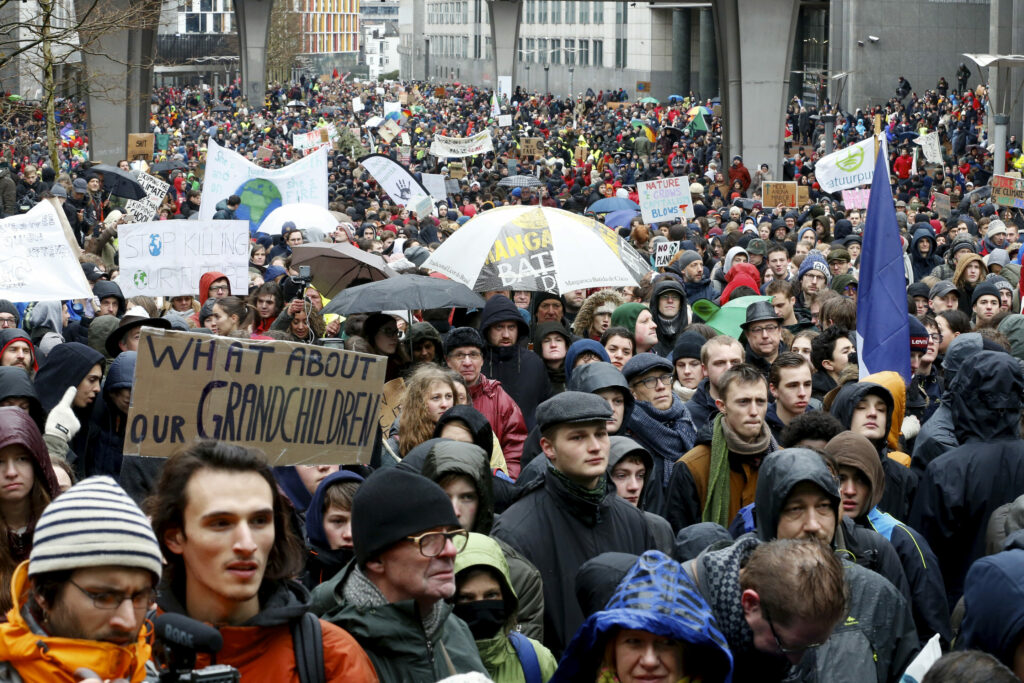
Socio-economically vulnerable young people will bear the brunt of ongoing greenhouse gas emissions, according to a study led by climate scientists from the Vrije Universiteit Brussel (VUB) and published in the journal Nature.
Climate extremes, such as heatwaves, crop failures, river flooding, tropical cyclones, wildfires, and droughts, will continue to escalate as atmospheric warming persists. The study indicates that today’s children will face more climate extremes than any previous generation.
Researchers examined three scenarios in which the Earth’s average surface temperature in 2100 is 1.5, 2.7, and 3.5 degrees Celsius higher than pre-industrial levels. They modelled the impacts on different age groups.
The younger a person is, the more likely they are to face unprecedented exposure to climate extremes. Even if global warming is limited to 1.5 degrees, 52% of children born in 2020 will experience unprecedented heatwave exposure, according to the scientists.
If the global temperature rises by 3.5 degrees by 2100, this figure increases to 92%. The study applied the same analysis to crop failures, droughts, wildfires, tropical cyclones, and river flooding.
“A similar pattern emerges for other climate extremes, though with slightly fewer people affected,” says Dr Luke Grant, co-author and climate scientist at VUB and Environment and Climate Change Canada. Children in tropical countries will bear the greatest burden under a 1.5-degree scenario.
The study also highlights the social injustice of climate change. Under current climate policies, 95% of socio-economically vulnerable children born in 2020 will face unprecedented heatwave exposure in their lifetime, compared to 78% of the least vulnerable group.
“The most vulnerable children experience the worst escalation of climate extremes. With limited resources and adaptation opportunities, they face disproportionately high risks,” says Wim Thiery, professor of climate science at VUB and study coordinator.
Ahead of COP30, the UN climate conference in November 2025 in Brazil, countries must submit updated climate plans. Current policies could result in warming of approximately 2.7 degrees this century. The study and a report by Save The Children stress the urgency of keeping global warming below 1.5 degrees for today’s and future children.
“As global emissions continue to rise and the planet is just 0.2 degrees from the 1.5-degree threshold, world leaders must act to reduce greenhouse gas emissions and lessen the climate burden on today’s youth,” concludes Thiery.
