
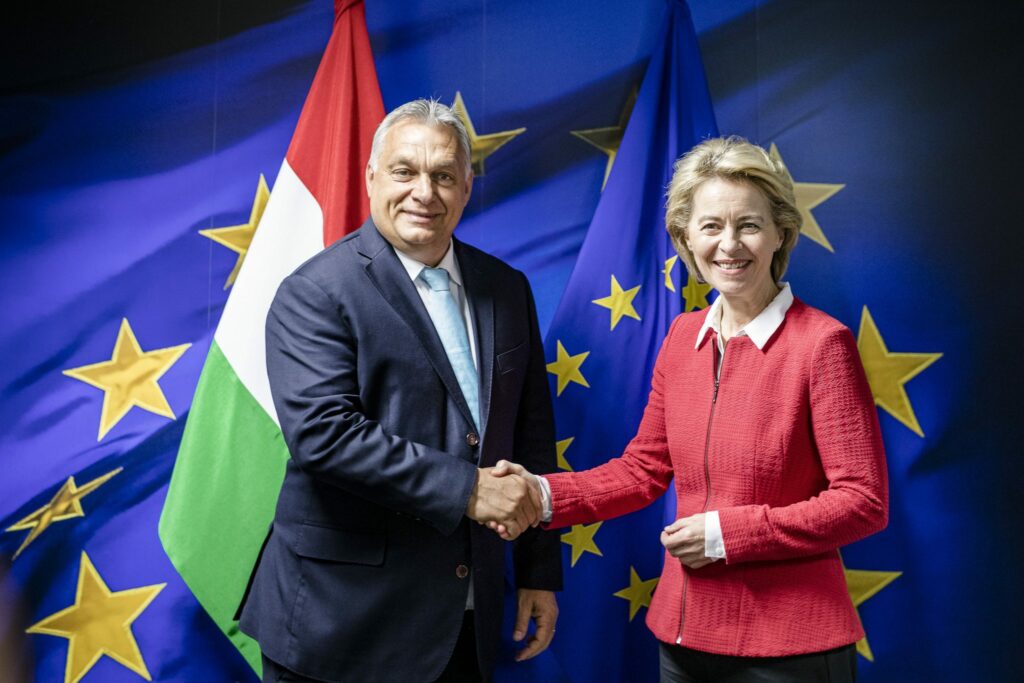
The dispute between the EU and Hungary’s EU Presidency over Prime Minister Viktor Orbán’s visit to Moscow continued after the re-election of Ursula von Leyen as European Commission President.
“Russia is still on the offensive in East Ukraine,” she said in her speech ahead of the vote in the European Parliament on Thursday. “They are banking on a war of attrition, on making the next winter even harsher than the last.” She repeated her critique against the Hungarian Prime Minister without mentioning him by name.
“And some, in Europe, are playing along. Two weeks ago, an EU Prime Minister went to Moscow. This so-called peace mission was nothing but an appeasement mission. No one wants peace more than the people of Ukraine. A just and lasting peace for a free and independent country. And Europe will stand with Ukraine for as long as it takes.”
As previously reported, Hungary’s EU Presidency got off on the wrong foot with Orbán’s visit to Moscow and the cancellation of the traditional meeting with the European Commission at the start of the Presidency. EU leaders denounced his uncoordinated visit as inconsistent with EU’s position and Hungary’s task as chair of the EU Presidency.
Last Monday, the Commission spokesperson announced on X (former Twitter) what seemed to amount to a boycott of Hungary’s EU Presidency. The announcement appeared also to have taken Commissioners by surprise.
The Commission President decided that the Commission will be represented at senior civil servant level only during informal meetings of the Council. The College visit to the Presidency, which the Commission previously has said would take place in September, was cancelled. Another spokesperson described the decision as a symbolic gesture against Orbán’s uncoordinated trips.
In practice the boycott was limited to the informal Council meetings in the beginning of the Presidency and would not affect the formal meetings where the Commission normally is represented on political level by its Commissioners. European Council President Charles Mitchel, who also denounced Orbán’s trips, has already distanced himself from any boycotts of Council meetings as counterproductive.
For Hungary, the decision came as a surprise. The Commission cannot cherry pick institutions and member states it wants to cooperate with, twitted János Bóka, Hungary’s EU affairs minister. “This is a slap in the face of every Hungarian official that has been working on making the Presidency a success for Europe,” commented Mátyás Kohán, deputy editor at the Hungarian conservative weekly Mandiner.
“This decision doesn't inhibit their ability to do so as it's a symbolic gesture with minor influence on day-to-day presidency affairs, but it will surely destroy a lot of goodwill among those who have been advocating within the Hungarian establishment for a softer course on EU affairs. You can't just keep humiliating a country for matters in which the Commission actually has no say at all.”
Orbán’s letter to Michel
Orbán has admitted that he was not acting on behalf of the EU. Immediately after his trips, he sent a report to Michel, the European Council President. Michel apparently provided copies of the report to the Commission and the member states. Part of its content was leaked to Financial Times and reported in other media.
Asked about the letter, a Commission spokesperson told The Brussels Times that there was no link whatsoever between von der Leyen’s decision and the letter. She had not even read the letter before her decision. The spokesperson declined to comment on the letter and said that it was not up to the Commission to disclose a letter which had been addressed to someone else.
Only on Thursday, did Orbán’s cabinet office publish the full report for everyone to read. It is described as a summary evaluation of his discussions with the leaders of Ukraine, Russia, China, Turkey and former president Donald Trump, as well as a few suggestions for Michel’s consideration. In the letter, Orbán refers to the current US “pro-war policy” and claims that the EU has copied this policy.
He finishes the letter with a proposal to discuss whether the continuation of this policy is rational in the future. Fearing that the intensity of the “military conflict will radically escalate in the near future”, he writes that “we could make an effort to decrease tensions and/or create the conditions for a temporary ceasefire and/or start peace negotiations.”
Among others, he proposes to “conduct high-level political talks with China on the modalities of the next peace conference”, referring to the conference which took place last June in Switzerland. China, which has not condemned Russia’s aggression, was invited to the conference but did not attend it. Hungary joined all other EU member states in signing the statement on a peace framework.
A senior EU official said on Friday that the foreign affairs council meeting on Monday (22 July) will among others discuss the aftermath of the peace conference and continued military support to Ukraine. He also expected that Orbán’s trip will be raised at the meeting but declined to confirm whether his proposals will be discussed.
In this regard, the EU official distinguished between form and substance. Russia has launched an unprovoked war of aggression against Ukraine but in his letter Orban took a different position, alleging that the EU has adopted a pro-war policy, he said.
M. Apelblat
The Brussels Times
