
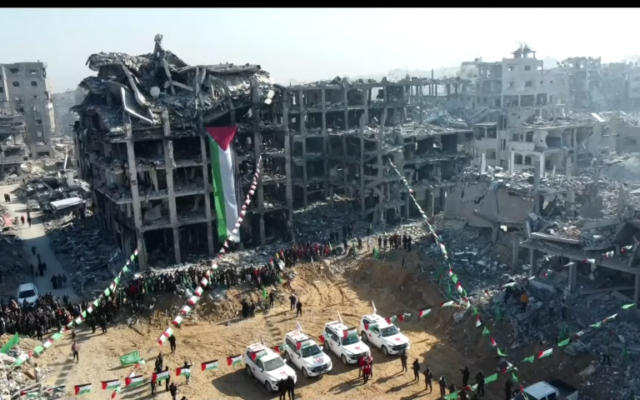
Three Israeli citizens and five Thai nationals that were taken hostages on 7 October 2023 were released today following two previous releases according to the ceasefire-hostage deal signed between Israel and Hamas.
The eight hostages were handed over by Hamas and the Palestinian Islamic Jihad group to the Red Cross at two different release points in the Gaza strip and escorted out of the Gaza strip by Israeli forces.
Among the Israelis, are two civilians, Arbel Yehoud (29), who was supposed to have been released last Sunday and Gadi Mozez (80). The third person is Agam Berger (20), one of the few female soldiers who survived the attack on a military surveillance base which had warned about the attack. The hostages were brought to a hospital where they were reunited with their families.
During the first phase of the ceasefire, 33 Israeli hostages will gradually be released each week. In exchange, close to 1700 Palestinian prisoners held by Israel will be freed, including 200 serving life sentences for terrorist attacks.
During this phase, the Israeli army will reduce its forces in the Gaza Strip. It has already withdrawn from most of the Netzarim corridor which divided the Gaza Strip. Tens of thousands of Palestinians started this week to return to the north of the area from where they were displaced. They are facing a terrible reality there as the area has been almost totally devastated during the war.
Talks have also started about the second phase. According to the agreement, it should enter into force towards the end of February, lead to the release of the 82 remaining hostages (of which 35 are believed to be dead) and end to the war. Both Hamas and Israel have an interest in ending the war and are likely to be under pressure under US President Donald Trump to fully implement the agreement.
“The release of Israeli hostages is good news,” said Kaja Kallas, High Representative for EU’s foreign affairs and security policy, in her press remarks after the Foreign Affairs Council meeting in Brussels on Monday.
“Palestinians are returning to the north of Gaza. The ceasefire is fragile, but it is holding. We are supporting its implementation, including by redeploying our civilian mission to Rafah to supervise border checks. Reopening the crossing will allow the transfer of injured individuals out of Gaza for treatment.“
The Gaza Strip needs to be rebuilt better but the reconstruction will take years and require a political solution which will prevent any recurrence of hostilities in the future. Trump has suggested that Gazans could be transferred to neighboring Arab countries but they have their own problems and fear that it will not be temporary. Kallas declined to comment on the issue.
The EU has increased humanitarian funding for the Palestinians but whether it can be used also for recovery and temporary housing in Gaza has not been clarified by the Commission.
In her mission letter, the new Commissioner for the Mediterranean, Dubravka Šuica, has been tasked to take forward the Support Programme for the Palestinian Authority and to “contribute to developing, with international partners, a dedicated reconstruction plan for Gaza and support the coordination of the recovery process”. Her own organization is reportedly still work in progress.
“I think the Palestinian people have suffered a lot and both Israelis as well as the Palestinians really deserve peace,” the High Representative said. “Right now, we have the ceasefire in place, but it requires also the next steps to be taken so that peace would be permanent, and that there is stability and peace in the region.” From our point of view, that requires the two-state solution.”
She confirmed that the issue of the redeployment of the EU border assistance mission (EUBAM) at Rafah, the border crossing between Gaza and Egypt, will be starting from February. “We had the invitation letters from both Palestine as well as Israel, also Egypt agreed to this, saying that this is important for the implementation of the ceasefire as well.”
The mission will have the same mandate as in the past, she added, but it is limited in time and depends on the implementation of the ceasefire. Her spokesperson, Anouar El Anouni, clarified that a specialist team from the EU will support Palestinian border staff during the first phase of the ceasefire. What uniforms the Palestinian staff will wear is not clear.
As has already been reported, the EU-Israel Association Council meeting is expected to take place towards the end of February. Her spokesperson confirmed on Thursday that a date has finally been determined and that the meeting will take place in the margins of next Foreign Affairs Council meting scheduled for 24 February.
The meeting, co-chaired by the High Representative and the Israeli foreign minister, with the EU foreign ministers present, will cover the full range of issues in the political dialogue with Israel, both global and bilaterial. A first ever EU-Palestinian high-level meeting with the Palestinian Authority will take place in the margins of next Foreign Affairs council meeting in March.
Asked if the Global Alliance for the Implementation of the Two-State Solution, which was initiated by Kaja Kallas predecessor Josep Borrell, is still alive, her spokesperson referred to previous council statements that confirm that the two-state solution is EU’s common position.
M. Apelblat
The Brussels Times
