
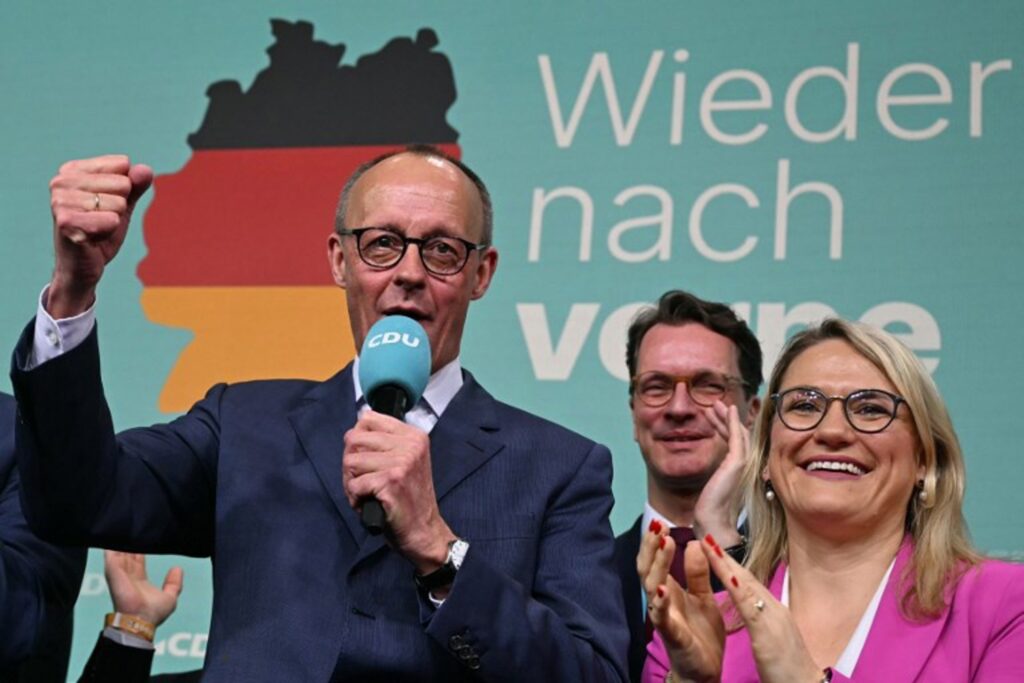
Friedrich Merz, leader of Germany's conservative CDU party, won the German legislative elections. He stated on Sunday that his top priority is to strengthen European defence so that the continent can gradually achieve independence from the United States.
Merz hopes to form the next government by Easter. He said Europe must develop its own autonomous defence capacity as an alternative to "NATO in its current form". His comments came in response to the perceived indifference of the American government towards Europe’s fate.
"I never thought I would have to say something like this," he admitted. "But after last week’s statements by Donald Trump, it’s clear that the Americans, at least this part of them, this government, are largely indifferent to Europe’s fate."
The relationship with the United States is delicate, with Trump’s actions regarding the war in Ukraine causing concern among Europeans. Merz believes NATO, established in 1949 for mutual protection of Western countries, is at a crossroads: "I am very curious to see how we approach the NATO summit at the end of June and whether we will still talk about NATO in its current structure, or if we need to quickly establish an autonomous European defence capability."
It's a clear break from Germany's previous governments – both Merkel's conservative executive and Scholz's social-democratic formation have been unreceptive to the idea, championed by France, of Europe having strategic autonomy from the United States. NATO Secretary-General Mark Rutte said on Sunday night that he looks forward to working with Merz during this "crucial period" for the continent’s security.
What voters want
A poll suggests that a coalition between the German conservative bloc CDU/CSU and the Social Democrats (SPD) is the preferred option among voters following Sunday’s legislative elections.
According to a YouGov opinion poll conducted after the elections, 44% of respondents support a "grand coalition" comprising the Christian Democrats of the CDU and the Bavarian CSU, along with the SPD.
25% favour a tripartite coalition that also includes the Greens. Meanwhile, 30% support a coalition with the far-right AfD, which had its best performance ever with 20% of the popular vote. However, all other parties have ruled out a coalition with the AfD, effectively imposing a cordon sanitaire.
The survey, conducted among a thousand voters on the evening of the election, took place before the final distribution of parliamentary seats.
Words of welcome from European leaders
Soon after the results were announced, French President Emmanuel Macron expressed his determination to "achieve great things" alongside Merz. Macron made the comments en route to Washington, where he is scheduled to meet U.S. President Donald Trump on Monday to discuss, among other topics, the security of Ukraine and Europe.
British Prime Minister Keir Starmer also said he plans to strengthen security ties between the two nations. "I look forward to working with the new government to deepen our already strong relations, enhance our common security, and ensure the economic growth of our two countries," Starmer wrote on Twitter / X.
Bart De Wever said that he looks forward to seeing a "strong German government."
