
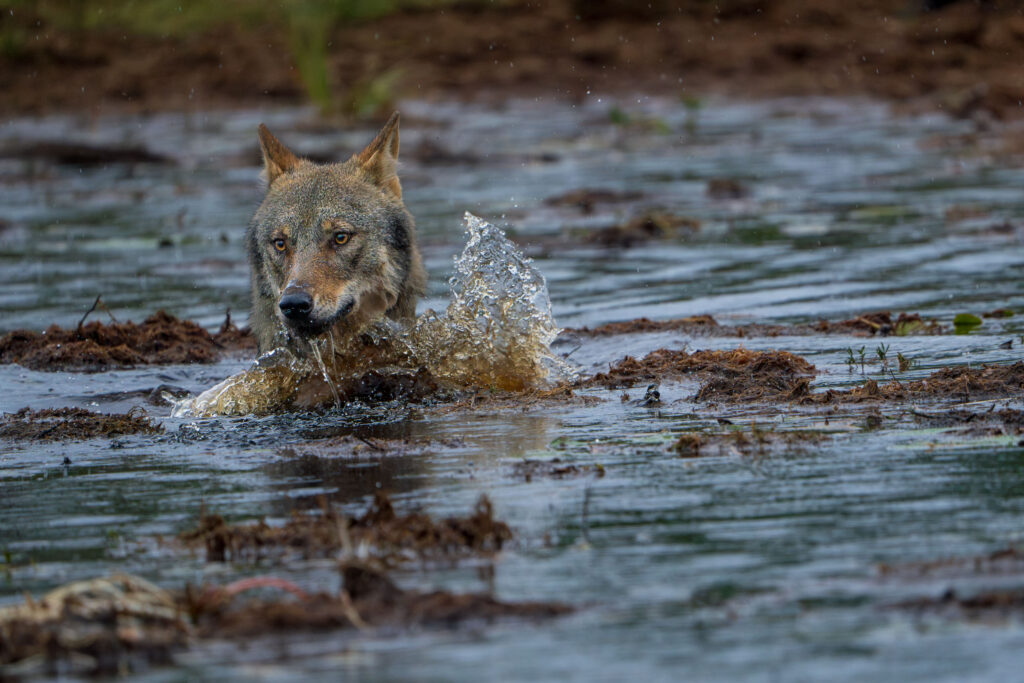
The controversy about of the protection status of wolves in the EU reached a crucial stage in the legislative process on Thursday when the European Parliament voted on the European Commission’s proposal to downgrade the protection from ‘strictly protected' to ‘protected'.
The long saga came to a sudden end when the Parliament decided to deal with the proposal in an emergency procedure so that it would be given priority over other items on the agenda. With 371 votes for, 162 against and 37 abstentions, the Parliament decided to support the proposal against protests from wildlife and animal welfare NGOs across the EU.
The European People’s Party (EPP), the largest political group in Parliament, credited the vote to its continued pressure and described it as a matter of balancing conservation efforts with protecting farmers. European Commission President Ursula von der Leyen, who reportedly has shown a personal interest in the proposal, belongs to the same political group.
“Farmers can now breathe a sigh of relief,” commented MEP Herbert Dorfmann (Italy, EPP), the group’s spokesperson in the Parliament's Agriculture Committee. “We have listened to their concerns and delivered real change at the European level to address today’s reality and protect rural livelihoods.”
In fact, the Parliament ignored existing possibilities to kill wolves. The previous strict protection regime of the Habitats Directive (Annex IV species) already allows for the killing of wolves when necessary to prevent serious livestock damage or human safety risks.
According to the Parliament, EU Member States will now have greater flexibility in managing their wolf populations to improve coexistence with humans and to minimise the impact of what it claims to be a growing wolf population in the EU. They will also be better able to take measures that are adapted to particular regional circumstances.
Member states must continue to ensure the wolf’s favourable conservation status and may continue to list the wolf as a strictly protected species in national legislation. If this will really happen is doubtful judging by the measures already taken by some Member States without waiting for the Commission’s proposal to enter into force as a targeted amendment of the EU Habitats Directive.
Spain decided already in March to end a ban on hunting wolves in the north of the country, where the vast majority of the country's Iberian wolves live, three years after the introduction of the ban by Prime Minister Pedro Sanchez's government. The change, which was proposed by the main opposition party (PP) and supported by regional parties, justifies the killing of wolves as a protection of agriculture.
Pending court case
In Sweden, wolf hunting has been on-going since 2010 in violation of the EU's legislation on the protection of endangered animal species. The Swedish government announced recently that the reference value of the wolf population would be further reduced to only 170 animals. So far, the Commission has failed to take legal action against Sweden despite an on-going infringement case.
The latest action in the infringement case was taken in 2015, when the Commission issued an additional reasoned opinion and requested Sweden to bring wolf hunting into line with EU legislation. “Wolves are strictly protected in Sweden, and their population has not reached a level that guarantees the conservation of the species ('favourable conservation status'), as aimed by the legislation.”
Sweden was asked back then to notify the Commission of measures taken to remedy this situation or risk that the case would be referred to the European Court of Justice.
In its latest infringement package, announced on Wednesday, the Commission decided to refer 18 cases to the Court and to close 83 cases “in which the Member States concerned, in cooperation with the Commission, have brought an infringement to an end and ensured compliance with EU law.” Neither happened in the Swedish wolf case and it is still on-going, a Commission source told The Brussels Times.
“A deteriorated protection status would in practice allow more or less free hunting of wolves throughout the EU and make the situation more difficult for Swedish wolves, commented Ann Dahlerus, wildlife expert at the Swedish Carnivore Association.
“This is why the Swedish case must be urgently reviewed by the Court. The case should be judged based on the legislation in force when the recurrent hunting of wolves took place in violation of the Habitats Directive.”
Animal welfare NGOs reacted with dismay to the Parliament’s vote and described it as scientifically unfounded and a betrayal of the wolves in the EU.
"Wolves are vital to healthy ecosystems, but today’s vote treats them as a political problem, not an ecological asset", said Ilaria Di Silvestre, Director of Policy and Advocacy for Europe at International Fund for Animal Welfare (IFAW).
"There is no data justifying a lower level of protection, but the EU institutions decided to ignore science. Decisions made on the basis of political interests, instead of facts, risk undoing decades of conservation progress."
Léa Badoz, Programme Officer at Eurogroup for Animals, said, "This is a sad day for biodiversity and wild animals,"
"The EU was once proud to lead on nature protection. Now we are seeing vital species like the wolf sacrificed for short-term political interests that will benefit no one. Member States must now step up and do the right thing. Wolves still need strong protection if we are serious about saving Europe’s nature."
To enter into force, the draft law now requires formal approval by the Council, which endorsed the same text on 16 April 2025. The directive will enter into force 20 days after it has been published in the EU Official Journal. Member states will then have 18 months to comply.
