
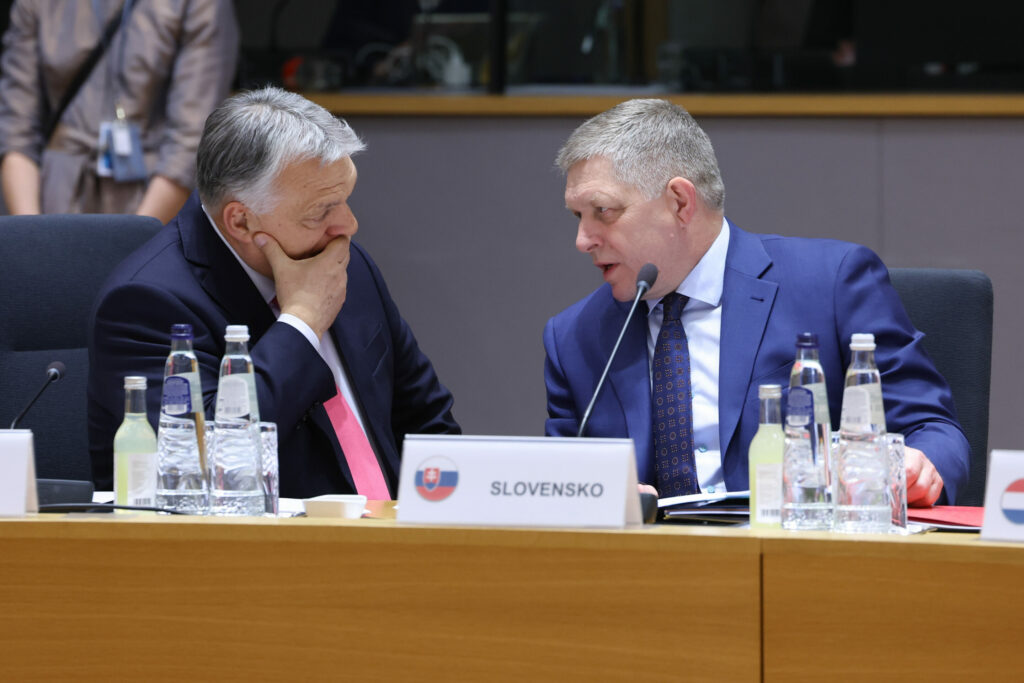
The European Commission will publish its annual rule of law report next week, revealing whether democratic norms have improved or regressed across the Union and its immediate neighbourhood. Here’s why the report is important.
Shared democratic principles are a fundamental strand holding the European Union together. Dictatorships and police states cannot be a part of the Union, for a variety of reasons.
Beyond the obvious reasons like respecting human rights, there is the business aspect of rule of law. How can a barrier-free alliance of 27 countries function if one or more of the members does not afford its people the same rights as everybody else?
The single market cannot work if democracy is not guaranteed across the entire bloc. It is as simple as that.
That is why the Commission produces an annual rule of law report on every member to check that standards are not slipping. Recommendations are issued and, in extreme cases, punishments doled out.
On the latter, the EU’s executive branch can either choose to sue the member country in question at the European Court of Justice, which can result in massive financial penalties or there is also a nuclear option available.
Article 7 of the EU’s treaty allows a member state found to be in breach of Union law to be stripped of its voting rights in the Council. This is a big deal, considering the increasingly powerful role over the legislative process that the Council has built for itself.
The Commission has launched infringement procedures based on rule of law shortcomings in the past, against countries like Hungary and Poland. It has also threatened to do so against others like Slovenia.
But it has never successfully triggered Article 7 as the Council has never unanimously agreed to strip a country of its voting rights.
During the early 2020s, Hungary and Poland flirted with the possibility by implementing legislation that clearly breached rule of law principles, but their two governments essentially protected each other from the risk of Article 7.
Council legal experts looked into how an Article 7 procedure against both countries in tandem could potentially get around the unanimous vote requirement but it was never seriously explored as an option.
When Poland’s current prime minister, former Council boss Donald Tusk, took power, there were suggestions that Hungary would lose its voting rights as Viktor Orban lost his ally in the form of Mateusz Morawiecki.
However, the issue has not reared its head in any meaningful manner since, as the Council has been too preoccupied with other issues like Ukraine, inflation and competitiveness.
The rule of law report is also not restricted to EU members, prospective members are also vetted as part of their ongoing accession procedures. Keeping tabs on existing EU states is hard enough but monitoring progress in the neighbourhood is a little less complicated.
This year’s report will rule on how rule of law issues are being dealt with in Albania, Montenegro, North Macedonia and Serbia.
Depending on the result, it could boost or undermine the membership prospects of those countries, which are at different stages of the accession process.
Serbia in particular is likely to be issued a rather damning report, considering that rule of law breaches have triggered nationwide protests on the streets of major cities like Belgrade and Novi Sad that have been ongoing for months.
The report’s outcome could set the tone for how enlargement is treated in the coming years and whether the prospect of a 28th member state is at likely in the short to medium term.
