
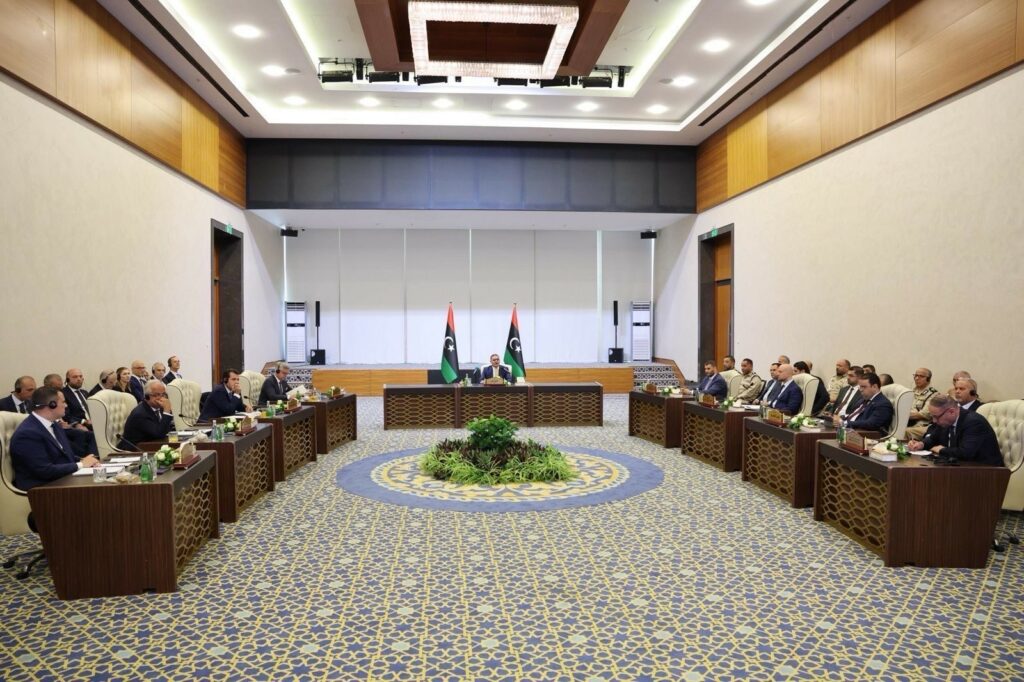
An EU delegation, including the Commissioner for Internal Affairs and Migration, Magnus Brunner, and interior ministers from Italy, Greece, and Malta responsible for migration, was expelled on Tuesday upon arrival to Benghazi airport in eastern Libya where they had arrived to discuss a sudden increase in irregular migration to Europe.
Before arriving to Benghazi, the Team Europe had met the internationally recognized government in Tripoli, also to discuss migration. Brunner twitted that the delegation had held in-depth discussions with the Libyan Prime Minister and other ministers and reaffirmed a joint commitment to combat migrant smuggling. This mission laid the groundwork for broader cooperation, he wrote.
However, the meetings planned in Benghazi could not take place in the end according to the Commissioner. The Libyan authorities in eastern Libya declared him “persona non grata” and the whole delegation was expelled from the divided country run by two parallel governments.
Spokespersons for the European Commission described the mission to Libya as complex. While the discussions in Tripoli were fruitful, they said that the incident in Benghazi was due to a protocol issue, without entering into further details. They indicated that the EU will continue its engagement and keep channels opens with all key actors in Libya to address common migration challenges.
We are not here to give a “blow-by-blow” account about what happened and to play a “blaming game”, the spokespersons said.
EU’s One Libya policy
According to media reports, the mission went sour after the EU Ambassador to Libya, Italian diplomat Nicola Orlando, raised concerns about the composition of the Libyan delegation in Benghazi, aiming to avoid engagement with the foreign and interior ministers of the government in eastern Libya. Orlando is considered an experienced diplomat with an understanding of the political dynamics within Libya.
A foreign affairs spokesperson explained that the EU works with the internationally recognized government, the Government of National Unity, located in Tripoli, which emerged after the UN mediation process. He added that the EU also engages with authorities throughout the country, in line or despite its One Libya policy.
Asked if the European External Action Service (EEAS) will examine what happened and reconsider the EU’s position of One Libya, a spokesperson told the Brussels Times on Thursday that it had nothing more to add to what already had been said. A high-ranking EU official confirmed at a technical briefing yesterday ahead of the foreign affairs council next week that the EU position has not changed.
The Commission is concerned about the increase of irregular arrivals of migrants from Libya but says that the overall picture shows that irregular arrivals across the Mediterranean decreased significantly in 2024 and the first half of this year.
As previously reported, more than 7,300 migrants have arrived in Crete and Gavdos, a small island south of Crete, since the start of the year, up to from 5,000 arrivals in 2024. The two islands lack reception camps. The issue was raised at the latest European Council summit and prompted Greece to ask the EU to prepare the mission to Libya.
Suspension of asylum procedures
Following the failed mission to Benghazi, the Greek government announced that it plans to suspend the assessment of asylum applications for three months from migrants arriving by boat from North African countries, especially Libya. The Commission announced that it will review the decision but only after the draft law has been approved and entered into force.
In fact, the Commission has faced a similar question in the past. In 2020, when Turkey pushed refugees across the border, the situation on the islands in the Aegean Sea became unacceptable. Greece was forced to temporarily suspend asylum application procedures. In Brussels, the Commission, questioned about the legality of the measures, was reluctant to provide straight answers.
In an audit report last year, the European Court of Auditors (ECA) found that the €5 billion EU Emergency Trust Fund for Africa (EUTF) is not concentrating enough on priorities to tackle the root causes of instability, irregular migration, and displacement on the African continent. In particular, the auditors were critical against the Commission’s monitoring of human rights violations in the countries receiving EU funding, including Libya.
The country is considered a failed state, controlled by fighting militias and divided between an UN-backed Government of National Unity in Tripoli and the Libyan National Army in the eastern part, led by a general who has been around since the Gadaffi regime. Each side is supported by other countries.
Furthermore, Libya is considered unsafe by the UN and NGOs, but not by the EU, which has been returning irregular migrants to the country despite mistreatment and abuse in the detention centres there. In recent years, rescue operations at sea have gradually been outsourced to the Libyan Coast Guard, trained and funded by the EU.
In 2023, an investigative consortium of journalists, Lighthouse, reported that the European Border and Coast Guard Agency (Frontex) had been sharing coordinates of migrant boats in distress in the Mediterranean Sea with a vessel run by a militia in eastern Libya.
