
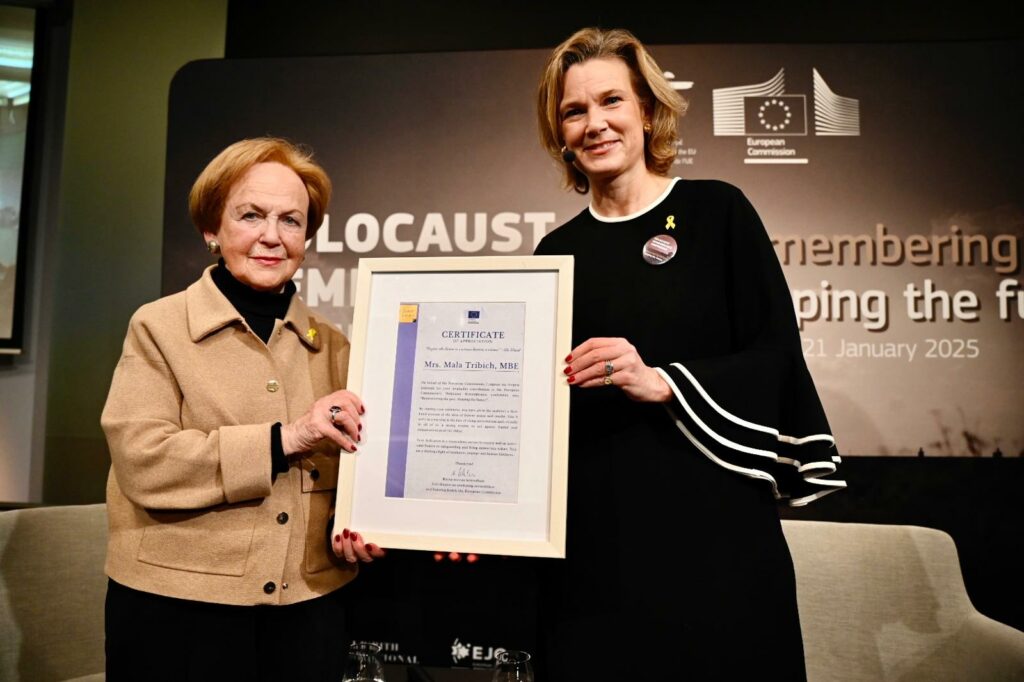
Katharina von Schnurbein, the European Commission’s coordinator on combating antisemitism and fostering Jewish life in Europe, has recently been targeted in media and by a group of MEPs following an internal document which was leaked from a meeting at the EU delegation in Tel Aviv. Those who criticize her want to put a gag on her or replace her.
The meeting, which took place on 29 May, gathered the heads of mission or ambassadors of the EU Member States in Israel for a discussion on the strained EU – Israel relations. The coordinator was invited to brief them on the growing antisemitism in Europe. Five days later an EU official at the EU delegation drafted a report which was signed off by the EU ambassador, Dimiter Tzantchev.
One month later, Brussels-based EUobserver wrote that the document had been leaked to it and published it. The media outlet claimed that the coordinator on combating antisemitism had been lobbying at the meeting against EU sanctions against Israel, referring to the review of the EU – Israel Association Agreement. Other media followed suit and repeated these and other allegations against her.
A group of 26 MEPs from the Socialist & Democrats group, the Renew group, the Greens, and the Left sent an open letter to Commission President Ursula von der Leyen and some of her Commissioners. While declaring that they are committed to both peace and human rights in the Middle East and the fight against antisemitism, they denounced the coordinator.
Describing sentences in the leaked report as “extremely problematic statements,” that might harm the EU’s fight against antisemitism, they asked if the Commission intended to take disciplinary action against the coordinator. But their own ruling was already made. MEP Tineke Strik (NL, Greens/EFA) wrote on X last week that the coordinator should be immediately replaced.
The document, which was labelled “sensitive” but unclassified, was addressed to Helene Le Gal, managing director for Middle East and North Africa (MENA) of the European External Action Service (EEAS). It said that it could be shared with the Member States but not the European Parliament.
According to the Commission’s rules on information security, EU institutions and bodies shall protect sensitive non-classified information. Such information may only be made available inside the EU institutions and bodies to individuals with a need-to-know for the fulfilment of their assigned tasks.
Asked for a comment, a Commission spokesperson replied that the Commission had no comments on “unverified leaks” from the meeting. He added that Katharina von Schnurbein participated in the meeting in her official capacity in line with the EU strategy against antisemitism which was adopted in October 2021. As regards the letter from the MEPs, the Commission will reply in due course.
Is the Commission or the EEAS investigating the leak? Was the report about her statements at the meeting accurate or taking out of their context? Was she too outspoken and talked outside the remit of her mandate as coordinator? The Brussels Times reached out to both the EU delegation in Tel Aviv and the EEAS for replies but both declined to comment.
Ambassador Tzantchev is currently on leave and unavailable. His spokesperson and political adviser declined to comment and referred to the Commission. Its spokespersons continued to decline to comment in line with practice not to comment on leaked documents, notwithstanding the breach of EU rules and the potential damage to EU’s fight against antisemitism.
According to the leaked document, EU ambassadors warned against the “temptation of labelling criticism toward the Israeli government as antisemitism”. Katharina von Schurbein issued similar warnings. The document spells out that she clarified that criticizing Israel is not antisemitism, “even if the Israeli government says that it is”. (Denying Israel’s right to exist is antisemitism according to the definition adopted by the EU).
She added that the “flirting” between the extreme right in Israel and Europe is dangerous. She referred to new forms of antisemitism and warned the ambassadors about the growing antisemitism in Europe in the wake of the 7 October attack and the ensuing war in Gaza. Antisemitism has reached the highest level since the Holocaust.
In fact, the increase in antisemitism has been fueled by the far-right Israeli government which rejects all criticism as support for Hamas and antisemitism. The longer the war dragged on, resulting in an intolerable humanitarian crisis in Gaza, indiscriminate killings of civilians and destruction, Israel lost any international legitimacy. Jews in Europe were accused for the war and became targeted.
“The calls for the resignation of Katharina von Schnurbein are unfounded, disgraceful, and based on false accusations and a misleading narrative,” commented the European Jewish Congress. “We call for continued support for her work and reject any attempt to discredit her or weaken the fight against antisemitism in Europe.”
