
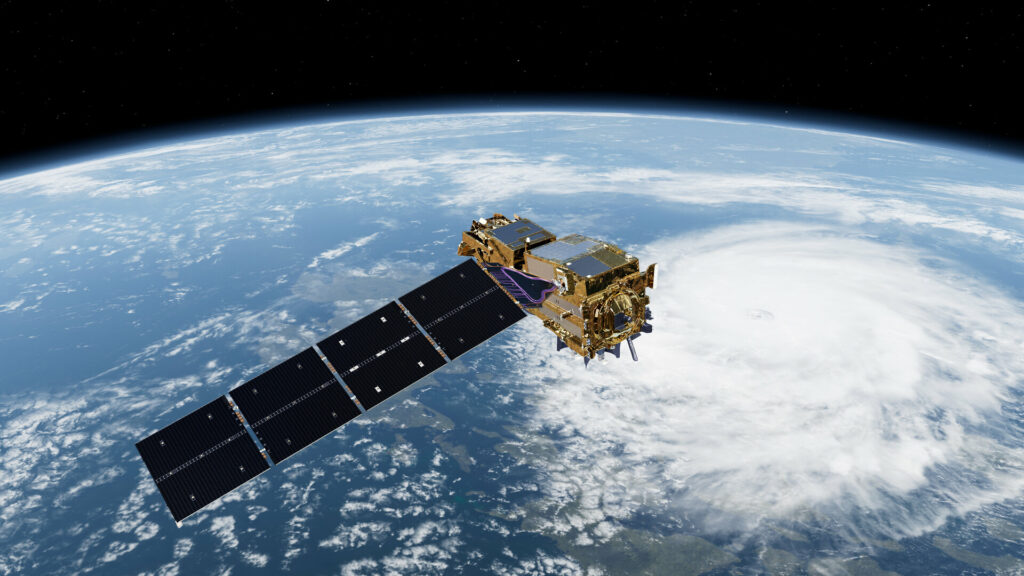
If all goes according to plan, a Metop Second Generation A1 (Metop-SGA1) satellite carrying the Copernicus Sentinel-5 mission will be launched from the European launch centre in Kourou (French Guiana) on 12 August.
This new generation Metop (Meteorological Operational Satellite) is expected to provide a significant boost to satellite monitoring of weather, climate, and atmospheric composition in Europe and beyond.
Metop-SGA1 is the first satellite of the second generation of Metop polar satellites to be launched. The second-generation Metop satellites are intended to strengthen Metop's role as the primary source of meteorological observations for weather forecasts up to 10 days ahead, extending until the mid-2040s.
To this end, the satellite is equipped with a suite of advanced and entirely new instruments designed to provide essential data for weather forecasting, storm prediction, climate monitoring, and a wide range of other services and applications.
Collaboration
The Metop programme is a collaboration between EUMETSAT, the European Organisation for the Development and Operation of Weather Satellites, ESA, and the European Commission, along with European partners.
The satellites are part of the EUMETSAT Polar System and fly at an altitude of 823 to 848 kilometres, much lower than geostationary satellites. The programme consists of three consecutive pairs of double Metop satellites: Metop-SGA and Metop-SGB.
Metop-SGA1 is the first satellite to be launched, followed by its "complementary satellite," Metop-SGB1, a year later. The A-type satellites are also equipped with Copernicus Sentinel-5.
This instrument measures the distribution of trace gases in the atmosphere, such as ozone, nitrogen dioxide, sulfur dioxide, formaldehyde, glyoxal, carbon monoxide, and methane, as well as aerosols.
The Copernicus Atmospheric Monitoring Service and the Copernicus Climate Change Service will use Sentinel-5 data for their information services, which support environmental agencies in monitoring climate and air quality and assist authorities in making decisions in these areas.
