
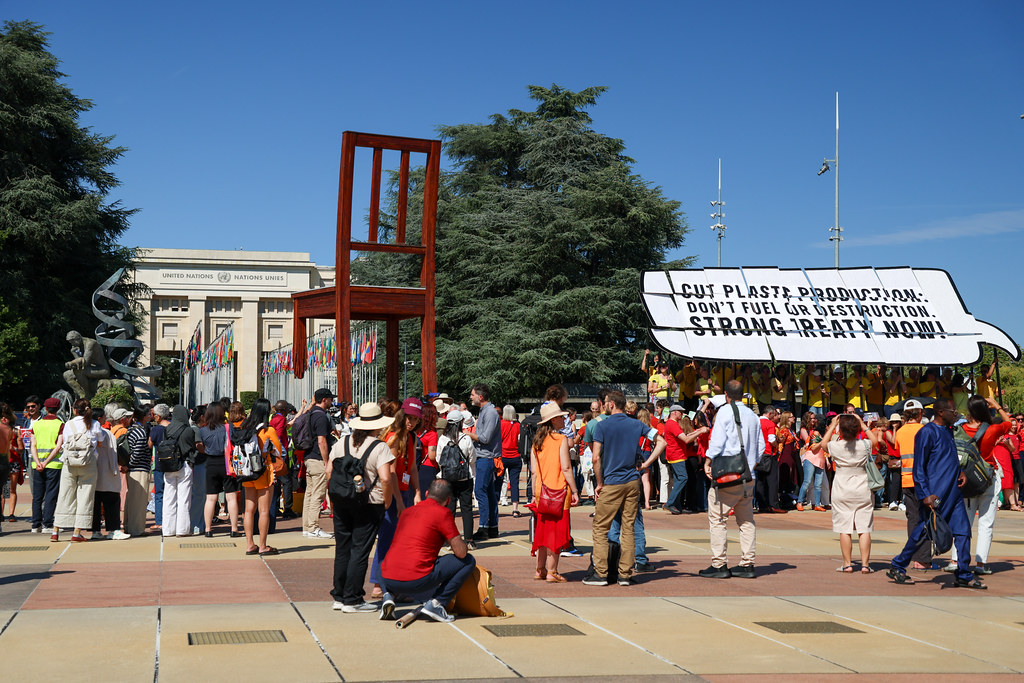
The UN-led talks on an international legally binding instrument which will address the full life cycle of plastic pollution started this week at the Palais des Nations in Geneva, Switzerland, and are scheduled to continue until 14 August.
The UN Environment Assembly requested the Executive Director of the UN Environment Programme (UNEP) to convene an intergovernmental negotiating committee (INC), to begin its work during the second half of 2022, with the ambition of completing its work by the end of 2024. The previous round of talks took place last November in Busan, South Korea, but did not complete the work.
“Plastic pollution is already in nature, in our oceans and even in our bodies,” commented Inger Andersen, Executive Director of UNEP, at the opening of the new talks. “If we continue as on this trajectory, the whole world will be drowning in plastic pollution – with massive consequences for our planetary, economic and human health.“
“But this does not have to be our future. Together, we can solve this challenge. Agreeing a treaty text is the first step to beating plastic pollution for everyone, everywhere.”
More than 3,700 participants have registered to participate in the conference, representing 184 countries and over 619 Observer organizations. The EU has also sent a delegation.
Asked about EU’s assessment of the chances to reach an agreement this time, a European Commission spokesperson reiterated that EU’s goal is to reach a global treaty to address the full life cycle of plastic pollution, including phasing out certain plastic products that pose most risks to health and the environment.
The EU also advocates sustainable management of plastic waste. It is an immense problem in developing countries in especially Africa because of the high importation of plastic products, low re-use and the scramble to dump plastic waste into the continent by the Global North. The spokesperson declined to go into details in EU’s position in order not to undermine the on-going negotiations.
Greenpeace activists from among others Belgium created a symbolic trail of black oil and held massive banners on the entrance of the Palais des Nations to call out the influence of the fossil fuel industry in the negotiations.
According to Greenpeace, the action highlights attempts by fossil fuel lobbyists and oil producing states to prevent countries agreeing to cut plastic production as a core part of the new treaty.

Greenpeace activists created a symbolic trail of black oil and held massive banners on the entrance of the Palais des Nations, credit: Greenpeace
The activists also climbed the roof of the entrance to the Palais des Nations and unfurled a banner that points to the fossil fuel lobbyists who registered to the ongoing talks, while another banner declared the Global Plastics Treaty is Not For Sale.
“Each round of negotiations brings more oil and gas lobbyists into the room,” said Graham Forbes, Greenpeace International Head of Delegation to the negotiations.
“Fossil fuel and petrochemical giants are polluting the negotiations from the inside, and we’re calling on the UN to kick them out. Governments must not let a handful of backwards looking fossil fuel companies override the clear call from all of civil society.” If business continues as usual under pressure of the fossil fuel industry, plastic production could triple by 2050.
Greenpeace and its allies from the Break Free from Plastic movement have called for setting a legally binding target to reduce plastic production by at least 75% by 2040 to stay below 1.5° C threshold of global warming.
The INC aims to finalize and approve the text of the agreement and forward it for consideration and adoption at a future Diplomatic Conference of Plenipotentiaries.
The current draft of the treaty, dated 1 December 2024, did not set any specific target and left this issue open to be decided at the diplomatic conference. Other issues such as the polluter paying principle and the management of plastic waste were hardly mentioned in the draft.
Update: INC reported on Friday evening (8 August) that the work of the contact groups during the conference has been assembled into a new draft of the treaty.
