
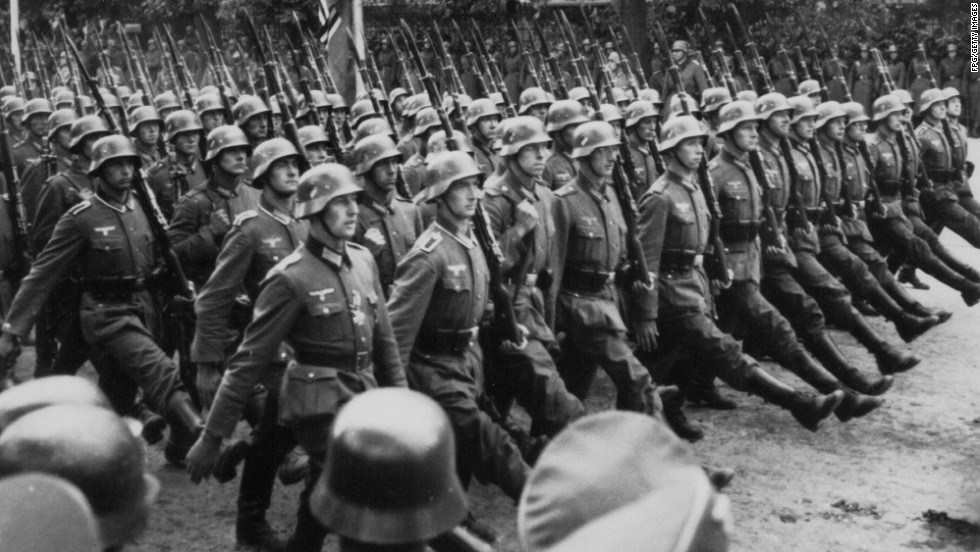
The Europe-Wide Day of Remembrance for the victims of all totalitarian and authoritarian regimes is commemorated today on 23 August, the day in 1939 when the Molotov-Ribbentrop pact which triggered WWII was signed by Nazi Germany and the Soviet Union.
The Molotov-Ribbentrop pact, named after their foreign ministers, divided Central and Eastern Europe and lead to the outbreak of the second world war a week later. The very existence of the pact was a long time denied by the Soviet Union until it was retrieved in the archives of the Russian ministry of foreign affairs.
Communist Soviet Union under Stalin and Nazi Germany under Hitler were ideological death enemies. Still the two powers signed a non-aggression pact which scared the Western powers from attacking Germany after it had invaded Poland on 1 September 1939 until 10 May 1940 ("the "phoney war"), when Germany attacked Western Europe. Then it was too late.
In a statement, the European Commission describes the pact as an “alliance of blood between two of the most brutal regimes in history, leaving a deep scar on Europe”. The oppression these totalitarian and authoritarian regimes inflicted, and the suffering endured by countless victims, remain vivid memories for many Europeans.
“On 23 August, we honour their story,” Executive Vice-President for Tech Sovereignty, Security and Democracy, Henna Virkkunen, and Commissioner for Democracy, Justice, the Rule of Law, and Consumer Protection, Michael McGrath, write in the statement.
“We celebrate the relentless pursuit of freedom and democracy by Europeans throughout history, who have resisted tyranny, demanded justice, and strove for a more just, equal, and free Europe. We owe it to them that, for the first time in history, every EU country is now home to a generation that has grown up free from the shadow of tyranny.”
Yet, this struggle is not a distant memory, they added. “The seeds of hatred, intolerance, and oppression can still be sown, and our adversaries are eager to exploit them. Freedom, democracy, the Rule of Law and fundamental rights are hard-earned principles, but they can be eroded if they are not properly maintained and guarded.”
“The EU will always stand on the side of those that nurture the soil of human dignity, justice, and equality,” the statement concludes. “It is our collective responsibility to safeguard these values.”
The Day of Remembrance has been commemorated since 2009, when the European Parliament adopted a resolution calling for the day to be commemorated with “dignity and impartiality”.
According to a Eurobarometer released in May 2025, the majority of European citizens agree that the EU, which was born from the ashes of WWII, is a place of stability in a troubled world with an on-going war on its own continent. Nearly nine in ten Europeans (88%) agree that there should be more rules-based cooperation between countries and regions of the world.
